


You can have 99 problems competing for your attention. Work deadlines. Relationship friction. Financial pressure. The ongoing grind of trying to build something that matters. Every one of those has some claim on your bandwidth, and on most days you’re managing them well enough. Then you lose your footing, fall straight back, and land hard on a concrete block and suddenly none of that exists.
There’s only one problem.
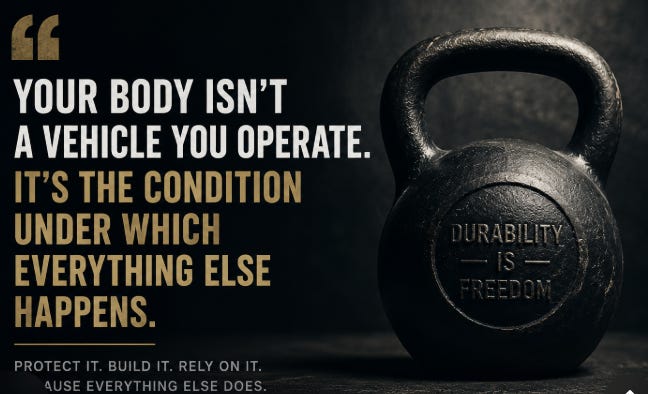
That’s the thing about the body. It doesn’t negotiate. When you’re hurt badly enough, every other priority collapses into a single point: the pain, the limitation, the question of whether something is seriously wrong. Your body isn’t a vehicle you operate. It’s the condition under which everything else happens. And most people treat it like infrastructure they only think about when it fails.
I took a fall recently. Lost my footing and went straight back, landing hard on a deck block with the lower right side of my back. Half a second of bad luck, then several days of consequences. Lying still, manageable. Move wrong and the pain spiked hard. Radiating. Seven or eight on a ten-point scale. And in that window, the question wasn’t how do I build something meaningful, it was did I crack a rib, or is my kidney involved.
It resolved to muscle and soft tissue. No blood in urine, movement-dependent pain, likely a bruised floating rib or deep contusion. Good outcome, bad moment. But the moment is the point.
The Illusion of Separateness
Most people mentally file their health as one department among many. Something you manage in the gym a few times a week, or intend to get back to eventually. The assumption underneath this is that the body is a constant. That it will be roughly the same tomorrow as today. That you can defer maintenance without accumulating a bill.
You can’t.
The slow erosion of muscle mass, bone density, connective tissue quality, and cardiovascular capacity is happening in every person who isn’t actively working against it. The bill doesn’t arrive as a heart attack at 65. It arrives as a slip, a fall, a moment of awkward impact that a better-prepared body absorbs while a neglected one doesn’t.
Two people, same fall, different bodies. One gets up sore. One doesn’t get up the same way. That’s not fate. Research on crash injury outcomes found that skeletal muscle mass and bone mineral density independently affected both injury risk and hospital outcomes in severely injured occupants [1]. That’s physics acting on tissue quality you built or didn’t build over years.
What Physical Durability Actually Means
The word fitness has been so thoroughly hijacked by aesthetics that it barely communicates anything useful anymore. Six-pack abs are not a survival asset. The things that actually matter when something goes wrong are different: bone density that doesn’t fracture on impact, muscle mass that absorbs force, connective tissue that handles unexpected load, balance that keeps you upright when the ground shifts, and the capacity to recover without being sidelined for months.
These are not the same as looking fit. They often overlap, but they’re built by different intentions.
Tendons, ligaments and joint capsules adapt to resistance training by becoming stronger and more elastic — better joint stability and shock absorption when unexpected forces hit [2]. That’s tissue physiology, not marketing copy. The body you build over years determines how you respond to a moment that lasts half a second. Muscle mass also exerts mechanical loading on bones, stimulating them to remodel and increase in density over time [3]. Which means the resistance training you do at 38 is directly influencing what your skeleton does at 55. And beyond the structural benefits, strength training improves the communication between your nervous system and your muscles, better balance, better coordination, faster reaction time. That’s what keeps you from falling wrong in the first place.
The Plan Is Not Optional
Most people agree with all of this in principle. They know they should be stronger, more mobile, less fragile. Then they continue operating without a plan.
A plan is not a gym membership or a vague intention. It has four components and none of them are optional.
Resistance training anchors it. Two to four sessions per week, compound movements, progressive load. Squat patterns, hip hinge, pressing, pulling. The goal isn’t performance. It’s structural capacity. Bone density, muscle mass, connective tissue integrity. These build slowly and protect you in moments you can’t anticipate.
Zone 2 cardio is the metabolic foundation. Three to five hours per week at a sustainable pace. VO2 max is one of the strongest predictors of long-term health we have, and the aerobic base is exponentially easier to build early than recover later. The body you need at 70 is being shaped by what you do now.
Mobility and stability is where most people have the widest gap. Hip mobility, thoracic rotation, single-leg stability. Not an hour of daily stretching. Consistent, focused work woven into training instead of treated as an afterthought. The person who moves well in unpredictable situations practiced moving in unpredictable positions.
Sleep is not bonus content. It is the mechanism by which every adaptation from the above three actually happens. Strength is built during recovery, not during the training session. Skipping sleep doesn’t just make you tired. It prevents the tissue remodeling that makes training worth anything.
The Diagnostic You’re Avoiding
Before any plan is useful, you need an honest read on where you currently are. Most people don’t have one.
Some things worth knowing: your resting heart rate trend over weeks. A VO2 max estimate, which most modern fitness trackers approximate well enough to be useful. Whether you can do a single-leg squat to depth on both sides without compensation. Whether you can get up from the floor without using your hands. How your thoracic spine moves. Whether you have chronic pain you’ve normalized and are quietly working around.
That last one matters most. The body is extremely good at compensating for dysfunction. It will redistribute load, alter movement patterns, develop secondary adaptations that let you keep functioning at the cost of creating vulnerability elsewhere. You won’t notice until something exposes it. A slip. A fall. A concrete block at the wrong angle.
Find those vulnerabilities before they find you.
The Emergency Protocol
Know the difference between musculoskeletal pain and internal organ involvement. Musculoskeletal pain is typically movement-dependent, localized, quiet at rest. Internal involvement tends to be constant, positional, accompanied by systemic symptoms like nausea, unusual radiating pain, or changes in urine color after a flank impact. Knowing that distinction in the moment isn’t dramatic. It’s just useful.
Know when to wait and when to go. Pain that’s movement-triggered only, no blood in urine, no systemic symptoms: likely soft tissue. Ice, acetaminophen, monitor. Constant pain, unexpected radiation, any systemic symptom: get imaging. A CT shows what an X-ray won’t. The cost of going when you didn’t need to is a few hours. The other kind of cost is worse.
Know who to call. In a moment of acute pain, your reasoning degrades and your options feel unclear. Have a primary care physician who knows your baseline. Know which urgent care near you has imaging on site. Know whether the ER is the right call. Same logic as keeping a fire extinguisher in the kitchen. You hope you never need it. You want it there.
What This Actually Requires
None of this is heroic. It doesn’t require extreme discipline or a dramatic lifestyle overhaul. It requires treating your physical capacity as a serious operating priority rather than something you’ll get back to when things calm down.
Things don’t calm down. The right time to build the infrastructure is before you need it, because when you need it, there’s no time to build it. You either have the bone density or you don’t. You either have the muscle mass or you don’t. You either have a plan or you have an injury and a hope.
The 99 problems are real. The job stress, the financial pressure, the relationship friction. None of it is a problem you can solve from a hospital bed, or six weeks of limited mobility, or sitting very still because moving means a pain spike to eight.
Take care of the one thing that everything else runs on.
For more on building physical durability, visit performanceprotocol.ai
Sources
[1] Weaver, A.A. et al. Effects of Muscle Quantity and Bone Mineral Density on Injury and Outcomes in Older Adult Motor Vehicle Crash Occupants. PMC, 2023. https://pmc.ncbi.nlm.nih.gov/articles/PMC9839521/
[2] Capstone Physical Therapy. Strength Training for Injury Prevention. 2025. https://www.capstoneptfit.com/articles/strength-training-for-injury-prevention/
[3] Yoshimura, N. et al. Relationship between Muscle Mass and Muscle Strength with Bone Density in Older Adults: A Systematic Review. Annals of Geriatric Medicine and Research, 2024. https://pmc.ncbi.nlm.nih.gov/articles/PMC12010744/
I've trained my mother-in-law (who is 82 now) using the deadlift only for about 2.5 years. The thing that got her started training for the first time in her life was a diagnosis of severe Osteoporosis. She lives alone and my nightmare was showing up one day 24+ hours after she'd fallen and broken a bone. Something like that when coupled with the obvious sarcopenia, could be a death sentence.
After 9 months of training, she went back for another DXA scan and her bone mineral density improved by 60% in the worst location. I still worry about her, but less so that she'll fall and seriously injure herself. The best day to start all of this was 10 years ago and the second best day to start is today.