


Most people treat their body like a side project—something to improve when there’s time, or fix only when it breaks. They treat physical health as a luxury that comes after work, money, and social obligations are handled.
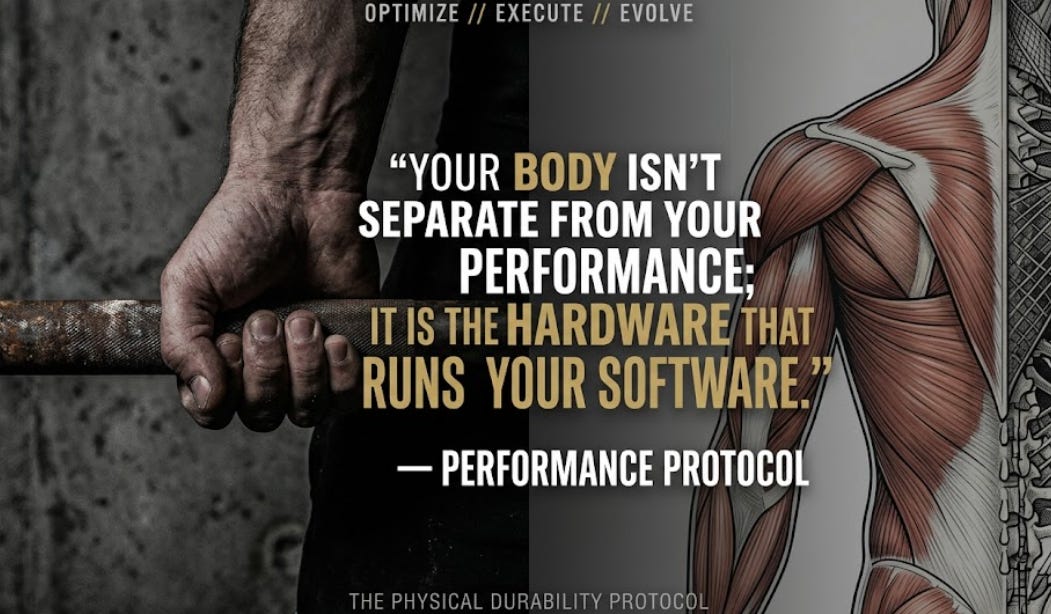
That logic fails quietly at first. Then all at once. Because your body isn’t separate from your performance; it is the hardware that runs your software. > “Physical exercise is not just about the body; it is the most powerful tool we have to optimize the brain’s ability to learn, focus, and maintain emotional stability.” — Dr. Andrew Huberman
The Failure Pattern: The Performance Debt Trap
High-functioning individuals often fall into a “Debt Trap.” They prioritize mental output while ignoring the physical capacity required to sustain it. They assume their drive can indefinitely compensate for a lack of physical maintenance.
The False Assumptions:
The Hero Complex: “I can push through it.”
The Efficiency Myth: “Exercise takes away time from work.”
The Optionality Error: “Workouts are a bonus, not a requirement.”
What looks like discipline is often just borrowing against the body. A study published in The Lancet demonstrates that physical inactivity is directly linked to a decrease in cognitive function and a higher risk of metabolic “performance killers.” When you neglect the body, you lower your “performance ceiling.” Eventually, recovery drops, focus fragments, and the debt gets collected.
The Reframe: The “Marginal Decade”
This isn’t about aesthetics or looking good for a 90-day window. This is about Longevity vs. Lifespan.
In his research, Dr. Peter Attia distinguishes between Lifespan (how long you live) and Healthspan (how well you live). The goal of this protocol is to dominate your Marginal Decade—the last ten years of your life. Whether you are mobile and independent or limited and frail depends entirely on the physical infrastructure you build today.
The Protocol
1. Train Strength First
Strength is the baseline of all physical attributes. If you are strong, every other metric—endurance, flexibility, power—becomes easier to maintain.
The Science: Research in the Journal of Frailty & Aging shows that muscle mass and grip strength are among the strongest predictors of cognitive longevity and all-cause mortality.
Compound Foundations: Stick to the “Big Four” for maximum ROI: Squat, Deadlift, Press, and Pull.
The Huberman Rule: Focus on “Modulated Intensity.” You don’t need to destroy yourself every session, but you must move heavy loads with control to trigger the nervous system adaptations required for durability.
2. Define Your Physical Standard
If it isn’t defined, it doesn’t exist. “Working out” is a vague intent; a Standard is a non-negotiable contract.
Frequency: Set a minimum number of days per week (e.g., 4 days).
Huberman’s “Non-Zero” Logic: Consistency is adaptability. If you don’t have time for the full session, do the 10-minute version. Just don’t put up a zero for the day.
3. Longevity > Exhaustion
You are not trying to “win” today’s workout at the cost of tomorrow’s ability.
Consistency > Intensity: Showing up 300 days a year at 70% effort beats showing up 50 days at 100%.
Repeatability > Novelty: Find a system you can execute for twenty years, not twenty days.
4. Fix the Foundation: The Big Three
Optimization is useless if the foundation is cracked.
Sleep: The ultimate performance enhancer. Without 7–9 hours, you are training in a state of biological decay.
Breathing: Proper nasal breathing and diaphragm control dictate your heart rate variability (HRV) and stress response.
Recovery: Adaptation happens during rest, not during the lift. If you can’t recover, you aren’t training—you’re just breaking.
5. Run Continuous Tests
Every 8–12 weeks, conduct a system audit.
Strength levels: Are your numbers stable or trending up?
Recovery speed: How quickly do you bounce back from high-stress days?
Verdict: If nothing is improving, your system is wrong—not your effort.
Recommended Resources
To go deeper into the mechanics of durability and longevity, I recommend adding these to your library:
Outlive: The Science and Art of Longevity by Dr. Peter Attia – The definitive guide on shifting from “Medicine 2.0” (treating disease) to “Medicine 3.0” (preventing it through physical standards).
Starting Strength: Basic Barbell Training by Mark Rippetoe – The “bible” of compound movements. It explains the biomechanics of why the Squat, Press, and Deadlift are the foundation of a hard-to-break body.
Breath: The New Science of a Lost Art by James Nestor – Essential for understanding the “Foundation” rule of the protocol and how breathing impacts performance and recovery.
The Closing
Someone following this protocol doesn’t look like an outlier—they look ready. They are hard to break. They don’t rely on “motivation” because they have a system.
Their body supports their life. It doesn’t limit it.
In the Physical Durability Protocol, you fall to the condition of your body.
Train accordingly.
Performance Protocol
Performance Protocol is a system-first approach to human performance — built on physiology, recovery, and real-world constraints.
Each article is a layer in the same framework.
No hacks. No hype. Just structure.