


You don’t have an emotional problem. You have a regulation problem.
Most people treat emotional control like a personality trait, something you either have or you don’t. You watch the stoic executive who never flinches or the athlete who stays ice-cold under pressure, and you assume they simply feel less than you do.
They don’t. They’ve built a system for what to do when the feeling arrives.
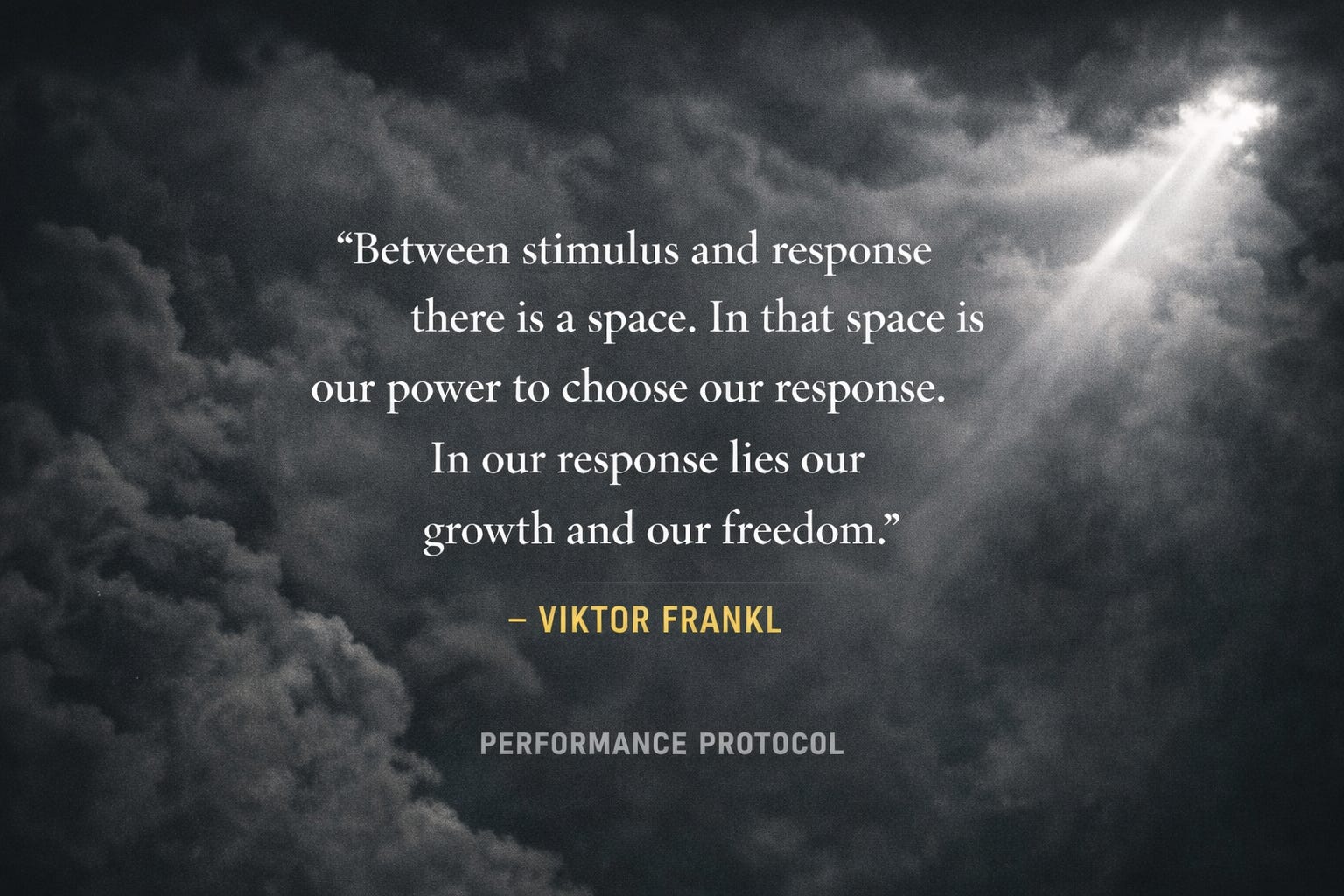
The performance failure isn’t the emotion itself. It’s the gap between stimulus and response, that fraction of a second where most people hand the controls over. Where frustration drives the email you’ll regret. Anxiety cancels the meeting you need. Embarrassment rewrites a high-stakes decision.
Marcus Aurelius wrote his Meditations not as philosophy for the masses, but as a personal operating manual he returned to daily to regulate his own mind. He wasn’t naturally calm. He was deliberately trained. Emotional control isn’t suppression. It isn’t pretending the feeling isn’t there. It is the disciplined practice of choosing what comes next.
Published by Performance Protocol
The Mechanism of Dysregulation
Emotional dysregulation follows a predictable pattern. To interrupt it, you have to understand the sequence.
The Trigger. Something happens, a criticism, a setback, an unexpected obstacle. Your nervous system registers it before your rational brain can speak. The amygdala fires. Cortisol and adrenaline hit the bloodstream. This is biology, not a moral failing. It happens to everyone.
The Story. In the milliseconds after the trigger, your brain constructs a narrative. They don’t respect me. This always happens. I’m losing control of the situation. The story isn’t the event. It’s your interpretation of it. And it’s the story, not the event, that dictates the response.
The Response. Behavior follows the story. If the narrative is threat-based, the behavior is reactive, defensive, aggressive or avoidant. If the story is examined first, the behavior can be chosen.
Peter Attia frames emotional health as a performance variable no different from cardiovascular fitness or sleep quality. In Outlive, he documents his own work to address emotional patterns that were sabotaging his decision-making, not as a weakness, but as a systematic intervention on a limiting factor. High performers don’t feel less. They shorten the distance between trigger and examination. They’ve practiced the pause.
The Identity Reframe
Here is the shift most people never make: you don’t control your emotions by fighting them. You control them by changing who you are in relation to them.
James Clear’s central argument in Atomic Habits is that behavior change fails when it operates at the outcome level. People try to control their reactions by force of will in the moment. It doesn’t hold. Will is finite. The moment always wins.
The reframe isn’t an affirmation. It’s architecture. Move from I will try to stay calm to I am someone who does not react from a triggered state. When the identity is clear, behavior in a hard moment has a reference point. The question is no longer what should I do? It’s what does someone like me do?
Ryan Holiday makes the same point from a different angle in Discipline Is Destiny: self-discipline is not restriction. It is the expansion of freedom. The undisciplined person is at the mercy of every passing mood and every fluctuating circumstance. The regulated person is not.
Emotional control is a form of self-governance. And self-governance begins with a decision about what kind of person you are.
The Failure Modes
Knowing the traps in advance is how you build around them.
The Compression Trap. You suppress the emotion in the moment and call it control. But suppression without processing is storage. Compressed emotions resurface later, usually displaced, short with the wrong person or reactive about something that shouldn’t matter. Suppression is not regulation. It’s deferral.
The Retrospective Rewrite. After a reactive episode, most people reconstruct events to justify the reaction. I had to respond that way. Anyone would have. This protects the ego but prevents learning. The same trigger will land the same way next time.
The Environment Excuse. High stress becomes the permission structure. Anyone would lose it in this situation. The problem: the high-pressure moment is precisely when regulation matters most. Control practiced only in easy conditions isn’t control. It’s comfort.
The Volume Fallacy. Calm performance is not evidence of internal regulation. The person who never raises their voice but never processes is not more regulated than the person who occasionally expresses frustration and then resets. The standard is whether the response was chosen, not how it looked from the outside.
The Missing Debrief. The most consistent error. Something happens, you respond, you move on. No examination of the trigger, the story or whether the response served you. Without the debrief there is no data. Without data there is no improvement.
The Minimum Standard
Not a life without anger or anxiety. That’s not the goal and it isn’t the point. The minimum standard:
No reactive communication. Emails and texts drafted from a triggered state do not get sent. They are held until the activation has cleared. This single rule eliminates a significant percentage of professional and personal damage.
Affect labeling before action. Name the feeling before you act on it. Not analysis, just accuracy. I’m frustrated. I’m anxious about this outcome. I’m embarrassed. Neurologically, labeling an emotion reduces its intensity. You cannot regulate what you haven’t identified.
The 24-hour rule on high-stakes responses. For any significant reaction, a difficult conversation, a consequential email, a professional confrontation, apply a mandatory hold when you’re in an activated state. The conversation still happens. The email still gets sent. Not from a reactive baseline.
The weekly debrief. Fifteen minutes, once a week. Where did I fall off my standard this week? What was the trigger? What was the story I told myself? Was my response aligned with who I want to be? Write it. The act of writing is the act of examination.
Recovery speed over zero incidents. Everyone gets triggered. The person in control is the one who returns to chosen behavior faster, not the one who performs composure while storing the damage.
The Implementation
Build the pause. The space between stimulus and response is trainable. Start with low-stakes reps, a minor delay or a small frustration. Deliberately wait two seconds longer than you’d naturally wait to react. You are training a circuit. Small reps in ordinary moments build capacity for high-pressure ones.
Build a trigger inventory. Over the next two weeks, note every time you feel reactive, even mildly. What preceded it? What type of situation? Who was involved? Patterns will emerge. Most people are surprised at how predictable their own triggers are. You cannot defend against a trigger you haven’t mapped.
Practice affect labeling in real time. When you notice an emotional state, name it internally. Not dramatically, accurately. This is not a mindfulness exercise. It is a cognitive interrupt that creates decision space between the feeling and the response.
Identify your recovery anchors. When you’re genuinely activated, have a physical protocol that reliably resets your baseline, controlled breathing, a brief walk or cold water. The anchor must be practiced when calm to be accessible when it matters. Identify yours. Use it before you respond, not after.
Run the weekly debrief consistently. Not when something dramatic happens. Every week, on schedule. Emotional regulation improves through pattern recognition over time and patterns only become visible when you’re looking for them systematically.
Epictetus framed the entire discipline as a single distinction: events are not in your control. What you do with them is. Emotional regulation is the daily operationalization of that line. Not once. Not when it’s convenient. Every day, as practice.
Part of the Performance Protocols series. Protocol 04 of 06.
Published by Performance Protocol