


What is the absolute least you can do and still be the person you said you were?
That is not a rhetorical question. It’s a design problem.
Most people don’t have a minimum standard. They have a full routine that collapses under pressure, and then nothing. The binary is either everything or zero, which means the whole structure falls apart the moment life compresses available time and energy. It was built for ideal conditions. Ideal conditions are rare.
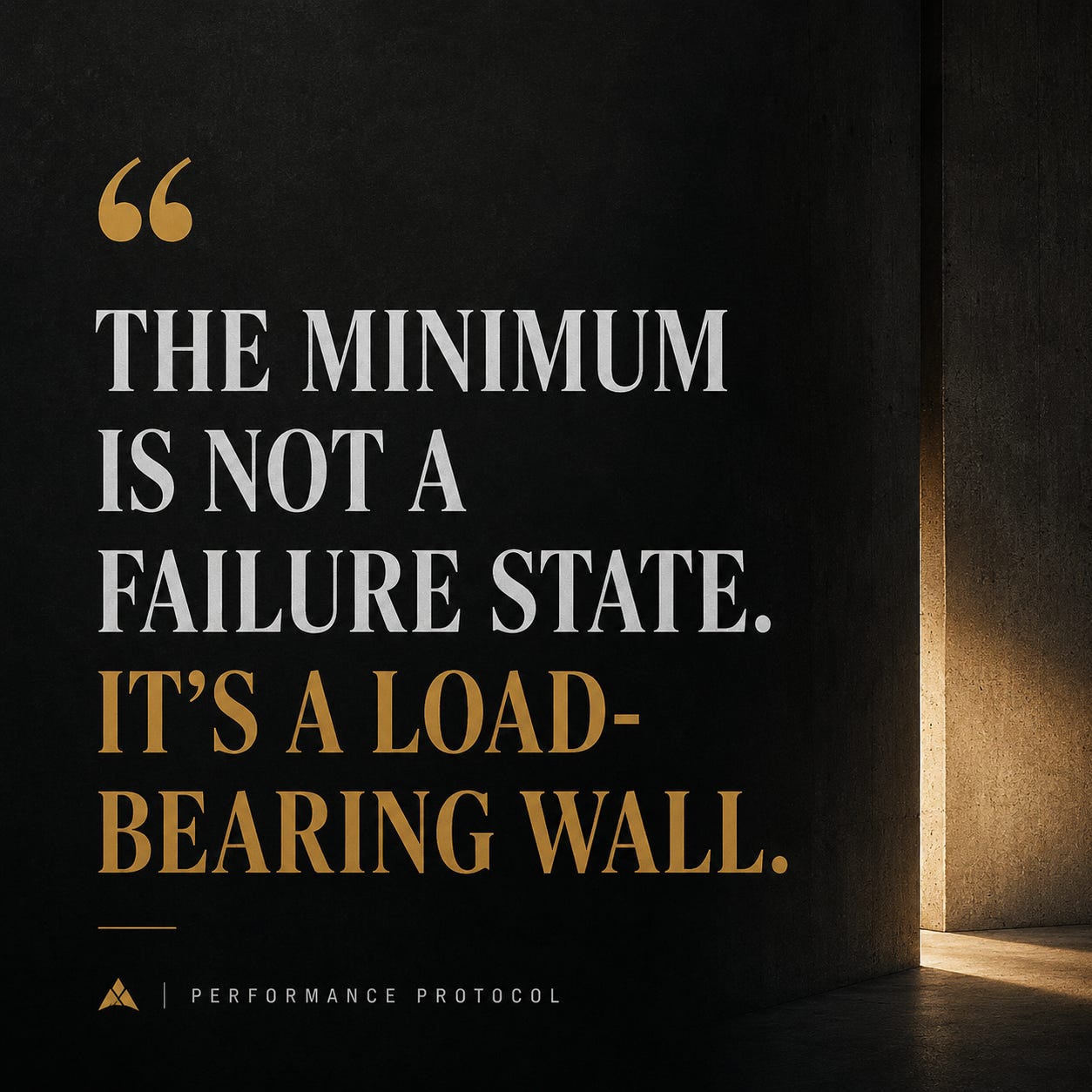
The minimum is not a failure state. It’s a load-bearing wall.
Identity Continuity Across Disruption
The purpose of a minimum standard is to preserve your identity when everything goes wrong. When you’re sick, traveling, overwhelmed, or running on four hours of sleep, you cannot execute the full routine. That’s not weakness. That’s reality.
But you can do something.
That something, however small, keeps the thread alive. The person who does ten minutes on a bad day is not just slightly ahead of the person who does nothing. They are a different person entirely, compounding in a completely different direction over time. The gap between them isn’t performance. It’s identity.
The error most people make is treating the minimum as the average in disguise. They set the floor low, then drift toward it permanently because it’s always available as an excuse. That is a discipline problem, not a system problem. The minimum is an emergency protocol. It is not a target, and it was never meant to be.
How to Set Your Floor
You establish your minimum once, deliberately, in a calm moment, and then you make it genuinely non-negotiable. Not aspirational. Non-negotiable. There is a difference. Aspirational means you try. Non-negotiable means the question of whether you do it is already settled.
It has to be something you can execute under the absolute worst circumstances you can realistically imagine. Not comfortable situations. Not average days. Your absolute nadir.
Sick? Still counts.
Traveling? Still counts.
A brutal day where everything went wrong? Especially then.
The logic is identical across every domain:
Training: The goal is sixty minutes in the gym. The floor is fifteen minutes of movement, anywhere, any kind.
Writing: The goal is a thousand polished words. The floor is one paragraph.
Sleep: The goal is eight hours. The floor is seven, and six is not an option.
Reading: The goal is thirty pages. The floor is one. Open the book.
The specific number matters less than the decision. Once you set it, it does not move based on how you feel, what happened that day, or how justified the excuse sounds. The floor is the floor because you said so, not because life permitted it.
Gaps Have Gravity
What breaks people is rarely a single hard week. It is the accumulated weight of the weeks where they gave themselves permission to stop completely, told themselves they’d restart Monday, and then discovered that Monday carries the exact same friction as any other day—plus the guilt of the gap on top of it.
Guilt is not motivating. It’s heavy. And the longer the gap, the heavier it gets, until restarting feels like it requires a whole production rather than just picking up where you left off.
The minimum closes the gap before it opens.
Most people treat their routine like a single, rigid object. It’s all one thing, so when one part breaks, everything breaks. A defined floor fixes that structural flaw. It’s the part that cannot collapse because you decided, in advance, that it won’t. Not because you feel like doing it. Because you made a decision, and the decision already happened.
The goal sits somewhere above it. Some days you hit it. Some days you exceed it. On the days when life compresses everything down, you land exactly on the floor. That is not failure. That is the system doing exactly what it was designed to do.
The floor held.
The Thread
When Monday arrives after a brutal week, the person who held their floor and the person who did nothing are not in the same position.
One has a thread to pick up. The other has a gap to justify. And gaps have a way of expanding into explanations, and explanations have a way of becoming the story you tell yourself about why you gave up on the person you said you were.
That story compounds too. Just in the wrong direction.
Set the floor. Make it genuinely doable under your worst conditions. Make it non-negotiable under exactly those conditions.
Then don’t move it.
Performance Protocol exists for one reason: to help you build systems around the things you actually mean. Not motivation, not mindset content, not another framework for feeling productive. If this piece landed, there is more at performanceprotocol.ai.