


Most people spend their lives trying to feel ready.
Ready to train.
Ready to focus.
Ready to start again.
They wait for motivation to show up like a permission slip. When it does, they move. When it doesn’t, they stall—and then blame themselves for lacking discipline.
This isn’t a character flaw.
It’s a misunderstanding of how performance actually works.
Motivation is not the engine.
It’s a signal light.
And building your life around a signal guarantees inconsistency.
Motivation Always Decays
Motivation feels powerful because it’s emotional. It comes with energy, clarity, urgency. It makes action feel easy—sometimes even inevitable.
But motivation is biologically temporary.
The brain adapts quickly to any stimulus, even meaningful ones. What felt urgent last month feels normal this month. What felt inspiring last year feels baseline today. This isn’t weakness. It’s how humans survive change.
That’s why relying on motivation produces a predictable cycle:
You start strong.
You feel good.
You lose momentum.
You assume something is wrong with you.
Nothing is wrong.
You just built a system that requires a feeling you cannot reliably generate.
Willpower Is Not a Strategy
When motivation fades, people reach for willpower.
They tell themselves to push harder. Be tougher. Want it more.
This works briefly—usually when stakes are high or consequences are immediate. But willpower is expensive. It burns cognitive fuel. It degrades under stress, sleep deprivation, emotional load, decision fatigue, and complexity.
Real life is full of those conditions.
High performers are not people with superior willpower. They are people who need it less.
They don’t win by forcing themselves forward.
They win by making the path easier to stay on than to leave.
Systems Replace Emotion
A system is a structure that produces behavior without asking how you feel.
It’s a default.
A constraint.
A sequence.
A rule you don’t debate every morning.
Systems don’t motivate you.
They remove the need to be motivated.
When training happens because it’s scheduled, not negotiated.
When sleep happens because devices shut down, not because you feel responsible.
When work happens because the environment demands focus, not because inspiration strikes.
That’s not rigidity.
That’s relief.
Emotion is volatile. Structure is stable.
Discipline Is an Outcome, Not a Trait
Discipline is often framed as a personal virtue—something you either have or don’t.
This is backwards.
Discipline emerges when systems reduce friction and eliminate choice.
People who look disciplined usually:
Decide once instead of daily
Design environments that support the behavior
Accept boredom as part of consistency
Remove decisions that don’t matter
They don’t “power through” more often.
They simply argue with themselves less.
What Performance Looks Like Without Motivation
It looks quieter than people expect.
There’s less hype.
Less intensity.
Less emotional storytelling.
There is repetition.
There are boring days.
There is consistency without drama.
Performance without motivation is not impressive in the moment.
It’s impressive in hindsight.
It compounds while others reset.
The Protocol Principle
You don’t rise to the level of your motivation.
You fall to the level of your systems.
If your life requires you to feel good, energized, inspired, or “ready” in order to function, it will eventually fail you—because life does not respect your emotional schedule.
The goal is not to feel motivated.
The goal is to make progress inevitable.
That is the difference between effort and protocol.
Between intention and execution.
Between people who start and people who stay.
Final Thought
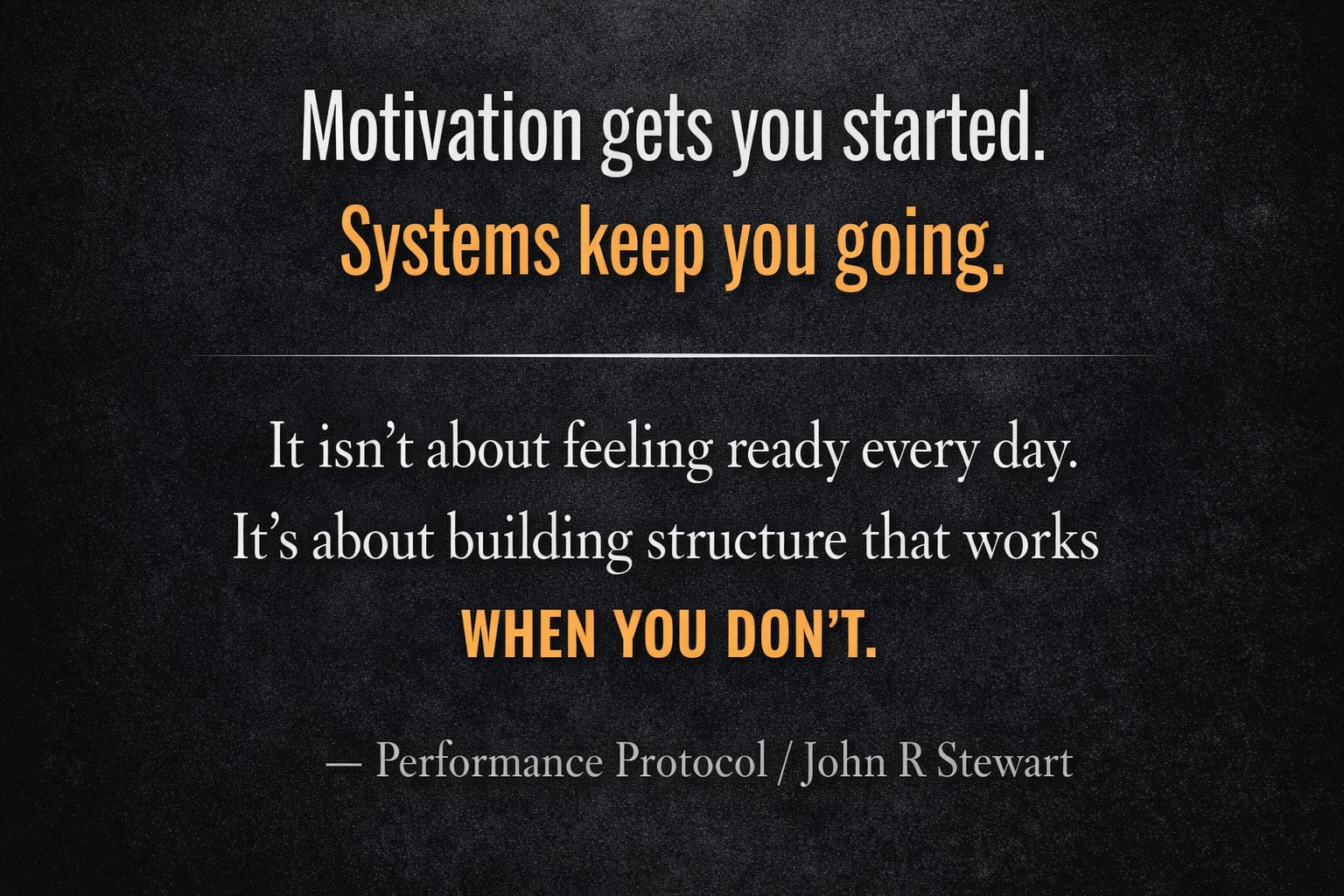
Motivation gets you moving.
Systems keep you moving when motivation disappears.
Build for the days you don’t feel like it.
Those are the days that decide everything.
Performance Protocol is a system-first approach to human performance — built on physiology, recovery, and real-world constraints.
Each article is a layer in the same framework.
No hacks. No hype. Just structure.