


There is a lie men tell themselves, and they tell it with pride:
“We don’t need to talk all the time. We can just pick up where we left off.”
That is not loyalty. That is neglect with a good excuse.
Friendships are not statues. They do not hold their shape untouched while life happens around them. They are living systems and living systems either get fed or they rot.
“The glory of friendship is not the outstretched hand, not the kindly smile, nor the joy of companionship; it is the spiritual inspiration that comes to one when you discover that someone else believes in you and is willing to trust you with his friendship.” — Ralph Waldo Emerson
OPTIMIZE: Understand What’s Actually Happening
When a man drifts into isolation, cortisol spikes. The amygdala, which is the brain’s threat-detection center, goes into overdrive. Over time, chronic disconnection degrades the prefrontal cortex. That is the part of the brain responsible for rational thinking, perspective and future planning.
This is why when the real hits come, an isolated man cannot find his way out. Divorce, financial collapse and job loss do not break men who have brothers around them. They break men who are alone. It is not a character flaw. His brain has been chemically compromised by months of quiet disconnection. He has no external perspective to carry the load with him.
Women figured this out. Not because they are more emotional, but because they treat connection like a utility. Water. Power. Non-negotiable. Men treat it like a vintage car in the garage. Appreciated in theory and touched almost never.
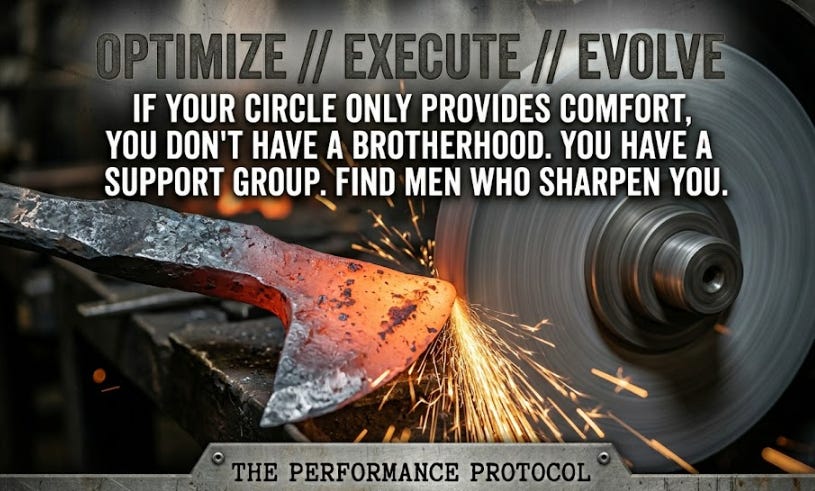
If your circle only provides comfort, you do not have a brotherhood. You have a support group. Find men who sharpen you.
“He who has a why to live can bear almost any how.” — Friedrich Nietzsche
EXECUTE: The Operational Standards
1. The 5-Man Roster
You cannot be a brother to twenty men. Pick three to five. Not group chat spectators. The men who show up at 5 AM when your world collapses. The men who carry your casket.
“He who is a friend to all is a friend to none.” — Aristotle
If you have not defined the circle, you do not have one.
2. Go First. Always.
Kill the ego scoreboard. “I reached out last time” is the internal monologue of a man headed toward isolation. The man who initiates is the leader. Text first. Call first. Set the plan first. If everyone waits, the brotherhood starves.
3. The 14-Day Rule
No man in your circle goes more than two weeks without contact. It does not need to be deep. “Saw this, thought of you.” Two minutes of consistent contact beats one four-hour dinner every two years. Consistency is the protocol.
“Iron sharpeneth iron; so a man sharpeneth the countenance of his friend.” — Proverbs 27:17
4. Pay the Vulnerability Tax
Surface-level interaction is a slow death. You do not need therapy sessions. You need truth. Talk about the pressure at home, the stress about money and where your life is actually headed. When you go first, you give your brothers permission to drop their masks.
5. Don’t Offer. Act.
“Let me know if you need anything” is a passive and useless sentence. It puts the burden on the man who is already drowning. Notice before it is announced. “I’m free Saturday, I’m coming to help.” That is the difference between a contact and a brother.
6. Do Hard Things Together
Men bond through shared effort and not through conversation alone. Gym sessions, road trips and businesses built side by side create the kind of bond that holds under pressure. Biologically, hard shared effort triggers vasopressin and oxytocin which are the compounds that build trust and lower threat response. Without a shared environment there is no relationship. Just a memory of one.
7. Say the Uncomfortable Thing
“We don’t talk enough.” “You’ve been quiet. Is everything actually alright?”
Most men never say it. Say it anyway. It interrupts the story a struggling man tells himself, which is that no one notices and that asking for help is a burden. One sentence can be the circuit breaker.
“Associate yourself with people of good quality, for it is better to be alone than in bad company.” — Booker T. Washington
EVOLVE: From Passive to Intentional
Most men end up busy, responsible and completely alone. Not because anyone left, but because no one moved first and the drift was too quiet to notice until it was too late.
The shift is simple.
Passive: “If something’s wrong, he’ll call me.” Protocol: “I make sure my people are good before something breaks.”
“Most men lead lives of quiet desperation and go to the grave with the song still in them.” — Henry David Thoreau
Do not be that man.
The one whose phone does not ring when it falls apart. The one standing alone at the exact moment he needed someone most. Not because he was unlikeable and not because he was unworthy, but because he waited. He assumed. He got busy. He told himself the friendship was low maintenance right up until it was no maintenance at all.
A man alone is easy to break. A man with a vetted circle of brothers is damn near immovable.
This is not about hanging out. This is about building the kind of life that does not collapse the moment pressure is applied.
Pick your three to five. Go first. Stay consistent. Say the hard thing.
The grave is full of men who meant to reach out.
Don’t wait.
Performance Protocol
Performance Protocol is a system-first approach to human performance — built on physiology, recovery, and real-world constraints.
Each article is a layer in the same framework.
No hacks. No hype. Just structure.