


The Great Productivity Lie
Most high-performers are experts at building someone else’s empire and amateurs at building their own lives.
They treat their calendar like a sacred document for meetings, deadlines, and deep work. But when it comes to the things that actually make a life worth living—travel, connection, stillness, or challenge—they rely on “if I have time.”
“If I have time” is a death sentence for a meaningful life.
You don’t “have” time. You take it. If you don’t schedule your life with the same ruthless precision you use for your work, the work will simply expand until there is nothing left of you.
Years won’t just pass; they will disappear.
The Performance Paradox
There is a specific kind of arrogance in thinking you can outrun the need for recovery.
We tell ourselves that intensity is the same as progress. We believe that life begins after the next project, after the promotion, or after the “season” calms down.
It never calms down.
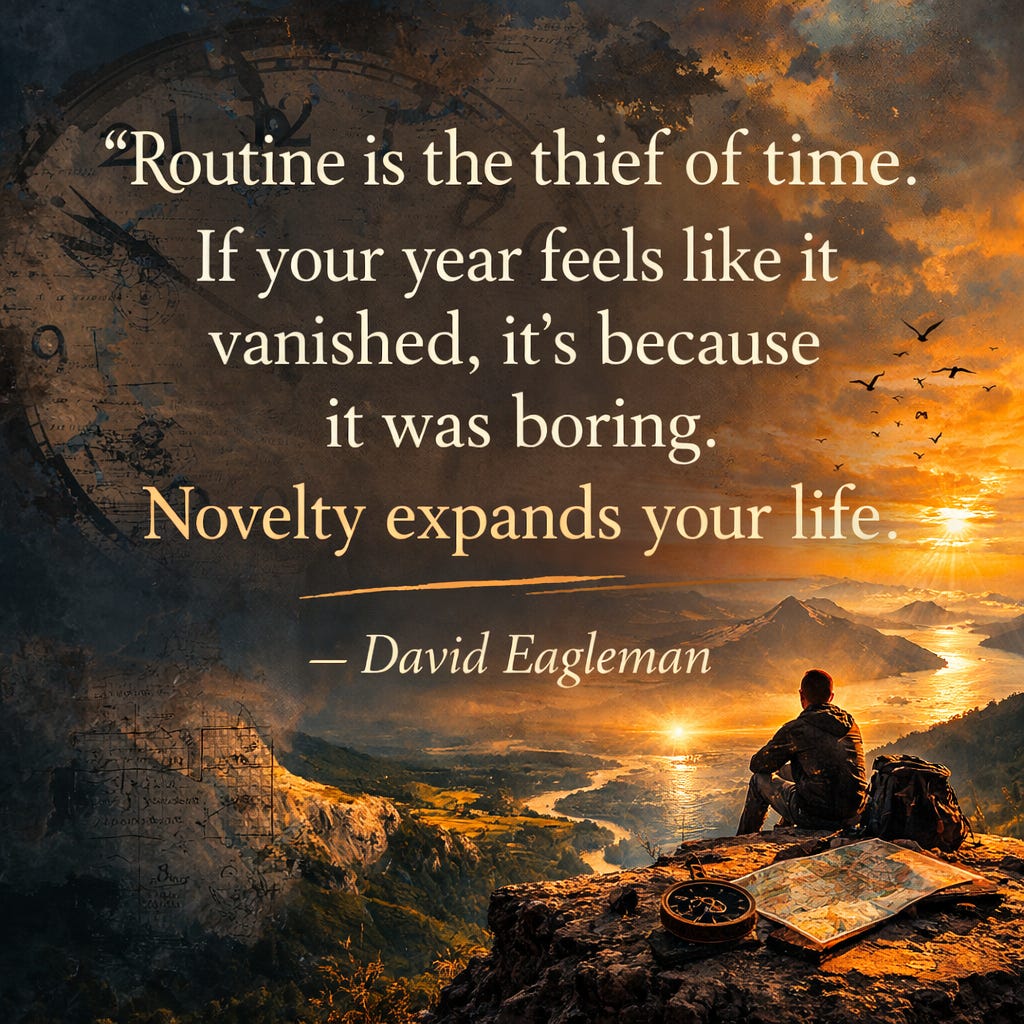
Without scheduled novelty, your brain enters a loop. When every day looks the same, your internal clock accelerates. This is why childhood felt like an eternity and your thirties feel like a weekend.
Routine is the thief of time. Intentional experience is the only way to slow it down.
The Protocol: Engineering a Life
This isn’t about “work-life balance”—a term used by people who are mediocre at both. This is about Integrated Rhythm. You work intensely, then you recover intentionally. You don’t wait for permission. You anchor the year.
1. Anchor the Year (Annual)
Before you commit to a single professional KPI, identify three to five Non-Negotiable Anchors.
A trip that forces you to unplug.
A physical challenge that scares you.
A reunion with people who knew you before you were “successful.”
These are not “vacations.” They are stakes in the ground. They create a psychological horizon. A year without anchors isn’t a year; it’s a 365-day shift.
2. The Quarterly Reset (90 Days)
Every twelve weeks, the system needs a reboot. Business owners plan in quarters because it’s the maximum amount of time a human can stay focused before the signal turns to noise. Your life is no different.
The Rule: One long weekend. New environment. Zero work.
The Goal: To remember who you are when you aren’t producing value for a marketplace.
3. Monthly Deliberation (30 Days)
If you don’t disrupt the month, the months will blend into a blur. Once every four weeks, do something that breaks the script. A concert, a day trip, a dinner with someone who challenges your thinking. If it doesn’t make it onto the calendar, it doesn’t happen.
4. The Solitude Mandate
Experience is not always social. The most dangerous man is the one who can sit in a room alone and think. Most people are terrified of this, so they fill every gap with “busy-ness.” Schedule time to be unreachable. To read. To move. To think. If you are always reactive to others, you aren’t leading your life; you’re just managing the requests of others.
Time Does Not Counter-Offer
Reality is indifferent to your “busy” schedule. It will continue to move at the same pace whether you are present for it or not.
Productivity without experience is just a well-optimized path to a mid-life crisis. Discipline without adventure is just a cage.
The people who live the most meaningful lives don’t stumble into them while waiting for a “break” in the workload. They engineer them. They protect them.
They schedule them.
Gemini said
This looks like a solid draft. The tone is sharp, unsentimental, and direct—exactly the kind of “no-nonsense” perspective that cuts through the typical productivity fluff.
I have integrated the “Experience Protocol” section at the end, framing it as the practical implementation of these concepts.
The Great Productivity Lie
Most high-performers are experts at building someone else’s empire and amateurs at building their own lives.
They treat their calendar like a sacred document for meetings, deadlines, and deep work. But when it comes to the things that actually make a life worth living—travel, connection, stillness, or challenge—they rely on “if I have time.”
“If I have time” is a death sentence for a meaningful life.
You don’t “have” time. You take it. If you don’t schedule your life with the same ruthless precision you use for your work, the work will simply expand until there is nothing left of you. Years won’t just pass; they will disappear.
The Performance Paradox
There is a specific kind of arrogance in thinking you can outrun the need for recovery. We tell ourselves that intensity is the same as progress. We believe that life begins after the next project, after the promotion, or after the “season” calms down.
It never calms down.
Without scheduled novelty, your brain enters a loop. When every day looks the same, your internal clock accelerates. This is why childhood felt like an eternity and your thirties feel like a weekend. Routine is the thief of time. Intentional experience is the only way to slow it down.
The Protocol: Engineering a Life
This isn’t about “work-life balance”—a term used by people who are mediocre at both. This is about Integrated Rhythm. You work intensely, then you recover intentionally. You don’t wait for permission. You anchor the year.
Anchor the Year (Annual): Before you commit to a single professional KPI, identify three to five Non-Negotiable Anchors. A trip that forces you to unplug. A physical challenge that scares you. A reunion with people who knew you before you were “successful.” These are stakes in the ground that create a psychological horizon.
The Quarterly Reset (90 Days): Every twelve weeks, the system needs a reboot. The Rule: One long weekend. New environment. Zero work. The Goal: To remember who you are when you aren’t producing value for a marketplace.
Monthly Deliberation (30 Days): Once every four weeks, do something that breaks the script. A concert, a day trip, a dinner with someone who challenges your thinking. If it doesn’t make it onto the calendar, it doesn’t happen.
The Solitude Mandate: Experience is not always social. Schedule time to be unreachable. To read. To move. To think. If you are always reactive to others, you aren’t leading your life; you’re just managing the requests of others.
Implementation: The Experience Protocol
Theory is useless without execution. To move these concepts from the page to your calendar, we use the Experience Protocol.
This framework is designed to automate the “Integrated Rhythm” mentioned above. It forces you to treat recovery and novelty as high-stakes deliverables. At performanceprotocol.ai/protocols/experience, we break down the mechanics of the Experience Audit:
The Velocity Check: Assessing if your current pace is sustainable or if you are simply drifting toward burnout.
Novelty Ingestion: Specific strategies to disrupt the “routine loop” that makes years disappear.
The Recovery Ratio: Calculating the exact amount of intentional downtime required to maintain peak output during “Deep Work” phases.
Productivity without experience is just a well-optimized path to a mid-life crisis. Discipline without adventure is just a cage. Stop hoping for a break in the workload and start engineering the anchors.