


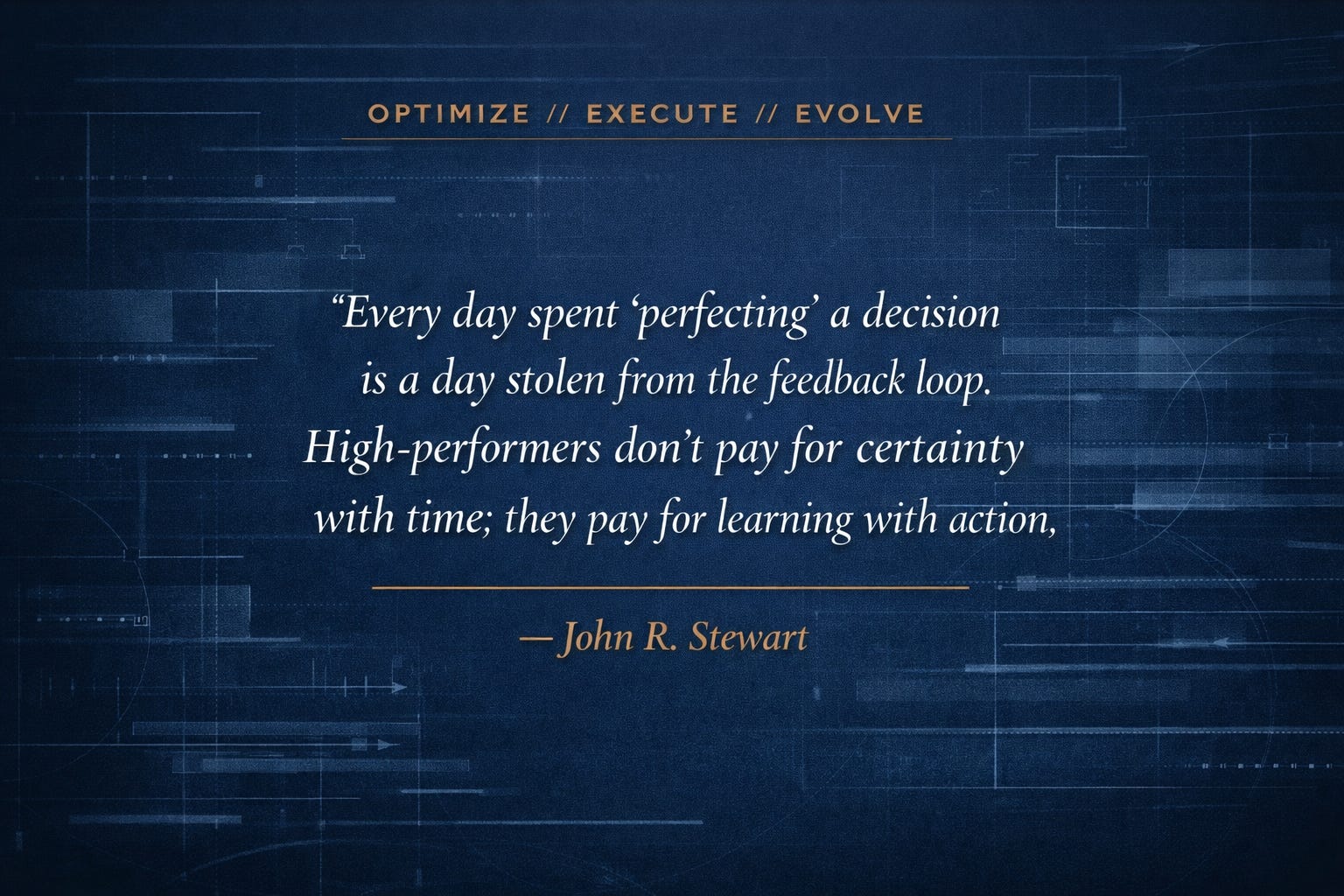
Most leaders—and most individuals—believe performance is a byproduct of information. They chase more research, more meetings, and more consensus, operating under the delusion that certainty is a required precursor to action.
In high-performing systems, the inverse is true. The best operators don’t win because they have more data; they win because they decide earlier and adjust faster.
“In any moment of decision, the best thing you can do is the right thing, the next best thing is the wrong thing, and the worst thing you can do is nothing.” — Theodore Roosevelt
The Hidden Tax of Indecision
Indecision is the most expensive form of waste. It doesn’t just stall a project; it creates a “drag coefficient” that slows every connected system—professional and personal.
Professional Drag: Open decisions occupy “RAM” in the minds of your team, preventing deep work. Organizations begin to mistake alignment loops and status updates for actual output.
Personal Drag: On an individual level, indecision manifests as rumination. We spend months “weighing options” for a career move or a health change, burning the very mental energy we need to actually execute the change.
The Learning Gap: In product-led growth, learning only begins after shipping. In life, clarity only begins after the first step. Every day spent in discussion or internal debate is a day of zero intelligence gain.
The Decision Compression Principle
Elite organizations and high-achieving individuals do not try to eliminate mistakes; they compress the decision cycle. They move faster by reducing three specific variables:
The Number of Deciders: Reducing “consensus bloat” in the office and “over-asking for advice” in your personal life.
The Time Window: Setting aggressive “hard-stops” for debate.
The Cost of Being Wrong: Building systems (and lives) that allow for cheap, reversible failure.
Speed is not a result of rushing; it is a result of lowering the penalty for being wrong. When the cost of a mistake is low, the requirement for certainty vanishes.
The Three Rules of High-Velocity Systems
1. Push Authority to the “Edge”
The people closest to the context should hold the power of the call.
In Business: Centralized decision-making creates bottlenecks that starve the front lines of momentum.
In Life: Don’t outsource your major life pivots to a committee of friends or family. You are the one with the “local data” of your own experience. Trust the edge.
2. Categorize by Reversibility
As Jeff Bezos famously noted, there are two types of decisions. Type 1 are “one-way doors”—irreversible and consequential. Type 2 are “two-way doors”—reversible and iterative.
“Most decisions... are changeable, reversible—they’re two-way doors. In those cases, why wait? If you’ve made a suboptimal Type 2 decision, you don’t have to live with the consequences for that long.” — Jeff Bezos
The fatal flaw of average organizations is treating every Type 2 decision like it’s a Type 1.
3. Decision as a Data Point
Every decision must be viewed as an experiment designed to produce information. Whether a feature succeeds or fails is secondary to the speed at which the system becomes smarter. If you aren’t deciding, you aren’t learning.
The Real Competitive Advantage
The modern world is obsessed with tools—AI, dashboards, and automation. But tools are a commodity; Decision Velocity is a scarcity.
Two companies (or two people) can have the exact same resources, yet one will outpace the other by 10x. The difference isn’t the talent; it’s the mandate to shorten the distance between a question and an answer.
Growth—both organizational and personal—is not a result of “correctness.” It is a result of iteration density. The more decisions you make, the more feedback you get. The more feedback you get, the faster you grow.
Summary
Performance does not come from avoiding errors. It comes from shortening the feedback loop. High-performing systems don’t chase the horizon of absolute certainty; they chase the compounding interest of rapid learning.
Decide sooner.
Performance Protocol
Performance Protocol is a system-first approach to human performance — built on physiology, recovery, and real-world constraints.
Each article is a layer in the same framework.
No hacks. No hype. Just structure.