


The majority of people treat preparation as a substitute for risk - I know it as I’m one of them. They read another book, refine another blueprint, and wait for a version of themselves that feels ready enough to start. That version never shows up. It can’t, because it’s built entirely out of imagination and imagination has zero friction in it.
Here’s the part nobody wants to sit with: you do not think your way into competence. You act your way into it. As Yogi Berra famously put it:
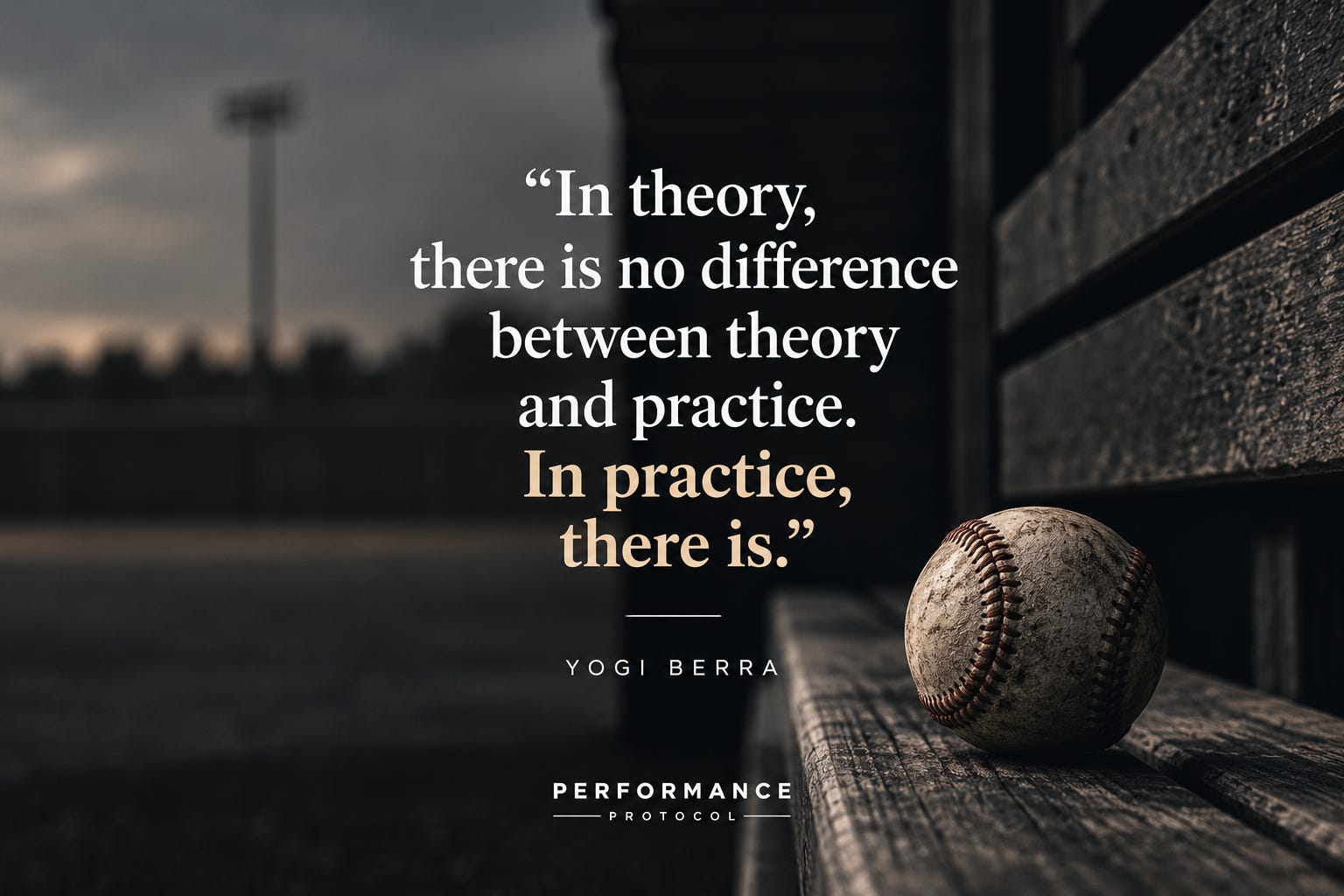
“In theory, there is no difference between theory and practice. In practice, there is.”
The gap between the person who spends six months studying a craft and the person who practices it badly for six months isn’t even close. The practitioner has already met real-world problems the theorist doesn’t have the vocabulary to imagine. Planning gives you a theory; doing gives you actual data.
Perfectionism feels like high standards and deep diligence. It’s actually a delay mechanism dressed up as a virtue. When you refuse to start until you can guarantee quality, you’re just protecting your ego from the immediate, undeniable evidence that you’re currently crap at it. That’s a crucial distinction and you need to separate the two.
Leonardo da Vinci framed the necessity of raw execution simply:
“I have been impressed with the urgency of doing. Knowing is not enough; we must apply. Being willing is not enough; we must do.”
The work teaches you things that thinking about the work never can. You don’t know which mistakes you’re going to make until you make them. You don’t know where your real weaknesses lie until reality points them out, usually at a volume you can’t ignore.
There’s a certain type of person who mistakes motion for progress and never builds anything real. There’s another who mistakes stillness for wisdom and meets the exact same fate. Both end up in the identical spot: twelve months older with nothing to show for the year. Mahatma Gandhi captured the bottom line of that dynamic in four words:
“Action expresses priorities.”
The ratio matters here. It’s not perfectionism versus action as binary opposites, but as a proportion you’re constantly rebalancing. Too much planning and you calcify, but too little and you are flailing without direction. But if you’re honest with yourself, almost nobody errors on the side of under-planning. Most failure is from the paralysis of preparation not recklessness.
Being in the arena beats planning for it because the arena is the only place skill actually forms. You cannot simulate the feeling of being wrong in public. You cannot rehearse your way into resilience. Those attributes are forged through direct contact and a specific discomfort of doing something imperfectly while people watch, and then doing it again slightly less badly.
Reid Hoffman summarized the necessity of making peace with that early step:
“If you are not embarrassed by the first version of your product, you’ve launched too late.”
The people who get good fast aren’t the ones with the best initial plans. They’re the ones who shortened the distance between deciding and doing to almost zero. They accepted looking unpolished early on because they understood a fundamental truth: unpolished and improving beats polished and theoretical every single time.
Start before you’re ready. “Ready” is just a myth built by people trying to shield themselves from the discomfort of being new and terrible at something.
Sources & Core References
Hoffman, Reid & Casnocha, Ben (2012) — The Start-up of You: Adapt to the Future, Invest in Yourself, and Transform Your Career. Crown Business.
Pressfield, Steven (2002) — The War of Art: Break Through the Blocks and Win Your Inner Creative Battles. Black Irish Entertainment LLC.
Dweck, Carol S. (2006) — Mindset: The New Psychology of Success. Random House.
Da Vinci, Leonardo — Notebooks / Historical Records.