


A window lets you look at something without paying for it. That is the whole appeal. You get the shape of the room, a sense of the light, maybe a glimpse of who is inside and you get all of it from a position of absolute safety. Nothing is asked of you and nothing is risked.
Peop[e run their careers and ambitions from behind glass. They watch the market, study the people who made the jump, and wait for the moment when the view becomes clear enough to justify moving. That moment rarely arrives, because the view was never going to tell them what they needed to know anyway.
What the Glass Does to You
Someone else built the window. They chose where it sits in the wall, how big it is, and which way it faces. What you see through it is a curated, framed version of the room selected for you. Crucially, the frame hides almost everything that matters: the real terms of the deal, the temperament of the people, and what the work actually feels like on a random Tuesday at three in the afternoon.
That information exists only on the other side of the threshold. No amount of staring produces it. Here looking carries a quieter cost, too: it feels like progress.
A person who spends six months researching a career move feels closer to it than someone who hasn’t. That feeling scratches the exact same itch that action would. The research becomes the activity. Glass is a barrier masquerading as access, and plenty of capable people spend decades pressed against it, where they are exceptionally well-informed and going nowhere.
Then there is the problem of crowds. An opportunity visible through a window is visible to everyone else walking down the street. By the time the view is clear enough to remove your doubt, it has removed everyone else’s doubt too, and the price reflects it. The business listed on every brokerage site, the role posted on every public job board, and the idea already analyzed in the trade press are all windows. The deals worth having tend to surface through a direct phone call, a casual follow-up conversation, or an introduction from someone you met in a room you almost didn’t enter.
Which brings us to the point most people miss entirely.
The Rooms You Can’t See From the Street
In his book on where good ideas come from, Steven Johnson borrows a concept from theoretical biologist Stuart Kauffman: the “adjacent possible.” It describes how at any given moment, only certain next steps are physically or conceptually feasible. Johnson frames it visually: “Think of it as a house that magically expands with each door you open.” You start in a room with four doors. Walk through one, and three brand-new doors appear, each leading somewhere you could never have reached or even seen from your original starting point.
Sit with what that means for the person standing at the window. Their set of options is permanently fixed by where they are standing. They can watch for twenty years and the house will never expand, because the house only grows in response to movement. The best door in any building is invisible from the street. It only reveals itself once you are two rooms deep, and nobody outside can describe it to you in advance because nobody outside knows it exists.
Psychologist Richard Wiseman demonstrated this exact mechanism at the level of human attention. He recruited people who self-identified as either consistently “lucky” or consistently “unlucky” and asked them to count the photographs in a newspaper:
The unlucky group took about two minutes on average.
The lucky group took seconds.
Why? Because on page two, a massive half-page notice in bold type read: “Stop counting—there are 43 photographs in this newspaper.” Further in, another notice offered £250 to anyone who pointed it out to the experimenter. The unlucky participants missed both notices because they were too busy counting.
Wiseman’s conclusion was that tension narrows attention. Lucky people are more relaxed and open; they see what is actually there rather than just what they are looking for. The window-watcher is a counter. They decided what they were looking for before they arrived, so the view simply confirms the plan and blocks out everything else. Wiseman also noted that lucky people intentionally inject variety into their lives, which is just another way of saying they open more doors and give the unexpected more chances to find them.
The hardest evidence on this comes from an experiment millions of us participated in without knowing it. Researchers randomly varied the distribution of “weak ties” in the LinkedIn networks of over 20 million people across five years, a period spanning two billion new connections and 600,000 new jobs.
The result? The greatest job mobility came from moderately weak ties, while the strongest ties did the least. There’s a reasonable nuance here: weak ties drove mobility far more in digital industries, whereas strong ties mattered more in traditional ones. Even so, the fundamental pattern holds. The people closest to you know what you already know. The casual acquaintance you met once at a conference is a door into a building you’ve never seen.
The Math of Most Doors
Having spent years running experiments for a living, the lesson that sticks with you has very little to do with statistics: most tests lose.
Ronny Kohavi, who led experimentation teams at Microsoft and Amazon, reported that among well-designed experiments aimed at improving key metrics at Microsoft, only about one-third succeeded. At Bing, the success rate was even lower. On heavily optimized platforms like Bing or Google Search, practitioners estimate typical success rates sit between 10 and 20 percent.
These figures come from some of the best-resourced product teams on Earth—people swimming in data and they still get it wrong two times out of three. The teams that win are simply the ones that launch more. When the hit rate is low and stubborn, the only variable within your control is volume.
A test sitting in a backlog teaches you nothing. Neither does an opportunity you only observed.
Doors operate by the exact same math:
Plenty of them open onto closets.
Some open onto rooms where nobody wants you, forcing you to walk back out with whatever composure you can muster.
That is the real price of opening doors, and it’s pointlessly dishonest to pretend it’s small. Rejection stings, and a few doors cost real time or money. But the window has a price too, it just bills you later.
Cornell researchers Thomas Gilovich and Victoria Medvec found that while actions produce more regret in the short term, inaction produces far more regret over the long run. In survey data from Lewis Terman’s landmark longitudinal study of people in their seventies, regrets of inaction outnumbered regrets of action by more than four to one. Furthermore, 65 percent of respondents had taken active steps to repair a regrettable action, whereas almost no one could fix an inaction.
A bad decision gives you something to repair. A door you never opened gives you nothing to fix, so it just sits there.
Learning to Leave
The true skill worth building isn’t just opening doors, it’s learning to leave. People avoid doors because they assume entering requires staying. They treat a conversation like a lifetime commitment and a first meeting like an irrevocable contract.
Jeff Bezos captured this distinction in his 2015 letter to Amazon shareholders by dividing decisions into two categories:
Type 1 (One-Way Doors): Consequential and irreversible decisions that demand slow, rigorous deliberation.
Type 2 (Two-Way Doors): Reversible decisions that should be made quickly by individuals with good judgment. As Bezos noted of a reversible move that fails: “You don’t have to live with the consequences for that long.”
His warning was directed at corporations: as organizations grow, they mistakenly apply heavy, risk-averse Type 1 processes to simple Type 2 decisions, destroying velocity and invention in the process.
Individuals make the exact same mistake in their personal and professional lives. They treat an exploratory coffee like a corporate merger. They treat an introductory call like a resignation letter. They apply a level of scrutiny that no two-way door could ever survive—and so the door stays shut.
Economist Steven Levitt tested what happens when people actually force the issue. He recruited over 22,000 people stuck on major life decisions and had them flip a digital coin (heads meant make the change, tails meant stay put). For major choices like quitting a job or ending a relationship, those instructed by the coin to make the change were significantly more likely to do so, reported higher satisfaction with their choice, and were measurably happier six months later than those told to keep the status quo. His takeaway was straightforward: people are excessively cautious when facing life-changing choices.
The study has its caveats. These were self-selected individuals who were already genuinely torn, and the coin toss only mattered at the margin. But that margin is precisely where most people spend their lives. The decisions that consume years are rarely the obvious ones; they are the ones sitting at 50/50 while we wait at the window for the view to clear. The data suggests that at 50/50, the door is almost always the better bet.
A person who learns to exit cleanly can afford to open twenty doors for every single one the cautious person opens. The cautious observer will always mistake that pace for recklessness. The difference, of course, is that one person is gathering intelligence from inside the room, while the other is just studying reflections off the glass.
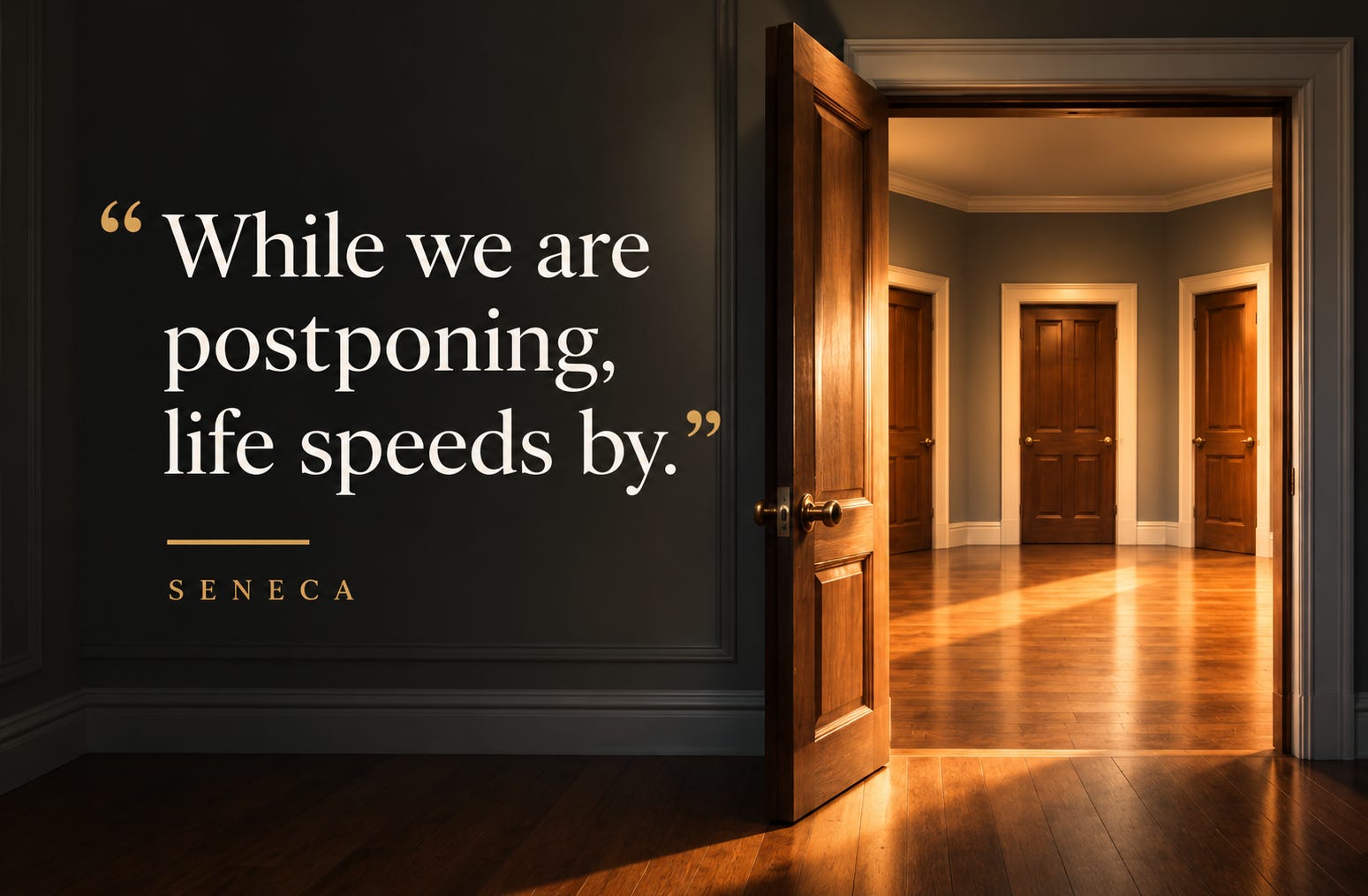
Seneca wrote to his friend Lucilius about this two thousand years ago, with a line that has aged better than almost any modern productivity advice:
“While we are postponing, life speeds by.”
He was writing about time. The window is simply the most comfortable place to waste it.
A Simple Audit
Count the doors you actually opened in the last ninety days:
The cold calls or emails you sent.
The meetings you requested.
The offers or proposals you put in writing.
The work you shipped before it felt fully finished.
Now, estimate the hours you spent sitting at the glass—researching, analyzing, and deliberating.
That ratio says far more about where you will be in five years than any view through the glass ever could.
References & Sources
Johnson, S. Where Good Ideas Come From (2010)
Wiseman, R. The Luck Factor (2003)
Rajkumar, K. et al. “A causal test of the strength of weak ties.” Science 377 (2022)
Kohavi, R. et al. “Online Experimentation at Microsoft”
Gilovich, T. & Medvec, V. “The Experience of Regret: What, When and Why.” Psychological Review (1995); 2023 replication study
Bezos, J. Amazon Letter to Shareholders (2015)
Levitt, S. “Heads or Tails: The Impact of High-Stakes Coins Flips on Decision Making.” Review of Economic Studies 88(1) (2021)
Seneca. Moral Letters to Lucilius, Letter 1 (trans. R. M. Gummere)