


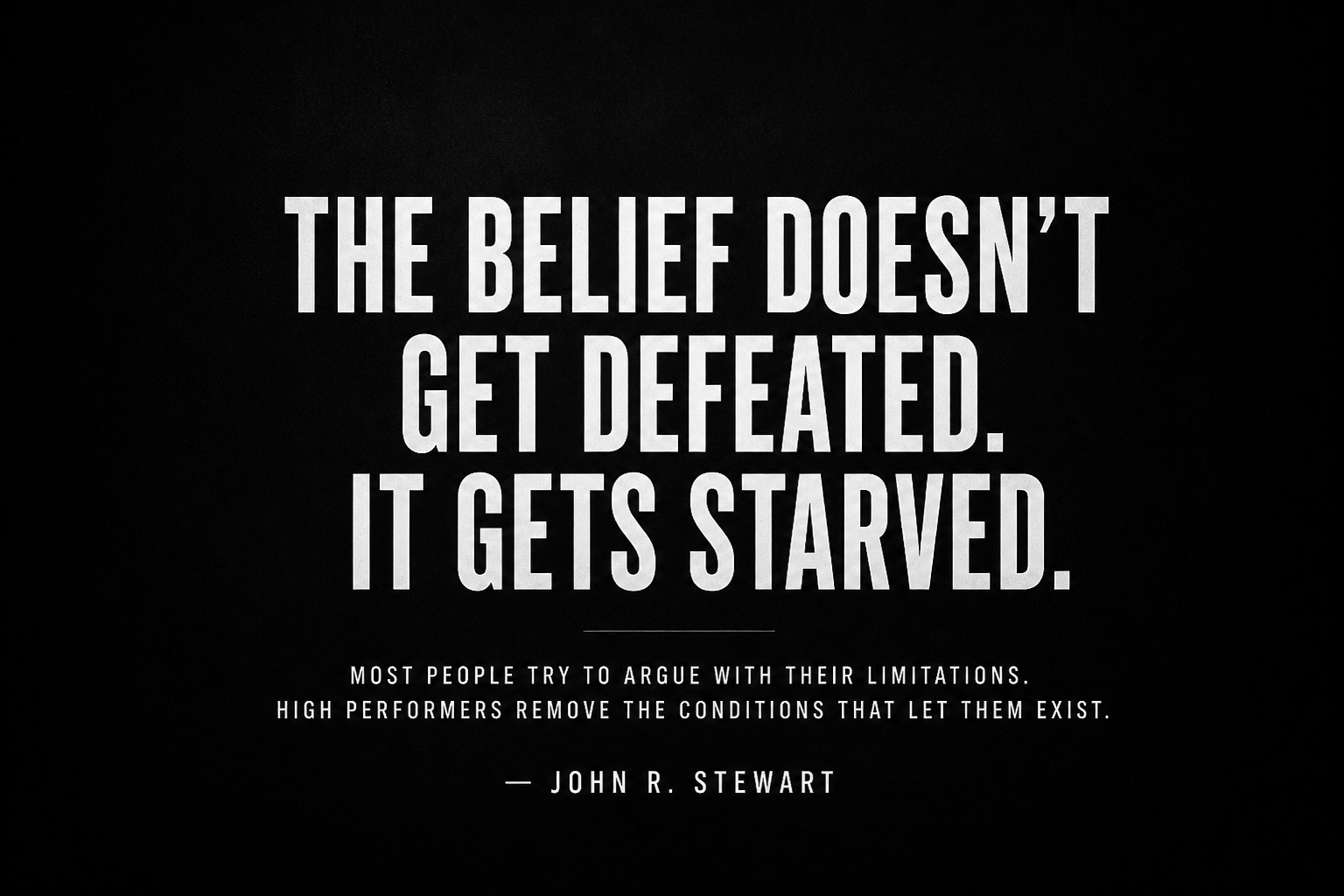
You don’t fail because you lack the ability. You fail because you built a system that assumes you don’t have it.
That’s the actual problem. Not the skill gap, not the discipline gap, not the circumstances. The architecture you constructed around the gap, and have been reinforcing ever since.
Nicholas Thompson is the CEO of The Atlantic and a competitive runner. Not a natural one. In his book The Running Grave, he documents the brutal transition from non-runner to elite, and somewhere inside that account he surfaces something most high-performers never confront: he had to forget he couldn’t do it before he could do it. Not push through the belief. Not reframe it. Forget it entirely.
Forgetting isn’t convincing yourself. It’s removing access. The belief doesn’t get argued down. It gets crowded out by inputs that leave it nothing to run on. Thompson didn’t beat the story. He stopped feeding it long enough that his body could do what it was always capable of doing.
That distinction matters more than it looks.
How a Description Becomes a Subroutine
There’s a fundamental difference between knowing you can’t do something and having organized your identity around that inability. The first is a data point. The second is a pattern running below conscious decision-making that doesn’t announce itself, doesn’t ask for permission, and requires zero effort to maintain.
Every time you’ve planned around a limitation, introduced yourself to a new challenge while already carrying the disclaimer, or pulled back just before the moment of exposure, you’ve cast a vote for the person who cannot do the thing. James Clear’s framing applies in both directions: every action is a vote for the type of person you’re becoming. The inverse is equally true. At a certain point, that vote count becomes identity. The belief stops being a conclusion and starts being the architecture.
Epictetus was precise about this. The task is to distinguish what is within your control from what is not. You cannot control the gap as it exists today. You can control whether you’ve built a permanent structure around it.
Most people skip the second question entirely.
The Trap of Awareness
The standard narrative says: become aware of the belief, examine it, replace it, move forward. The assumption underneath is that awareness is always the antidote.
It isn’t.
When you’ve rehearsed a limitation in enough detail, with enough personal history behind it, awareness stops being the solution. It becomes part of the mechanism. Think about the last time you hesitated before sending something important, pulled back in a meeting right before making the point, or missed something you’d made a hundred times before under pressure. The hesitation wasn’t random. It was a practiced pattern executing on cue. You knew exactly how that moment was going to go before it happened, and that knowledge is precisely what made it go that way.
“You have power over your mind, not outside events.” — Marcus Aurelius
Aurelius was describing a practice, not a belief. The practice of returning to what is within your control, repeatedly, as an act of will. The person who has built a complete cognitive architecture around their limitation is exercising that power against themselves. Deliberately. Every day.
How to Starve the Subroutine
You cannot argue with a subroutine. Confrontation requires the belief to be active, which means confrontation feeds it. You disrupt it by changing the inputs until it has nothing to run on.
This is why Peter Attia’s framework for behavior change goes beyond knowledge and intention. The environment, the timing, what you’re actually doing in the physical world, has to change before the internal model updates. Thompson’s process worked not because he found insight but because the structural demands of what he was doing left no room for the old story to operate. The model got crowded out. He lost access to the version of himself that held the belief, and in that gap, his body did what it was always capable of doing.
You don’t think your way to a new identity. You act your way there, with enough repetition that the old model runs out of evidence to sustain itself.
The belief doesn’t get defeated. It gets starved.
The Diagnostic
You don’t have a limitation problem. You have a story problem.
How much of your current behavior is organized around a story you built to explain a gap that stopped being accurate years ago? How much cognitive real estate is occupied by a model of yourself assembled under different conditions, tested under different pressures, and never once updated?
If the answer is uncomfortable, that’s the diagnostic. Not a character verdict. A structural one.
You’re not stuck. You’re rehearsed.
Stop rehearsing it.
Optimize // Execute // Evolve
Performance Protocol publishes systems-based frameworks for physical durability, execution and emotional control. Read more at performanceprotocol.ai.