


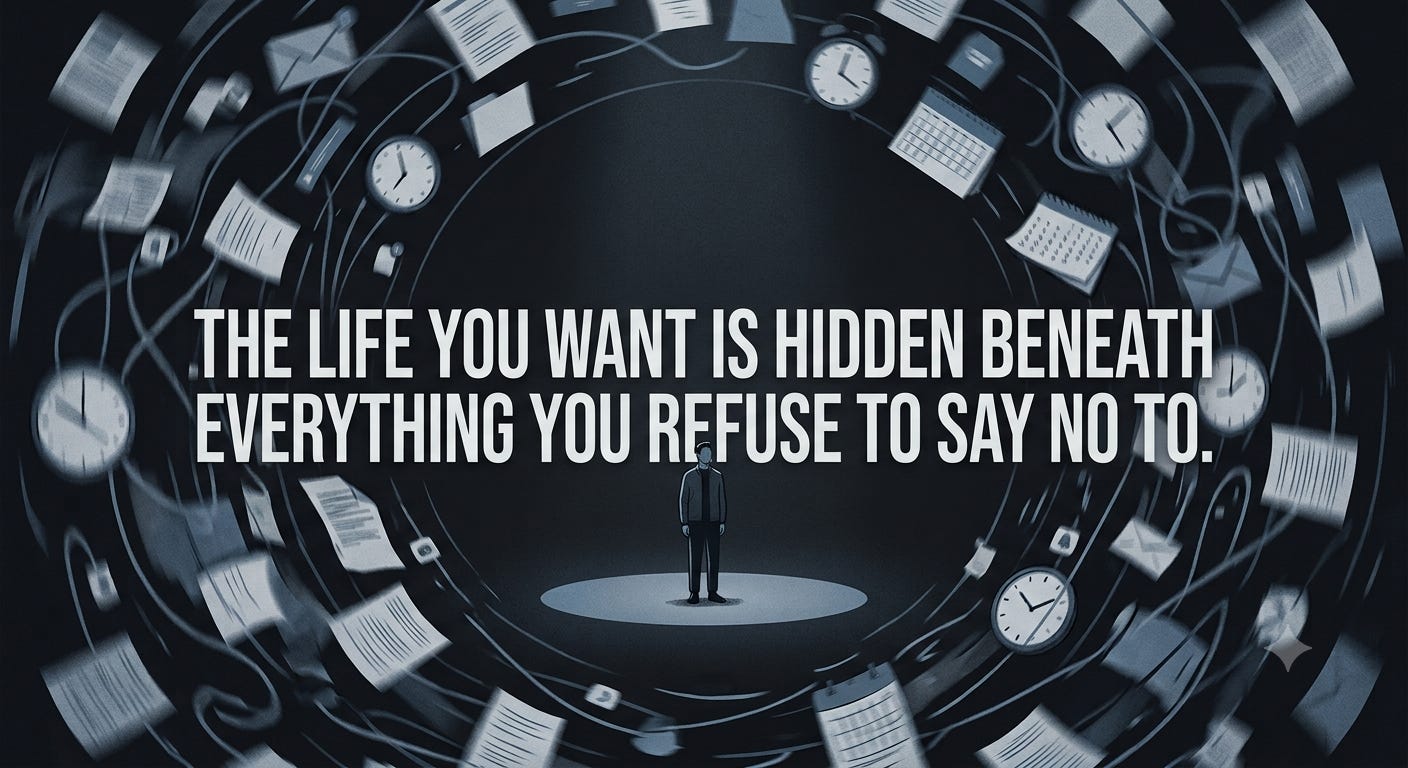
In both corporate boardrooms and daily life, busyness has become a psychological safety blanket. We wear packed calendars, buzzing notifications and general exhaustion like armor, treating a state of constant reaction as a proxy for usefulness. Yet the difference between the frantic amateur and the elite operator has nothing to do with hours logged and everything to do with a single question asked before the chaos of the day begins: what actually matters here?
Watch how the highest performers run their enterprises, their bodies and their days, and a stark pattern emerges. Roughly 80% of their cognitive and physical capital goes to a tiny, fiercely protected set of priorities. Three things. Sometimes five. Rarely more than seven. The rest of the day, the performative meetings, the Slack pings, the low-stakes social obligations and the operational sludge of daily living, gets compressed, delegated or ignored entirely.
That ratio is the whole game. Signal gets the prime hours. Noise gets the scraps.
1. Professional Signal: Focus as Subtraction
When Steve Jobs returned to Apple in 1997, the company was weeks away from bankruptcy, suffocating under a sprawling, incoherent web of dozens of products. Jobs didn’t try to optimize the mess. He brought a chainsaw. He famously drew a simple two-by-two grid on a whiteboard: “Consumer” and “Pro” across the top, “Desktop” and “Portable” down the side. He told the company they would build just four great products, one for each quadrant. Everything else was killed.
He brought this same brutal discipline to Apple’s annual Top 100 retreats. Jobs would gather his brightest minds and ask them to brainstorm the ten most important things Apple should do next. Once the list was finalized, Jobs would look at it, grab a marker and cross out the bottom seven.
“Deciding what not to do is as important as deciding what to do,” Jobs remarked to his biographer, Walter Isaacson. “That’s true for companies, and it’s true for products.” [1]
The underlying operational insight is deeply uncomfortable: every priority you keep taxes every other priority you keep. Attention behaves exactly like capital. Spread $100,000 across twenty different micro-cap stocks and no single position has enough weight to meaningfully compound your wealth. Jobs treated focus as a subtraction exercise. The value of Apple came from what he refused to do.
2. Operational Signal: The Tyranny of the Bottleneck
Elon Musk manages multiple multi-billion-dollar enterprises simultaneously (Tesla, SpaceX, xAI, Neuralink). By all laws of traditional corporate management, this should be impossible. It would be impossible if he distributed his attention evenly. He doesn’t.
Instead, Musk views engineering and leadership through the lens of Eliyahu Goldratt’s Theory of Constraints [2]. At any given moment, Musk identifies the single, fundamental constraint choking output at a company. Whether it is a battery cell production bottleneck on the factory floor or an orbital launch licensing delay, his time floods toward that exact fracture point.
Everything downstream of that constraint is noise by definition. As Peter Drucker, the father of modern management, noted:
“There is nothing so useless as doing efficiently that which should not be done at all.” [3]
Picture a factory line capped at 100 units an hour by a broken machine. Optimizing a downstream packaging station to handle 500 units an hour improves absolutely nothing. The output remains capped at 100. Musk isolates the limiting factor, works it until it breaks open and then immediately pivots to the next bottleneck.
Two different men, two different eras, but one shared conviction: a microscopic number of variables determine the macro outcome. Everything else is decoration.
3. Physical Signal: The Iron Laws of the Body
In fitness, the noise is deafening. The wellness industry survives by selling complexity: endless supplement stacks, hyper-specific biohacking routines and constantly shifting workout trends designed to keep you confused and spending money.
Serious operators treat their physiology the same way Jobs treated Apple’s product line. They bring a chainsaw to the noise. Elite physical output does not rely on twenty different variables. It relies on a microscopic number of foundational constraints handled with absolute weight [2].
The Movement Signal. You do not need a dozen isolation machines. You need a small number of heavy, multi-joint compound movements executed at a high intensity: weighted pull-ups, heavy bench presses, deep squats. Progressive overload on the core movements that demand full-body stabilization is the constraint. Variations are just noise.
The Recovery Signal. The highest-leverage performance enhancer on earth is free. Sleep hygiene and deep physiological recovery dictate your cognitive and physical ceiling. Without 7 to 8 hours of high-quality sleep, optimizing your supplement timing is mathematically irrelevant [4].
The Metabolic Signal. Tracking every calorie down to the single digit can create an obsessive, low-return mental tax. True metabolic control comes down to a few critical levers: hitting a precise protein target based on your lean mass, drinking clean water and managing systemic inflammation.
When you treat your training as a subtraction exercise, you stop chasing fatigue and start chasing adaptation. Three hard, heavy, perfectly executed movements beat an hour of randomized circuit training every single day.
4. Relational Signal: The Subtraction of Presence
Relationships are the ultimate victim of the “activity trap,” the cognitive bias where we prioritize urgent, low-stakes micro-interactions over deep, systemic priorities [5].
We live in a world where it is possible to be constantly available yet entirely absent. Replying to a work email on your phone while sitting at dinner with your family is a classic operational failure. You are handing your peak presence over to other people’s low-priority noise while starving your primary signal of its capital.
True connection behaves exactly like capital. Spread your relational energy across hundreds of surface-level digital acquaintances and no single relationship has enough concentrated attention to meaningfully compound. Elite operators apply the Bottleneck Framework to their personal lives. They identify the single constraint choking harmony or depth at home, perhaps a lack of uninterrupted one-on-one time or a breakdown in shared vision, and they flood their presence toward that exact fracture point. They accept a short-term social cost to pay for an outsized, long-term relational return.
The Four-Step Daily Methodology
The mechanics of separating signal from noise in daily life require developing an exceptionally high tolerance for social discomfort. The protocol is simple, rigid and rare.
Step 1: Identify the Signal the Night Before. Before the day has a chance to make demands on you, write down the three to seven items that genuinely change your position tomorrow. A structural bottleneck cleared. A heavy training session completed. Focused, uninterrupted time with your family. To filter these ruthlessly, apply the 90-Day Test: will completing this item still matter three months from now? Answering an email at 8:00 AM fails this test instantly. Taking a 20-minute walk through the neighborhood to clear your head or connect with your spouse passes it seamlessly.
Step 2: Give Signal Your Best Hours. Human cognitive and physical quality is a depletable resource. It is highest shortly after waking and steadily degrades through the afternoon as decision fatigue sets in [6]. Protect your early-morning windows for your heaviest, highest-leverage problems, whether that is deep creative work or your primary training session. Do not give away your peak capacity to other people’s reactive agendas.
Step 3: Contain the Operational Noise. Noise never completely disappears. Admin, scheduling, low-stakes calls, the inevitable logistical sludge of running a business or a household. This is the gas of life. It will expand to fill whatever space you give it. The strategy is strict containment. Batch these tasks into a fixed, hard-stopped window late in the afternoon when your high-level focus is already spent. Give it less space.
Step 4: Run a Zero-Based Time Audit. At the end of every week, look at your calendar and cross-reference it with your actual output. The gap between your intended focus and your actual focus is the most honest personal metric you possess. As Harvard professor Clayton Christensen noted, we often fail because we allocate our personal resources to things that give us immediate, short-term validation rather than long-term strategic success [7]. Most people never measure this gap, which is why they genuinely believe they are focused while spending six hours a day reacting to notifications.
Why Almost Nobody Does This
The methodology is not a secret. It has been written about for decades. Jobs talked about it. Musk demonstrates it daily. Management textbooks have preached it for generations. So why do most people remain chronically unfocused and overwhelmed?
Because noise feels good.
Clearing an inbox, running endless errands and scrolling through fitness content generate small, cheap dopamine hits of completion [5]. Signal work is heavier. It carries the psychological risk of business failure, the physical strain of heavy iron and the quiet vulnerability of deep presence.
Protecting the signal also means disappointing people. It means saying no to commitments that are merely “fine” to protect the ones that are vital. The elite operators who master this framework accept a low-grade, short-term social cost as the price of an outsized, long-term return.
Three things, done with your full weight behind them, will always beat thirty things done at a quarter capacity. Jobs proved it. Musk proves it daily. The list is short because the truth is short.
Decide what your three are tonight, before tomorrow decides for you.
Sources and References
[1] Isaacson, Walter. Steve Jobs. Simon & Schuster, 2011. (Detailing Jobs’ restructuring of Apple’s product line and his “Top 100” retreat protocols.)
[2] Goldratt, Eliyahu M. The Goal: A Process of Ongoing Improvement. North River Press, 1984. (The foundational text on the Theory of Constraints and bottleneck management.)
[3] Drucker, Peter F. The Effective Executive: The Definitive Guide to Getting the Right Things Done. HarperBusiness, 1967. (Classic management literature on efficiency vs. effectiveness.)
[4] Walker, Matthew. Why We Sleep: Unlocking the Power of Sleep and Dreams. Scribner, 2017. (Detailing the baseline systemic necessity of sleep over micro-optimized performance variables.)
[5] Zhu, Meng, Yang, Yang & Hsee, Christopher K. “The Mere Urgency Effect.” Journal of Consumer Research, Vol 45(3), 2018. (Psychological study demonstrating the human bias toward urgent, low-importance tasks over important ones.)
[6] Baumeister, Roy F., et al. “Ego Depletion: Is the Active Self a Limited Resource?” Journal of Personality and Social Psychology, Vol 74(5), 1998. (Academic research detailing the predictable depletion of cognitive performance and willpower throughout the day.)
[7] Christensen, Clayton M. How Will You Measure Your Life? Harvard Business Review Press, 2012. (On the critical trap of misallocating personal and resource capital toward short-term, high-dopamine tasks at the expense of long-term strategic relationships.)
For more operational frameworks and performance design strategies, visit performanceprotocol.ai.