


Most people think focus is about discipline.
It isn’t.
Focus is about protection.
Attention is the most valuable performance asset you have — and the easiest to leak.
You don’t lose focus because you’re weak.
You lose it because your environment is designed to steal it.
Attention Is a Biological Resource
Focus doesn’t exist in isolation.
It sits downstream of:
Sleep
Stress regulation
Energy availability
Emotional state
When those degrade, attention fragments.
But even when biology is intact, attention still collapses if structure is wrong.
Focus is not effort.
It’s allocation.
The Real Cost of Context Switching
Every interruption carries a hidden tax.
An email preview.
A Slack notification.
A quick check of social media.
A “just one minute” message.
Each one forces the brain to:
Reorient
Reload context
Suppress previous threads
That process consumes cognitive bandwidth.
It also elevates stress.
Context switching is not neutral.
It is accumulated friction.
Over time, this creates the illusion of busyness without output.
Distraction Is Structural, Not Personal
Most people blame themselves for distraction.
But look at the design:
Phones within reach.
Notifications default-on.
Infinite-scroll feeds.
Open tabs.
Reactive calendars.
The system is built for fragmentation.
The Focus Protocol begins by accepting one truth:
If attention is unprotected, it will be taken.
The First Principle: Define Before You Enter
Focus collapses when you open inputs before defining outputs.
Email before priority.
Slack before intention.
News before direction.
The protocol reverses this.
Before any external input:
Define the single most important task.
Clarify the next concrete step.
Commit to the block length.
Output first.
Inputs later.
The Second Principle: Remove Reactive Channels
Deep work cannot coexist with reactive communication.
During focused blocks:
No email.
No Slack.
No phone within reach.
No browser tabs unrelated to the task.
Not minimized.
Removed.
This is not productivity theater.
It’s cognitive preservation.
The Third Principle: Time Blocks Follow Energy
Not all hours are equal.
High-cognitive tasks require:
Freshness
Clarity
Bandwidth
The protocol anchors deep work to peak energy windows — usually earlier in the day for most people.
Administrative tasks follow.
Reactive tasks follow.
Focus is scheduled when capacity is highest.
Not when time is merely available.
The Fourth Principle: Close the Loop
Open loops drain attention even when you aren’t actively working on them.
Unfinished tasks.
Unclear commitments.
Vague next steps.
At the end of each workday:
Define tomorrow’s first action.
Capture unresolved items.
Shut down intentionally.
Without closure, stress bleeds into recovery.
Focus tomorrow depends on clarity today.
Where Focus Breaks
The periods where my output is strongest aren’t when I’m trying hardest.
They’re when structure is tight:
Clear priorities.
Protected blocks.
Limited inputs.
Defined shutdowns.
Focus degrades when optionality creeps back in.
When everything feels important.
When availability replaces priority.
When attention becomes reactive instead of deliberate.
The protocol doesn’t fail.
Commitment erodes.
What Reliability Looks Like
Reliable focus isn’t dramatic.
It looks like:
Longer stretches without interruption.
Predictable output.
Reduced mental fatigue.
Less emotional volatility tied to work.
You feel less busy.
You accomplish more.
That’s not intensity.
That’s control.
The Performance Order Still Applies
You cannot focus your way out of:
Sleep debt
Chronic stress
Energy deficits
But once biology and regulation are intact, attention becomes the multiplier.
Protect it.
Because what you focus on compounds.
What you leak disappears.
Final Thought
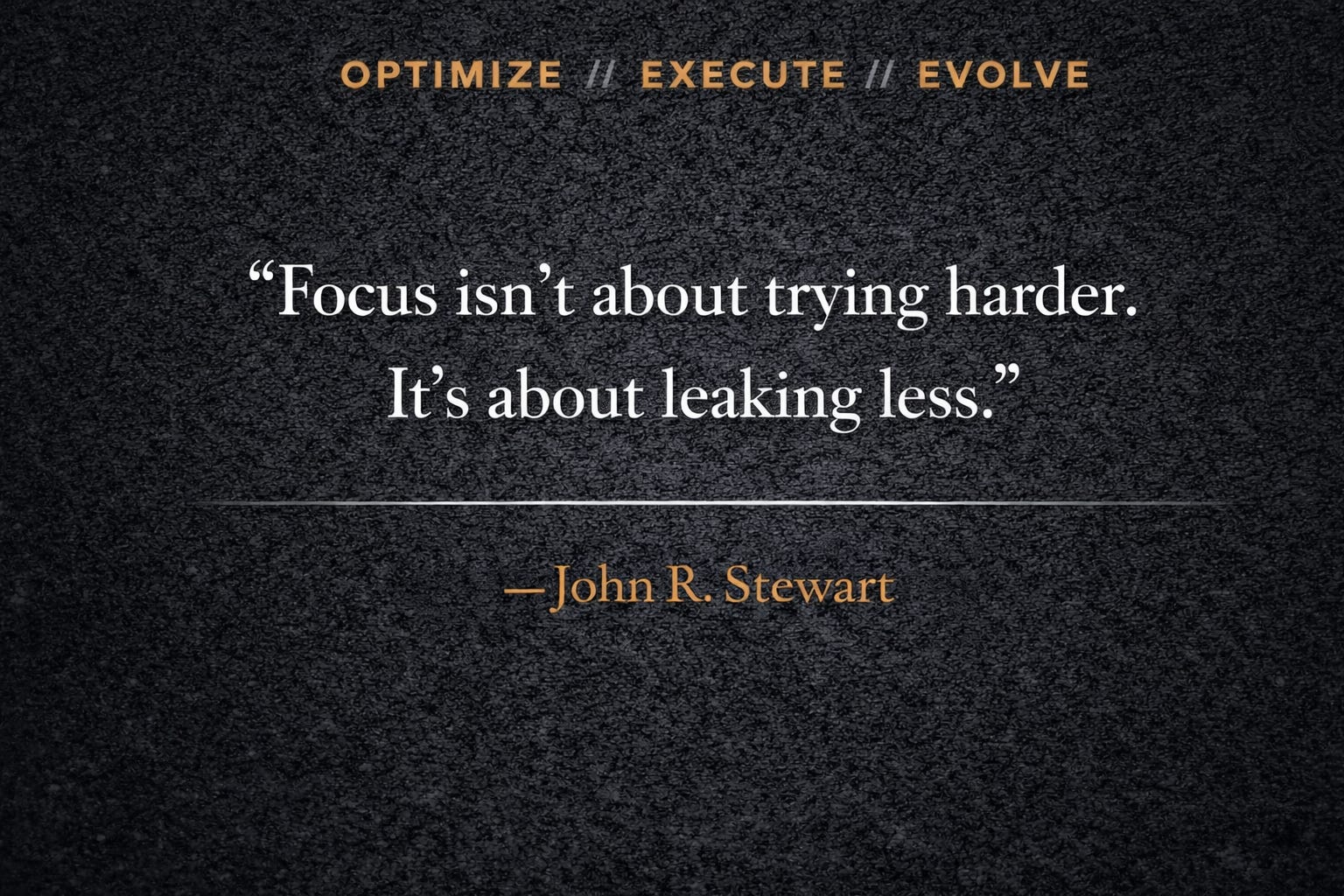
Focus isn’t about trying harder.
It’s about leaking less.
If attention is your most valuable asset, treat it like one.
Protect it before you attempt to optimize it.
Next up:
The Pareto Protocol
Where Focus protects attention —
Pareto decides where it goes.
Performance Protocol is a system-first approach to human performance — built on physiology, recovery, and real-world constraints.
Each article is a layer in the same framework.
No hacks. No hype. Just structure.