


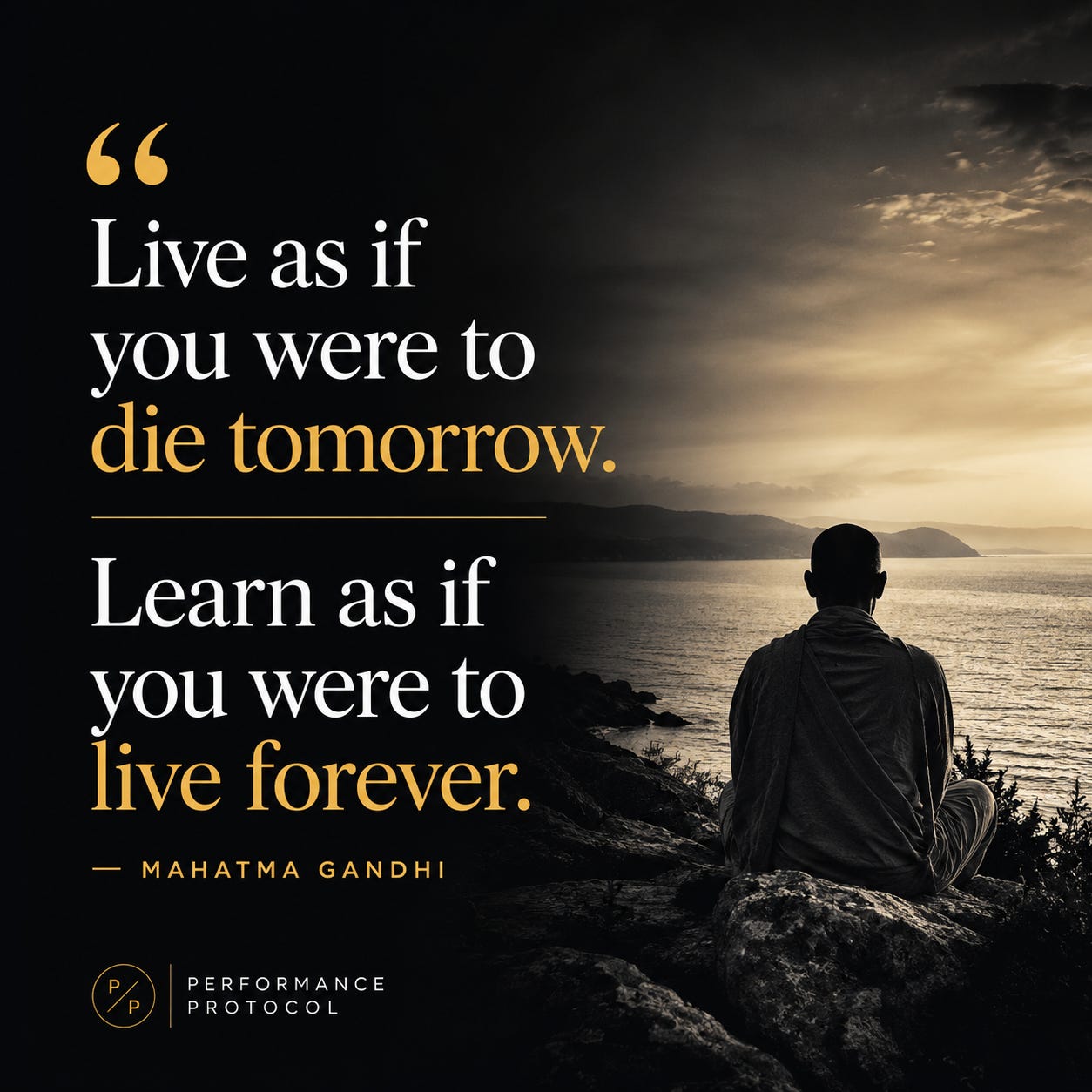
The words are painted on the walls of startup incubators, letterpressed onto graduation cards, and whispered in motivational videos: “Live as if you were to die tomorrow. Learn as if you were to live forever.” Most people hear Mahatma Gandhi’s famous maxim and feel a brief, familiar surge of inspiration. Then, they return to their existing lives, carrying slightly more guilt about not “seizing the day.”
But that is a profound misread. Gandhi didn’t mean this as a motivational band-aid. He meant it as a design spec.
The quote is not a simple call to urgency, nor is it a romanticized plea to stay curious. It is an engineering requirement for the human condition. It asks you to hold two opposing orientations at the exact same time, and to let the friction between them organize how you actually spend your hours.
When you invert this tension, life breaks down. When you master it, you build a life where the present is fully inhabited and the intellectual project never ends.
1. Living Like You’ll Die Tomorrow: The Immediate Filter
To live like you will die tomorrow is not an invitation to recklessness. It does not mean skydiving, quitting your job on a whim, or burning your life to the ground.
What it actually means is that your choices today must be able to stand entirely on their own. They cannot be treated as mere installments in some vague, future payoff. They cannot be justified solely as grueling groundwork for a version of your life that hasn’t arrived yet. They must hold value right now, precisely as they are.
As the Roman Stoic philosopher Seneca famously observed in On the Shortness of Life:
“You are afraid of dying, and, tell me, is the kind of life you lead any different from being dead?”
When you apply the filter of immediate impermanence cleanly, it cuts through an incredible amount of noise. If you knew this was the final round, would the way you are spending your attention still make sense? If the answer is no, the structural design of your day is flawed. You are treating the present as a disposable bridge to a destination that is never guaranteed.
2. Learning Like You’ll Live Forever: The Infinite Runway
Learning like you will live forever demands something almost entirely opposite. It means you are in absolutely no hurry to close the loop on understanding.
When your intellectual runway is infinite, you gain the luxury of patience. You can pursue an idea far past the point where it stops being immediately useful. You can sit quietly with a complex question that has no clean, executable answer. You grant yourself permission to change your position over the span of a decade, because the thinking you did in year three finally collided with something you read in year nine.
In his classic work Letters to a Young Poet, Rainer Maria Rilke captured this exact posture:
“Be patient toward all that is unresolved in your heart and try to love the questions themselves, like locked rooms and like books that are now written in a very foreign tongue. Do not now seek the answers, which cannot be given you because you would not be able to live them. And the point is, to live everything. Live the questions now.”
With an infinite runway, there is no deadline on the intellectual project. You don’t have to force premature conclusions, nor do you have to perform a false certainty you don’t actually possess to satisfy an audience or an algorithm.
3. The Great Inversion: Endless Time, Finished Thinking
The tragedy of the modern professional is that most people operate on a deeply flawed, inverted version of Gandhi’s spec.
They treat their time like it is endless, and their thinking like it needs to resolve by Friday.
They defer the choices that require absolute presence—procrastinating on deep health, authentic relationships, and true agency—while rushing toward shallow opinions they haven’t actually earned. They manage life like a corporate project with an infinite timeline, while treating the human mind like a static task list to be checked off before the weekend.
The cultural commentator and essayist Thomas Carlyle warned of this intellectual stagnation, writing:
“The fatalest condition of genius is to choose a wrong sphere; the next fatalest is to choose none at all, to hover in between.”
The result of this inversion is a pervasive, vague malaise—the persistent, unsettling sense that you are working incredibly hard at the wrong things.
4. The Mechanics of the Dual Awareness
The brilliance of Gandhi’s design spec is that it puts a short leash on how you allocate your life while giving your intellectual development infinite runway.
These two domains are not in conflict. In fact, they require each other.
   THE DUAL AWARENESS TENSION

   [ URGENCY IN LIVING ]  <====== Friction ======>  [ PATIENCE IN LEARNING ]
   - Demands immediate presence.                     - Grants infinite runway.
   - Stops deferring life to the future.             - Resists rushing to shallow conclusions.
   - Cuts through daily noise.                       - Allows ideas to mature over decades.
The urgency in living creates the pristine conditions necessary for real learning. When you realize time is short, you stop using the future as a convenient dumping ground for things you don’t want to deal with today. Concurrently, the patience in learning stops you from treating every single concept like a commodity that needs to produce a measurable return this quarter.
Practically, this demands a brutal dual awareness that does not come naturally to us. You must be present enough to feel the heavy, compounding weight of how you spend this Tuesday afternoon, and patient enough to resist collapsing a complex understanding into a simplistic, transactional takeaway just because you can use it right now.
Both of these orientations require profound discipline. Neither one looks like a sudden spark of inspiration.
5. Building the Structure
This is the exact part that gets glossed over on graduation day. The quote is celebrated because it sounds like permission to feel more alive, to be more curious, to wander.
But it is actually a cold, structural demand. It asks you to engineer a lifestyle capable of holding two radically different timescales simultaneously, letting each govern its proper domain.
It is a rejection of the middle ground where most people live—that lukewarm space of hurried thinking and delayed living.
To build a life where the present is fully inhabited and the thinking never stops is an exceptionally difficult art. Most of us do neither particularly well. But the friction between the two is exactly where the fire is.
Concepts explored via performanceprotocol.ai.