


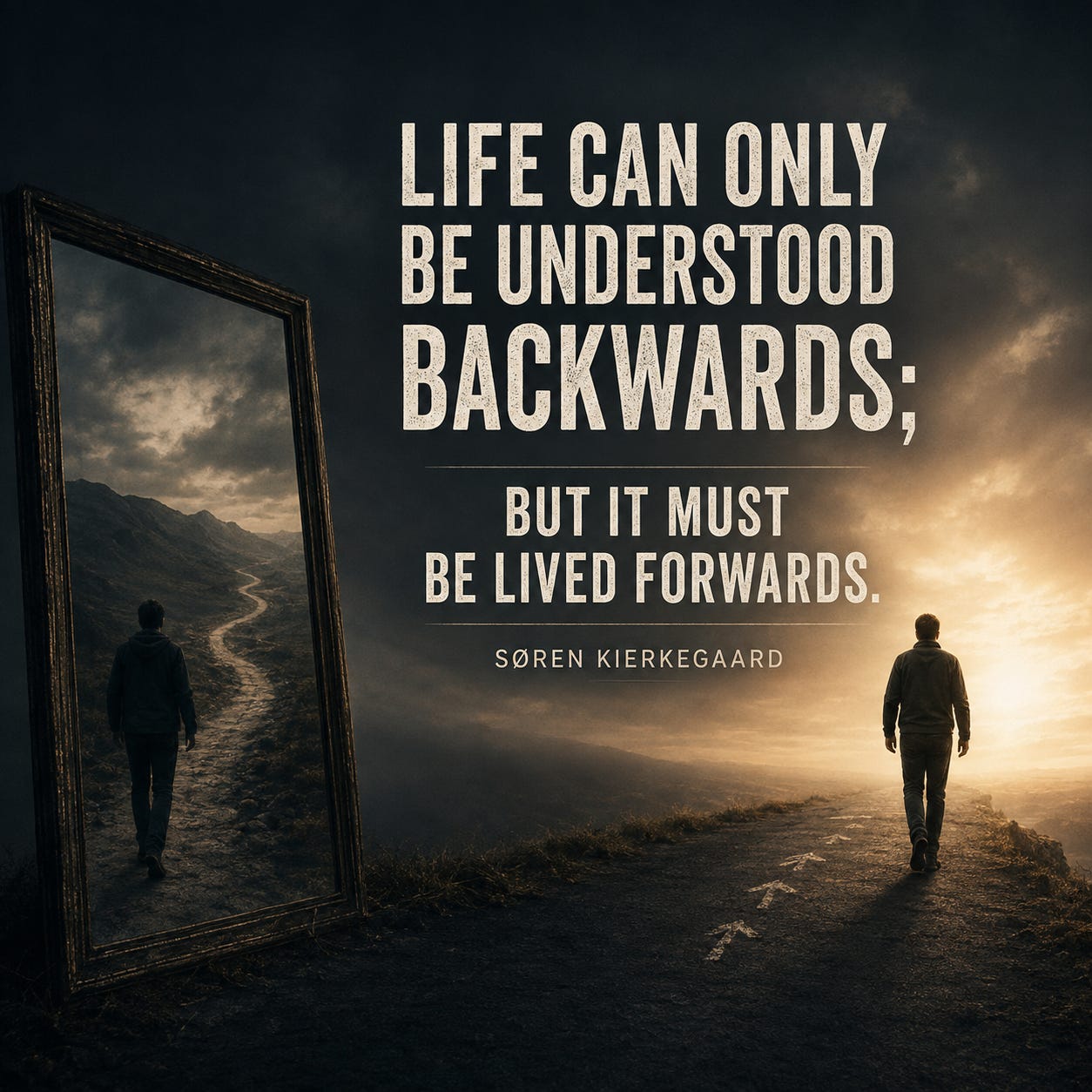
“Life can only be understood backwards; but it must be lived forwards.”
Søren Kierkegaard penned that entry in his journals in 1843, not a tech founder on stage at a key note. Yet the modern tendency to misattribute or strip away the roots of profound thoughts says everything about how we consume wisdom today. We hear a line, it sounds like an actionable framework, and we assign it to whichever modern figure feels most credible in the moment. Nobody checks. The idea gets detached from its origin—which is fitting, because the entry itself is about the structural limits of looking back in the first place.
Here is the part people skip past: the quote isn’t really about hindsight being useful. Everyone already knows hindsight is useful. It’s about the trap hidden inside that usefulness.
You can only make sense of your life in reverse. The failed relationship makes sense once you see the pattern. The wrong job makes sense once you see what it taught you. The bad year makes sense once you’re far enough from it to see the shape. All of that is real. But none of it was available to you at the precise moment you had to decide.
That’s the paradox of human experience. Clarity arrives after the moment that required it.
Borrowed Hindsight vs. Real Foresight
Because this temporal lag creates acute anxiety, people try to cheat the sequence. They try to live forward as if they already possess the backward view. They want the lesson without paying for the experience.
They read the self-help book, absorb the mental model, study the post-mortem of someone else’s startup, and think they’ve skipped a step. They haven’t. They’ve just borrowed someone else’s retrospective map and mistaken it for their own foresight.
In The Black Swan, Nassim Nicholas Taleb highlights this exact human flaw through the concept of the narrative fallacy: our vulnerability to over-interpreting facts and constructing clean, logical stories after the fact. We look backward, smooth out the chaotic noise into a neat line of cause-and-effect, and pretend the outcome was predictable all along.
“The narrative fallacy addresses our inability to look at sequences of facts without weaving an explanation into them... Explanations bind facts together. They make them all the more easily remembered; they help them make more sense.”
— Nassim Nicholas Taleb, The Black Swan
When a mentor tells you what they learned from a failed company or a wasted decade, you nod because the narrative is compelling. Then you go make a version of the exact same mistake anyway.
It’s not because you weren’t paying attention. It’s because their understanding was built backwards from their specific, unrepeatable terrain, while you are standing at the front end of a completely different one. As the novelist Rebecca Solnit observed in A Field Guide to Getting Lost, true experience requires stepping into the unknown rather than trying to map it out beforehand:
“Leave the door open to the unknown, the door into the dark. That’s where the most important things come from, where you yourself came from, and where you will go.”
— Rebecca Solnit
The Condition of Being Alive
None of this implies reflection is useless or planning is a waste of time. It simply means holding your plans loosely. You will always execute your next move with less information than you’ll have later.
That gap isn’t a flaw in your judgment; it is the baseline condition of being alive. You are permanently one step ahead of your own understanding. Most catastrophic decisions don’t come from moving too fast, but from assuming you already possess backward clarity while still standing in the middle of forward motion.
Psychologist Daniel Kahneman famously captured this cognitive blind spot in Thinking, Fast and Slow:
“A general limitation of the human mind is its imperfect ability to reconstruct past states of knowledge, or beliefs that have changed. Once you adopt a new view of the world, you immediately lose much of your ability to recall what you used to believe before your mind changed.”
— Daniel Kahneman
The people who move well through uncertainty aren’t the ones who have eliminated it through rigorous planning. They are the ones who have made peace with acting inside it. They make a choice, step into the dark, and let the meaning catch up later—knowing it always does, just never on schedule.
You don’t get to understand your life while you’re living it. You only get to live it, and understand it after. Anyone selling you a way around that sequence is selling a shortcut that doesn’t exist.