


There is a version of you that exists before the evidence does. He knows how to do the thing before he has done it once. He talks like a professional before anyone would pay him like one.
This isn’t delusion, it’s the mechanism that precedes every real transformation. Almost nobody talks about it honestly because it sounds arrogant until it works.
The Rehearsal Before the Result
Cassius Clay called himself the greatest before he had won a single title fight. Not after. Before.
He said it enough times that the claim stopped being a boast and started being a rehearsal. The belief came first, and the ability spent years catching up to it.
“I figured that if I said it enough, I would convince the world that I really was the greatest.”
— Muhammad Ali
Most people get this story backwards. They assume he became great and then started saying so. In reality, he said so and then built a life that made the sentence true.
This is the part self-help culture gets wrong on purpose. “Believe in yourself” sells better as a poster than as an operating principle, but the real version is far less comfortable:
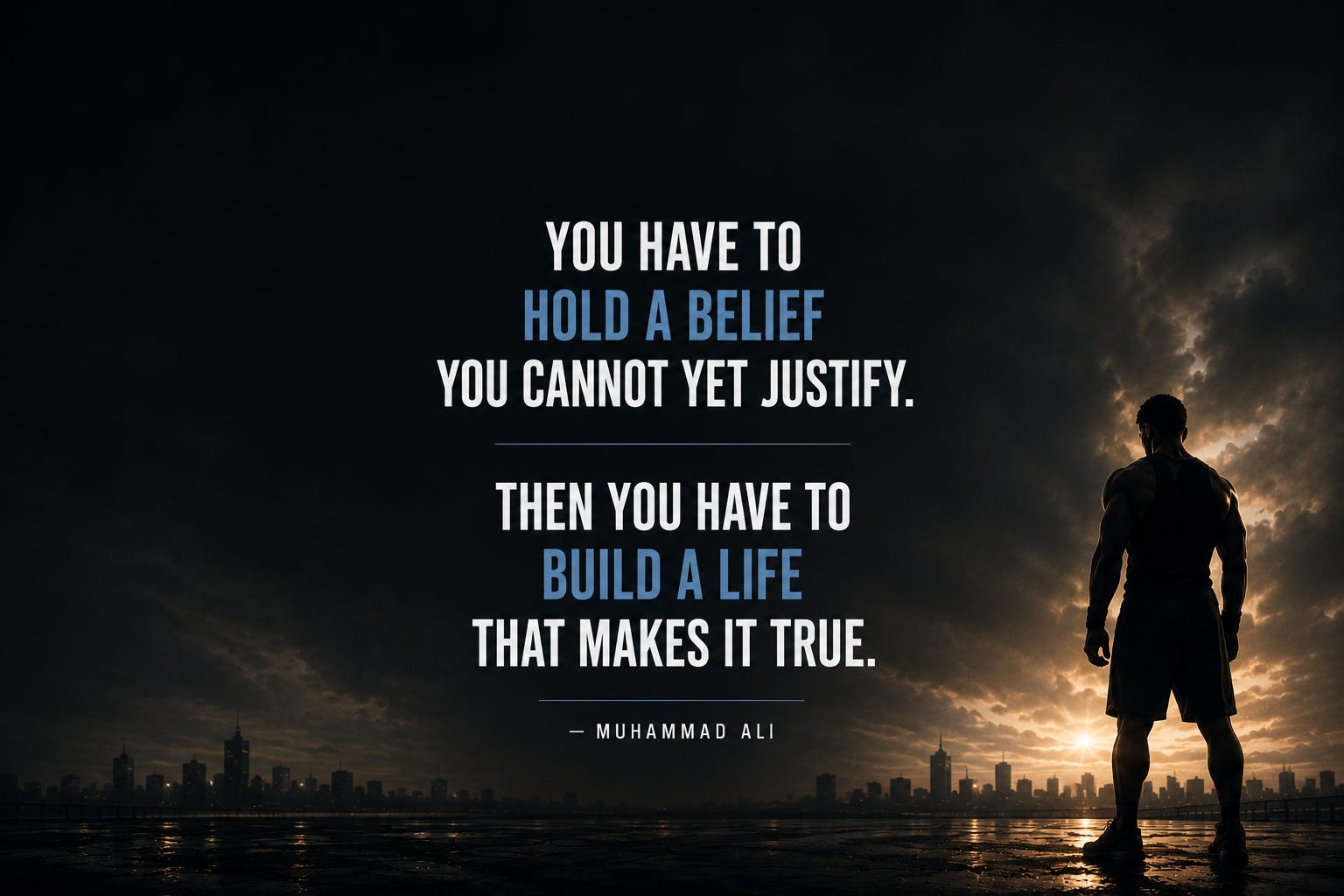
You have to hold a belief you cannot yet justify.
You have to act on a skill you do not yet possess.
You have to inhabit a long gap where you look and sound like someone pretending.
That gap is not a flaw in the process. It is the process.
Overcoming the Structural Gap
In his letters, Seneca gave us one of the most enduring observations on human nature:
“We suffer more often in imagination than in reality.”
— Seneca the Younger
The inverse is just as true and far less discussed: we underestimate in imagination what we could become in reality.
Imagination is downstream of current ability, and current ability is always the smallest, most conservative estimate of what a person is capable of. If you only visualize what you already know how to do, you have built a ceiling and called it a plan.
Visualization gets dismissed as soft because athletes and executives have turned it into a wellness ritual: close your eyes, picture the win, feel the feeling. That’s the diluted version. The real function of visualization is structural, not emotional. It is rehearsing a version of competence your nervous system has not built yet.
Michael Phelps didn’t just visualize winning—he visualized the mechanics, the friction, and the emergency scenarios:
“I visualized every scenario: if my goggles filled up with water, if my suit ripped, if I felt terrible... I had already played out the race thousands of times in my mind before I jumped off the block.”
— Michael Phelps
When his goggles actually filled with water at the 2008 Beijing Olympics, he didn’t panic. He needed a body that had already run the tape, and his mind had provided it.
Belief without rehearsal is just optimism. Rehearsal without belief never gets started at all.
Identity Drags Competence
Here is the mechanism most people miss entirely: ability is not a precondition for commitment; it’s a consequence of it.
You do not wait until you can write well to call yourself a writer. You call yourself one badly for long enough that the label starts pulling the skill toward it. The identity comes first and drags competence behind it like a rope.
Reverse that order, and you get what most people actually do: waiting for permission that never arrives, because the permission was never external to begin with.
The Work Behind the Claim
This is uncomfortable to admit because it sounds like an endorsement of arrogance or fraud. It isn’t. There’s a vital distinction here:
Fraud: Claiming an ability you actively refuse to build.
Growth: Claiming a direction you are actively walking toward under real strain.
Ali trained obsessively. Phelps swam more meters before breakfast than most people swim in a year. The belief was never a substitute for the work—it was the thing that made the work bearable when there was no proof yet that it would pay off.
Marcus Aurelius captured this exact dynamic of moving through discomfort:
“The impediment to action advances action. What stands in the way becomes the way.”
— Marcus Aurelius
Most people read that as a line about obstacles, but it’s actually about sequencing. The obstacle exists in the space between belief and ability, and it is not there to be avoided. It is where the person you are trying to become gets built. Skip it and you skip the only part that matters.
The Failure Modes
Sustaining this process requires balancing two distinct traps:
Believing without acting: This curdles into fantasy.
Acting without believing: This curdles into burnout, because there is nothing underneath the effort to sustain it when results are slow.
You need both running at the same time—out of sync with your current evidence, uncomfortable the entire way through.
Belief Only: Vision without strain —> Fantasy
Action Only: Grind without identity —> Burnout
Belief + Action: Identity pulling ability forward —> Transformation
Nobody tells you how long the gap lasts. It can be years of sounding like someone you are not yet, doing work that doesn’t yet look like the thing you claim to be building.
The people who quit in that window mistake the discomfort for proof that they were wrong. The people who don’t quit understand that the discomfort was the entire deal from the start—priced in, expected, and never optional.
You are allowed to believe something about yourself that the evidence hasn’t caught up to. You are not allowed to stop there. Belief buys you the right to start. Only the work buys you the right to keep the claim.
Sources & References
Muhammad Ali Quote: Ali, Muhammad, and Richard Durham. The Greatest: My Own Story. Random House, 1975.
Seneca Quote: Seneca, Lucius Annaeus. Moral Letters to Lucilius (Epistulae Morales ad Lucilium), Letter 13: “On Groundless Fears.” c. 65 AD.
Michael Phelps Quote: Phelps, Michael, and Alan Abrahamson. No Limits: The Will to Succeed. Free Press, 2008.
Marcus Aurelius Quote: Aurelius, Marcus. Meditations, Book V, Section 20. c. 161–180 AD.