


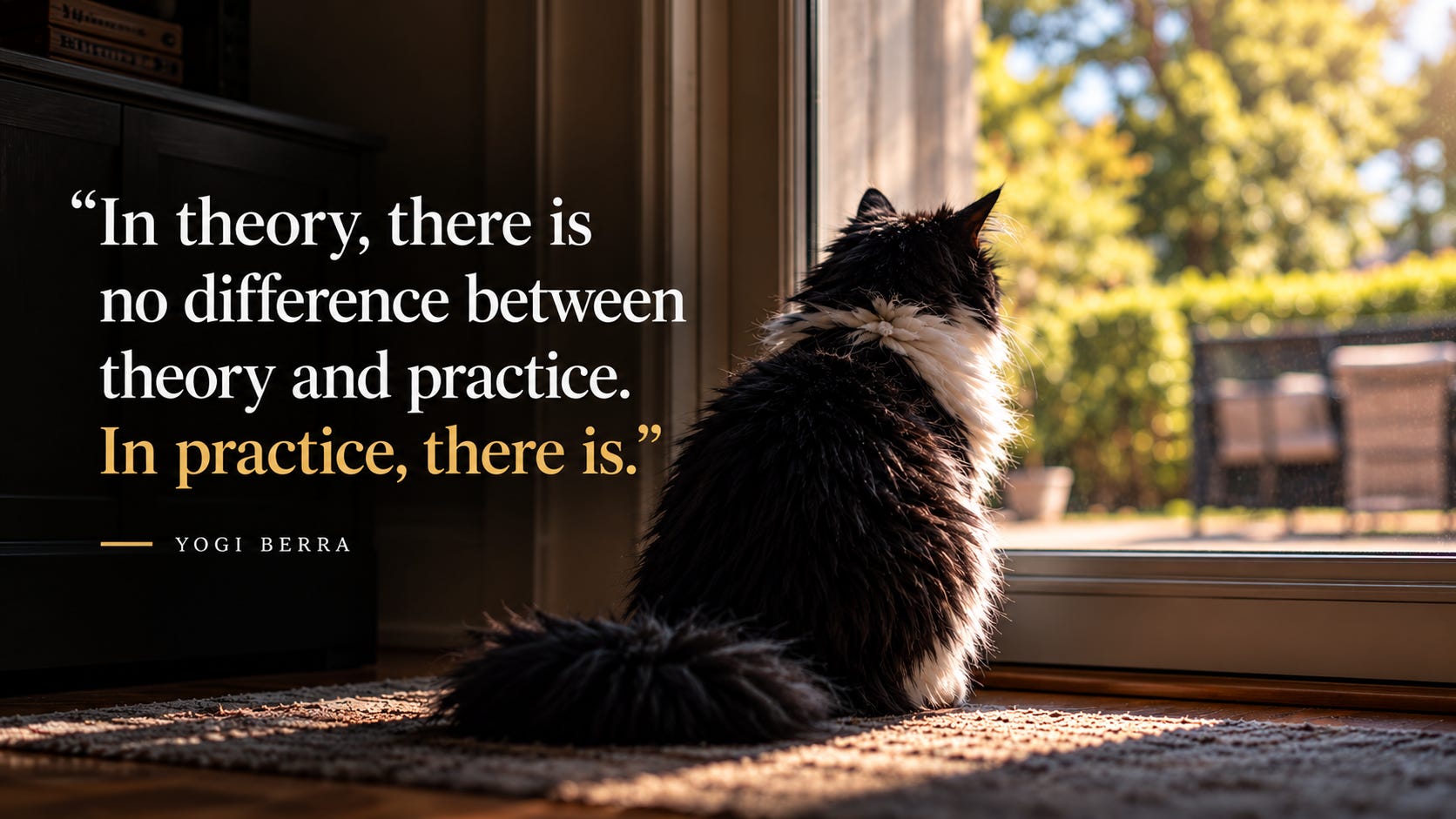
When we lived in Huntersville, North Carolina, we had a young boy and my wife had two cats, Teddy and Sophie. Sophie was sweet. Teddy was an asshole.
Teddy wanted to be outside more than he wanted anything. In his head he was half dog and all predator, the alpha of the neighborhood who just hadn’t been given the chance to prove it yet. He sat at the door and begged, and when we ignored him he begged some more. Eventually we gave in. He kept asking, so we figured we’d open the door and see what happened.
What happened was a loud noise from the yard. Teddy had found a proper outdoor cat, and the outdoor cat had kicked his ass. By the time we got to the door he was trying to get back in, ruffled and scuffed and nowhere near as alpha as he’d been ten minutes earlier.
A couple of days later he was back at the door asking to go out.
We didn’t let him. He got out once more by accident, and this time he didn’t go looking for a fight. He hid the entire time he was out there.
What the Cat Taught Me
Teddy looked at the yard and saw something better than the house. That’s the oldest mistake there is. The grass on the other side isn’t necessarily greener (although the grass outside literally was greener), and even when it is, someone already lives on it who knows the ground better than you do.
The outdoor cat wasn’t tougher because it was bigger, it was tougher because it had been out there every day, learning how a fight goes, while Teddy was inside waiting for someone to fill his bowl. He brought house skills to a yard fight and got exactly what that deserves.
I see people do the same thing all the time. They quit a stable job before they’ve built the institutional muscle the next arena demands, or they buy into a complex industry on sheer optimism before they know how to survive a downturn. They head out on confidence they got entirely from looking through the window, take a heavy hit, back off, lie low for a while, and then turn up at the door again asking for another go with the exact same tools that failed them the first time.
Cognitive psychologists call this the illusion of competence, a mechanism first isolated in memory and metacognition research by Asher Koriat and Robert Bjork, which demonstrates how easily our brains mistake the fluent, effortless appearance of information for actual, hard-earned mastery. Later experimental work by researchers like Shana Carpenter reinforced that when people watch an expert operate fluidly in a specialized environment, they drastically mistake that passive observation for personal capability. You watch someone else command a room, scale an enterprise, or dominate a market, and because they make it look entirely natural from the sidelines, your mind tricks you into believing you have absorbed the execution by osmosis.
It’s the exact trap when I left Wrexham in the nineties to play College soccer. You get a head full of steam, convinced that raw momentum will carry you across the pond, only to find out that wanting a green pasture doesn’t mean you know how to graze on it. When the contract didn’t come through, I had to retreat, lick my wounds, and actually learn the mechanics of the new ground before I went back out there.
The Protocol
I’m not telling anyone to stay inside. Failing is fine, and being the house cat at the start is fine too, because that’s where everyone starts. If you want to go and look at the other side, go. Just do three things first.
Do your research before you walk out. Learn the ground. Figure out who already owns that patch of grass and how they hold onto it.
Sharpen your claws. Confidence won’t win the fight on its own, so build the actual skills you’ll need. Take your early losses somewhere they’re cheap, like a side project, a controlled simulation, or a smaller version of the bet where you don’t bleed out if you miss.
Learn from every trip out. If you turned left last time and ran into the cat that runs the yard, try right next time. Teddy never worked that out, because he’s a cat. You can. Every time you get knocked back you come home knowing something you didn’t, and it only counts if you take it with you on the next attempt.
So don’t be a house cat. Be a lion, and be a smart one, because until you’ve put the work in, you’re still a house cat with big ideas sitting at the glass.
Sources & Further Reading
Koriat, Asher, and Robert A. Bjork. “Illusions of competence in monitoring one’s knowledge during study.” Journal of Experimental Psychology: Learning, Memory, and Cognition 20, no. 4 (1994): 953–965. (Establishes the foundational cognitive research regarding how fluency of information leads to false assumptions of mastery).
Carpenter, Shana K., Katherine A. Rawson, Rachel E. Vanecek, and Keith J. Allen. “The illusion of competence in learning: Why studying easy material feels harder to remember later on.” Memory & Cognition 48, no. 2 (2020): 281–295. (Explores how passive observation and fluent presentation distort self-assessments of skill).