


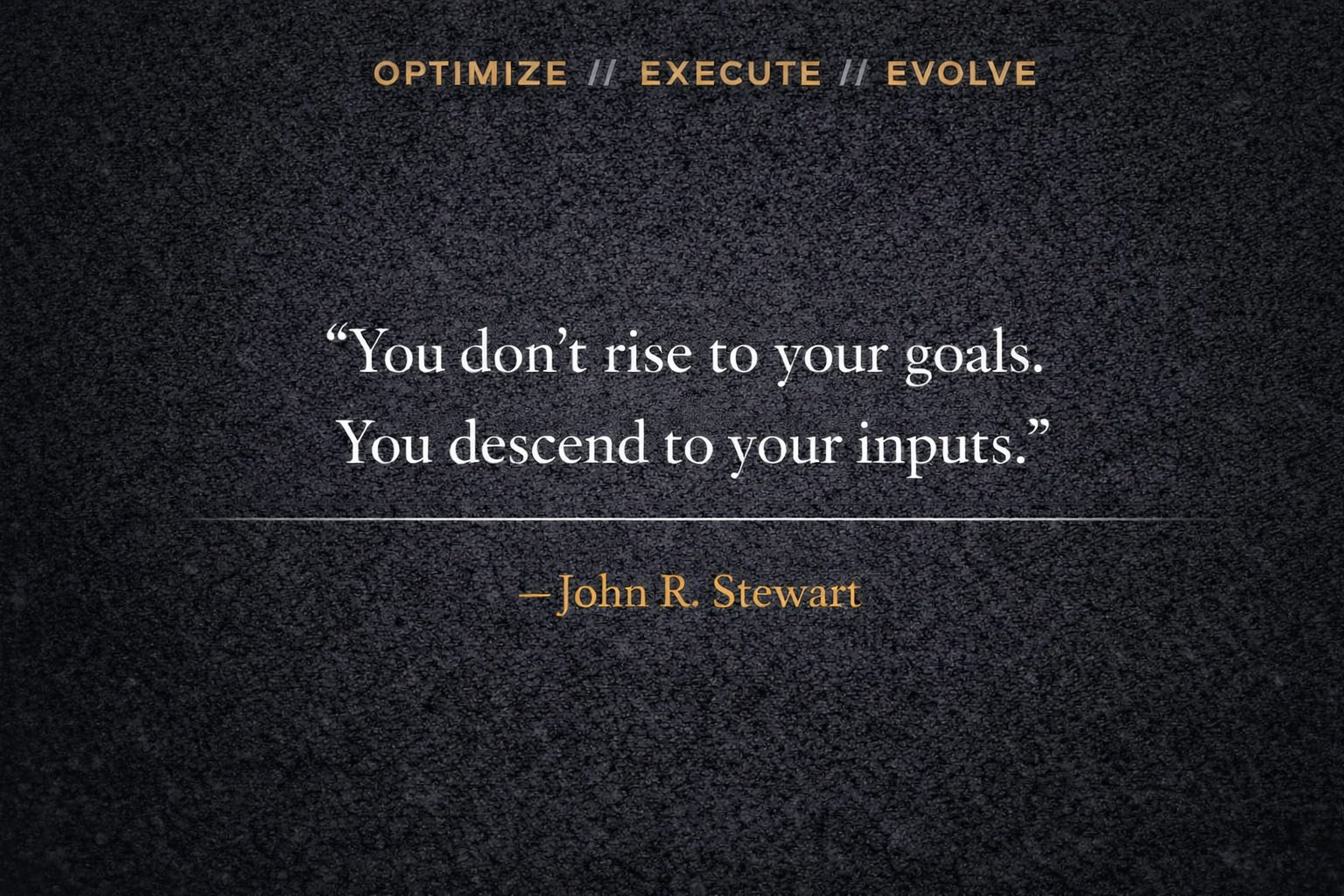
Most people obsess over output. They refine strategy, optimize workflows, and measure performance relentlessly. Very few apply the same scrutiny to input. Yet input precedes output. It shapes perception, and perception shapes judgment. If judgment drifts, trajectory drifts with it.
Performance is not only about what you do. It is about what you repeatedly expose yourself to.
The Invisible Environment
When people think about environment, they picture physical surroundings — desks, schedules, routines. But the more influential environment is informational.
The articles you open in the morning.
The tone of the commentary you follow.
The feeds you refresh when attention dips.
The conversations you immerse yourself in.
These create a cognitive climate.
The brain adapts to that climate automatically. It normalizes pace, emotional intensity, depth, and urgency. Over time, what once felt loud becomes baseline. What once felt shallow becomes sufficient. What once felt urgent becomes constant.
The shift is gradual. That is why it goes unnoticed.
Information Is Training
Every input functions as rehearsal.
If you repeatedly consume short-form content, you rehearse rapid shifts of attention and abbreviated thought. If you consume fragmented arguments, you rehearse fragmentation. If outrage dominates your informational diet, outrage becomes a familiar cognitive pattern. If you immerse yourself in sustained analysis and long-form reasoning, you rehearse depth.
The brain strengthens what it practices.
It does not distinguish between intentional study and casual exposure. Repetition shapes defaults either way. What feels natural to you cognitively is often just what you’ve rehearsed most often.
The question rarely asked is not what you believe — but what you are training your mind to do.
Noise Raises the Baseline
High-emotion content is not neutral. It elevates arousal. It increases perceived urgency. It narrows attention toward threat and novelty.
Over time, baseline stress rises subtly. Focus thins. Patience shortens. Everything begins to feel slightly more important than it is.
You may tell yourself you are “just staying informed.” But your nervous system registers patterns, not intentions. Repeated volatility conditions a volatile baseline.
This does not happen dramatically. It happens quietly.
And once that baseline shifts, perception follows.
Noise vs. Signal
Noise captures attention quickly and produces stimulation. Signal compounds slowly and reshapes thinking.
Noise creates reaction.
Signal builds capability.
Noise feels productive because it occupies the mind. Signal is productive because it restructures it.
The Input Protocol is not about abstinence. It is about filtration.
It asks: Does this increase clarity? Does it deepen understanding? Or does it merely intensify emotion?
There is nothing inherently wrong with entertainment. The problem arises when stimulation masquerades as development.
Replacement, Not Removal
Elimination alone rarely lasts. Remove distraction without replacing it, and boredom will eventually reintroduce it.
The durable approach is substitution.
Replace reactive commentary with primary sources. Replace infinite scroll with finite formats — books, long-form essays, structured analysis. Replace ambient consumption with deliberate blocks of learning.
Narrow the aperture. Deepen the signal.
Clarity is rarely the result of volume. It is the result of filtration.
Compounding Perception
Inputs compound quietly.
One day of noise does little. Months of it reshape perception. One month of depth feels incremental. Years of depth alter trajectory.
Most people measure effort. Few measure conditioning.
Yet conditioning determines what feels normal. And what feels normal determines what you tolerate, what you pursue, and what you ignore.
Selection becomes distorted long before results do.
Upstream of Everything
Input sits upstream of every other protocol.
You cannot regulate stress effectively if your informational environment keeps elevating it. You cannot protect focus if your inputs fragment it daily. You cannot apply Pareto honestly if your sense of importance has been conditioned by repetition.
Perception drives allocation. Allocation drives outcomes.
If perception is noisy, everything downstream suffers.
Final Thought
You become what you repeatedly consume.
Not instantly. Gradually.
If your informational environment is chaotic, your thinking will reflect it. If it is deliberate, your trajectory will be as well.
Control the signal.
Everything downstream depends on it.
Performance Protocol is a system-first approach to human performance — built on physiology, recovery, and real-world constraints.
Each article is a layer in the same framework.
No hacks. No hype. Just structure.