


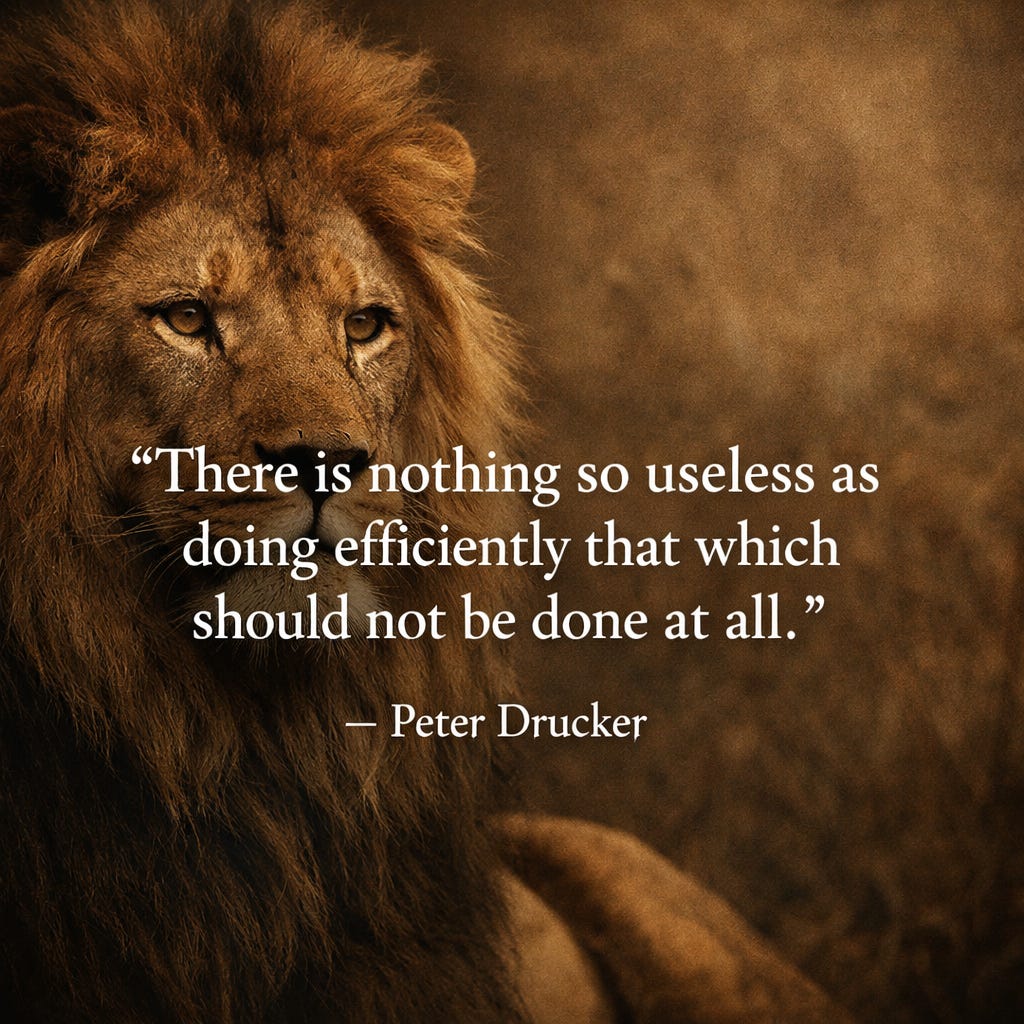
Most ambitious professionals do not suffer from laziness. They suffer from diffusion. Their calendars are full, their Slack notifications never stop, and their task lists grow faster than they shrink. From the outside, it looks like momentum. In reality, it is grazing.
The Lion vs. Cow Principle is not about intensity. It is about energy strategy. It is about the difference between constant consumption and selective aggression. And in modern work, almost everyone defaults to the cow.
The Cow: Continuous Motion Without Leverage
A cow survives by grazing all day. It keeps its head down and consumes whatever is directly in front of it. There is no selection, no urgency, no decisive movement. Survival is volume-based.
In professional life, grazing looks productive. You answer emails quickly. You sit in back-to-back meetings. You run incremental experiments. You tweak copy, adjust buttons, refine decks, and respond to every incoming request. You are busy, responsive, and exhausted.
The problem is not effort. The problem is misapplied effort.
This is where Parkinson’s Law quietly takes control. Work expands to fill the time available for its completion. If you do not define a clear target with a defined constraint, the low-leverage tasks will happily consume your entire week. The trivial becomes urgent simply because it is available.
Grazing feels safe because it spreads risk. If you are working on ten initiatives, you can blame complexity. If results are marginal, you can blame the environment. Motion becomes a shield against accountability.
But motion is not leverage.
The Lion: Selective Aggression and Constraint
A lion does not chase every animal it sees. It observes. It studies terrain and timing. It waits for alignment — position, weakness, opportunity. Then it commits with force.
The sprint is short, violent, and decisive. It is not half-hearted. It is not hedged. It is not multitasked.
This is where Pareto’s Principle becomes real. Twenty percent of actions produce eighty percent of outcomes. Most leaders understand this intellectually. Very few operationalize it. The challenge is not identifying the 20%. The challenge is having the discipline to ignore the other 80%.
Selective aggression requires constraint. It requires saying no to good ideas in order to pursue the right one. It requires shortening timelines so that Parkinson’s expansion cannot take over. It requires defining success clearly enough that you cannot hide behind busyness.
The lion does not improve everything. It eliminates one constraint at a time.
Why Focus Feels Dangerous
True focus exposes you.
If you define one objective that would materially change your position over the next 30 to 60 days, you remove your excuses. Now the outcome is clear. Either the needle moves, or it does not. There is no fog of activity to hide behind.
This is why grazing persists. It protects the ego.
In product organizations, this shows up as bloated roadmaps and endless experimentation without prioritization. In personal performance, it shows up as reactive days filled with low-stakes tasks that never require decisive courage.
But decisive execution is what changes position.
The Pareto–Parkinson Collision
When poor focus meets unlimited time, something predictable happens. The 80% of low-impact work fills the calendar. The high-leverage objective remains important but unaddressed. It grows psychologically larger with every week of avoidance.
Eventually, it feels overwhelming. So you return to smaller tasks for relief. The cycle repeats.
The Lion vs. Cow Principle breaks that cycle by enforcing two rules: focus on the bottleneck and apply constraint.
Find the constraint in your system. In Product Led Growth, that might be activation, time-to-value, or pricing clarity. In your personal output, it might be uninterrupted deep work or a single high-stakes conversation you keep postponing.
Then design your week around attacking that constraint first.
Not after the inbox. Not after the meetings. First.
The Lion Operating Model
Operating like a lion does not mean reckless aggression. It means structured selectivity.
First, define the hunt. Identify the single objective that would materially shift your trajectory if solved. Be specific. Vagueness invites grazing.
Second, apply constraint. Shorten the timeline. Limit scope. Reduce parallel initiatives. Constraint suffocates Parkinson’s expansion.
Third, eliminate distraction. Do not “manage” the 80%. Delay it, delegate it, or delete it. Focus is subtraction before it is intensity.
Fourth, execute with total commitment. When it is time to move, remove every competing input. Deep work is not a preference; it is a condition for decisive output.
Finally, recover intentionally. Intensity without recovery collapses into noise. The lion rests not from weakness, but to preserve force for the next hunt.
The Core Distinction
Cows optimize for continuous comfort. Lions optimize for positional gain.
Cows stay active. Lions move territory.
The marketplace does not reward motion. It rewards decisive force applied to the right constraint at the right time.
You do not need more activity. You need fewer targets, tighter deadlines, and the courage to commit fully to the 20% that actually matters.
You can graze indefinitely and remain busy.
Or you can hunt — and change your position.
Performance Protocol
Performance Protocol is a system-first approach to human performance — built on physiology, recovery, and real-world constraints.
Each article is a layer in the same framework.
No hacks. No hype. Just structure.