


There is a specific kind of hell that has nothing to do with fire. It is much quieter than that.
It’s meeting the version of yourself who took the opportunities you didn’t.
Same starting point. Same neighborhood. Same broken car idling in the driveway. Same parents who didn’t understand what you were trying to build. He had all of it, too—he just did something with it.
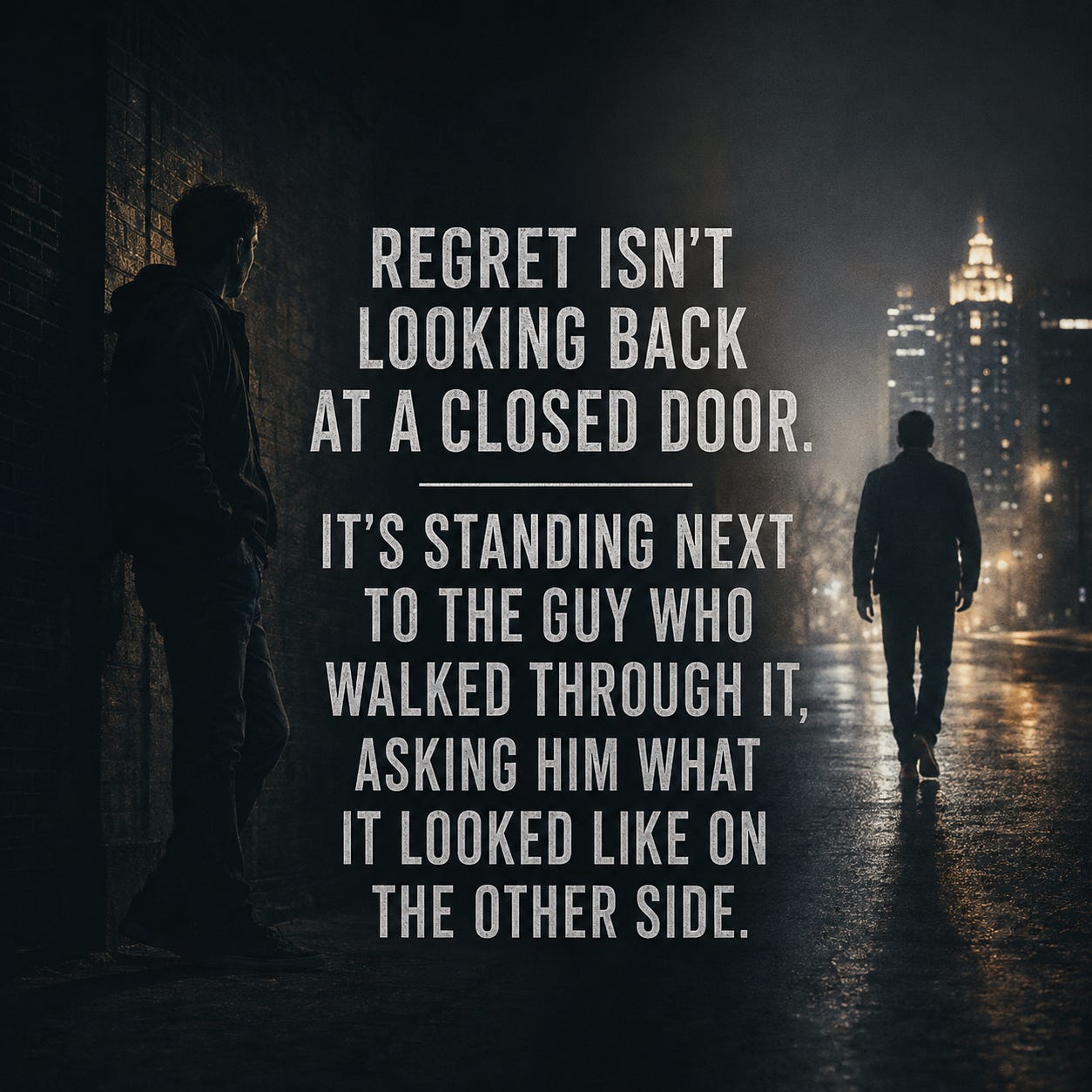
“Regret isn’t looking back at a closed door. It’s standing next to the guy who walked through it, asking him what it looked like on the other side.”
As F. Scott Fitzgerald famously observed, “Our lives are defined by opportunities. Even the ones we miss.” You had the same raw material. The other guy just built something out of it.
The Architecture of Alibis
Most people construct their entire identity around the idea that their circumstances were a ceiling: the town with no industry, the lack of capital, the family that didn’t push.
Hardship is real. It costs real time and energy that others never had to spend. Nobody is pretending the terrain was flat. But the story people tell themselves usually ends at the obstacle—because the obstacle is the exact explanation that permits them to stop looking.
Key Insight: We often mistake our starting conditions for our speed limits. Hardship explains the friction of the terrain, but it rarely explains why we stopped walking.
Here is the harder truth: Most people had a moment. One, maybe two. A window where the door was open, they knew it, and they stayed put.
Not because they couldn’t move, but because moving was uncomfortable. Because someone they respected told them to wait. Or simply because they were tired that week—and being tired for a week quietly turned into a decade.
The Qualifications Myth
The opportunity wasn’t rare. It showed up. In fact, it’s probably showing up for you right now, disguised as an inconvenience or demanding a version of you that doesn’t exist yet.
That’s the trap.
People wait to become the person capable of taking the opportunity, completely missing the fact that the opportunity is what builds the person.
Consider Richard Branson’s practical rule on unready action: “If somebody offers you an amazing opportunity but you are not sure you can do it, say yes—then learn how to do it later!”
The breakdown is simple:
Waiting to feel qualified leads to stagnation masked as preparation.
Stepping through unqualified forces growth through immediate friction.
You don’t get qualified first and then step through. You walk through underqualified, building capability in real time—usually while embarrassed, and almost always doing it worse than you’d like.
The Stoic philosopher Seneca framed it thousands of years ago: “Luck is what happens when preparation meets opportunity.” But the modern truth goes one step further: sometimes taking the opportunity is the preparation.
“The guy who took the shot wasn’t smarter than you. He was just willing to be bad at something in public for a while.”
The Cost of Deliberation
The tragedy isn’t that you lacked ambition; it’s that you traded momentum for certainty.
Theodore Roosevelt called this out when describing the critic versus the man in the arena—the person who sits on the sidelines measuring risks while another man gets dirty, stumbles, and comes up short again and again because there is no effort without error.
When you spend years “preparing to be ready,” you aren’t preparing. You are rehearsing hesitation.
Breaking the Loop
Mourning the ghost of who you could have been is a closed loop. It generates the exact same paralysis that created the gap in the first place.
The real work is noticing that the mechanism hasn’t changed.
There is a door in front of you right now that you are giving a different name:
“Bad timing.”
“Lack of resources.”
“Need to prepare more.”
Look at it honestly. It is the exact same shape as the one you walked past ten years ago.
The Mindset Shift: Stop asking what you need to become before you take the leap. Ask who you will become after you take it—badly, awkwardly, and without the perfection you’ve been demanding as a prerequisite.
The man you could have been isn’t a mythical figure living in a parallel universe, forever out of reach. He is simply what happens when you stop expecting opportunity to arrive cleanly wrapped.
The nightmare was never that he was given more.
The nightmare is realizing he wasn’t.