


The Subtraction Problem
Everyone sold you productivity. What they didn’t tell you is what you’d pay for it.
The pitch was simple. AI handles the mechanical work, you focus on the thinking. Delegate the low-value tasks, elevate the high-value ones. On paper, that’s a reasonable trade. In practice, it doesn’t work like that, because the line between mechanical and meaningful turns out to be much harder to hold than anyone admitted.
You start with formatting and research aggregation. Then first drafts of things that feel routine. Then responses to emails that require a degree of nuance you don’t have time for right now. Then the thinking itself, because thinking is slow and the tool is fast and the output is good enough that nobody notices the difference.
Nobody except you. Eventually.
“The irony of automation is that by mechanizing routine tasks, you deprive the user of the routine opportunities to practice their judgment and strengthen their cognitive musculature, leaving them atrophied.” — Carnegie Mellon / Microsoft Research on Cognitive Decay
The Architecture of Cognitive Atrophy
The capacity to think independently is not a fixed asset but rather a perishable one. You use it or it degrades, the same way cardiovascular fitness degrades when you stop training, the same way you lose the ability to navigate a city when you stop navigating and let the phone do it instead.
The body and mind are adaptive systems. They shed what isn’t being demanded of them.
This is what nobody is saying clearly enough. The risk of AI is not that it replaces your job. It’s that it replaces you, quietly, over eighteen months of small surrenders that each feel completely reasonable in the moment.
You won’t notice until you sit down to write something from scratch and the words don’t come the way they used to. Or you’re in a room where no tool is available and you can’t hold a complex argument in your head long enough to do anything with it. Or you pick up a book and can’t finish a chapter because your attention has been restructured around consuming outputs rather than generating thought.
By the time you notice, the atrophy is already deep.
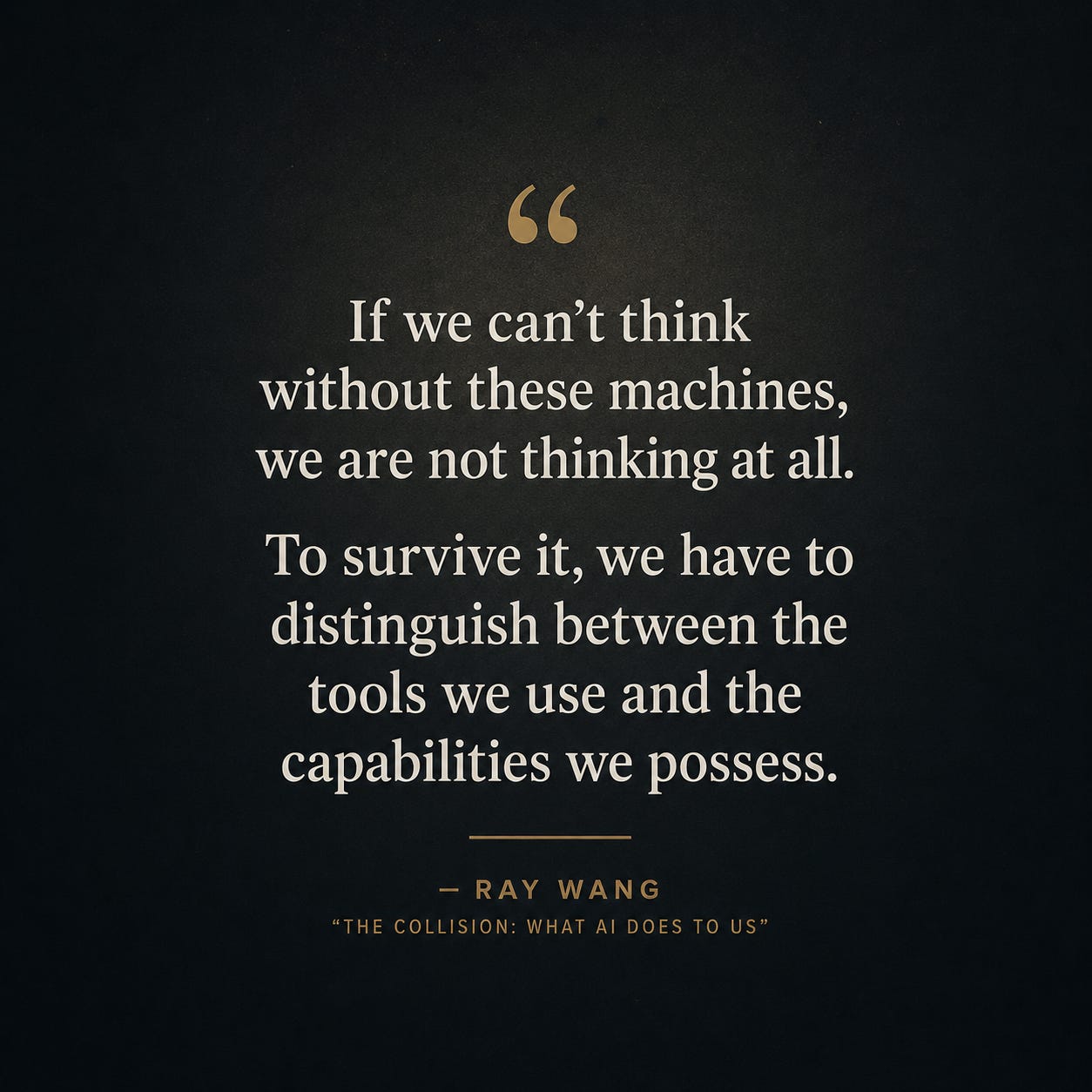
“If we can’t think without these machines, we are not thinking at all. To survive it, we have to distinguish between the tools we use and the capabilities we possess.” — Ray Wang, “The Collision: What AI Does to Us”
The High Price of Low Friction
The word atrophy matters here because it changes the nature of the problem. Atrophy is not a habit you break; it’s tissue loss. You don’t recover lost cognitive capacity through motivation or intention. The only answer is prevention, and prevention requires you to be deliberate about what you protect before the degradation starts, not after.
So what’s worth protecting?
The activities that make you generative rather than reproductive:
Reading without summarization tools: Where you have to hold the argument yourself and feel the discomfort of a difficult idea before it resolves.
Writing before generating: Because the struggle of finding your own words is not inefficiency—it’s the actual work of thinking.
Sitting with a problem: Staying in the room long enough to feel stuck, because the friction is not a sign that you need a better tool. It’s the friction that produces original thought.
These aren’t productivity rituals. They’re maintenance of the underlying system that makes any of your output worth anything.
“When users bypass the difficult processes of synthesis and articulation, they also bypass the deep encoding essential for memory and intellectual ownership. The user becomes a spectator to their own output.” — Neurological study on ‘Cognitive Debt’
The Protection Protocol
The framework is not complicated, but it requires honesty about what AI is actually doing in your workflow.
The Line: Use it exclusively for what doesn’t require you. Research, aggregation, formatting, mechanics. Be fanatically strict about that boundary.
The First Hour: Protect the first hour of any serious cognitive work. No generation, no prompting, no outputs to react to. Think first. Write first. Struggle first. Ensure the thinking happens before it gets papered over by something faster.
The Analog Layer: Read physically and regularly. Long-form, no tools, no annotations layer. Track a complex argument across fifty pages and synthesize it into something original. It will go if you don’t use it.
The Friction Test: Be honest when you notice yourself reaching for AI not because the task is mechanical, but because the task is hard. That instinct is the thing to fight.
The Core Reality: The goal was never to produce more. The goal was to think better, build something real, and be the kind of person who could do both without the tool as a crutch.
AI can help with that. It can also quietly hollow it out. Which one it does depends entirely on what you decide to protect.
Performance Protocol publishes frameworks for physical durability, cognitive performance, and behavioral execution at performanceprotocol.ai.