


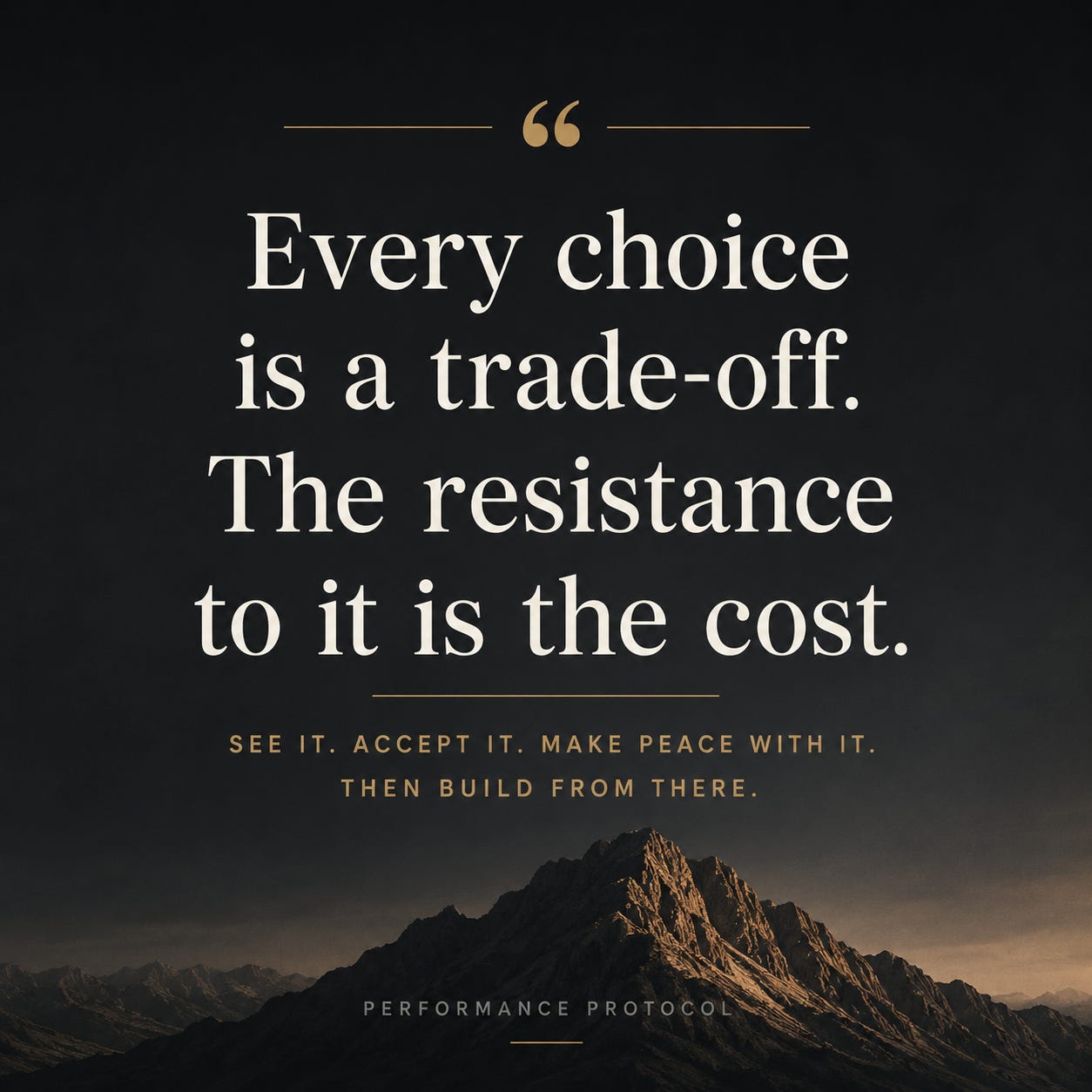
Every choice is a trade-off. Not a problem to solve. Not a design flaw in the human experience. The structure of reality.
When you say yes to one path, you are saying no to another. Always. There is no version of a meaningful life where this isn’t true. The people who try to escape it don’t succeed. They just make trade-offs unconsciously, which is worse, because you can’t make peace with something you never admitted you chose.
The cost isn’t the problem. The resistance to it is.
Most of the internal friction people carry doesn’t come from the choices they made. It comes from the refusal to accept what those choices cost.
They want the career and the unhurried presence at home. The peak physical condition and the effortless social life built around food and drink. The business and the relaxed evenings. When reality makes clear they can’t have both, they don’t grieve the loss cleanly. They convert it into resentment, distraction, a low-grade dissatisfaction that colors everything.
Naval said it directly: “One of the most important decisions you can make is who you allow to disturb your peace.” Most people read that as advice about other people. It isn’t. The loudest disturbance is internal. It’s the voice that keeps reopening decisions you already made, relitigating choices that are no longer available to change.
Clarity about what you chose changes how you carry it.
When you make a trade-off consciously, you see the cost, you accept it, you move. The demanding career means less free time. You know that. You stop pretending otherwise. The clarity doesn’t erase the loss but it stops the loss from becoming confusion. You’re not wondering why you’re tired. You chose this.
The unconscious version is a different problem entirely. You drift into a set of priorities through inertia, habit or social pressure and then feel vaguely cheated by consequences you never officially agreed to. That’s not a trade-off. That’s drift. And drift is its own trap because you can’t make peace with a life you never actively chose.
Marcus Aurelius wrote: “You have power over your mind, not outside events.” The trade-off lives in the outside event. The peace lives in the mind. But only if the mind is honest about what it actually decided.
Peace is not indifference to the cost.
This is the part people misread. Being at peace with your trade-offs doesn’t mean the cost doesn’t matter. It means you stop treating the cost as evidence that you made the wrong choice.
The cost is just the cost. You paid it because something else mattered more to you.
The person who chose depth over breadth, who went narrow and specific while their peers stayed broad, who turned down opportunities that didn’t fit the direction they’d committed to. That person still feels the weight of unchosen paths sometimes. They still wonder. But they don’t spin. They don’t confuse feeling the loss of a choice with having made the wrong one.
Seneca said time alone is ours. Everything else belongs to someone or something else. Every trade-off is ultimately a transaction of time and what you allow it to become. Peace comes from making that transaction deliberately rather than by default.
The unlived life will haunt you more than the cost you paid.
Regret has two flavors. The regret of what you did and the regret of what you didn’t do. The research is consistent on which one compounds with age. People don’t lie awake haunted by the risks they took that failed. They lie awake haunted by the versions of themselves they never tested.
The trade-off you made consciously, the one where you saw the cost clearly and decided the return was worth it, that trade-off doesn’t usually produce the corrosive kind of regret. The kind that does is the trade-off you avoided entirely. The direction you never committed to. The life you managed around instead of into.
Make the trade-off. See it clearly. Name what it costs. Then stop carrying the cost as a grievance against yourself or the world.
You cannot build anything durable from a position of quiet resentment toward your own decisions. Peace isn’t passivity. It’s the foundation you build from after you’ve made your choice and meant it.
performanceprotocol.ai