


Most people treat recovery like it’s something that just happens to them. Time passes, the bad feeling fades, and they call that getting over it.
That’s not recovery. That’s just waiting.
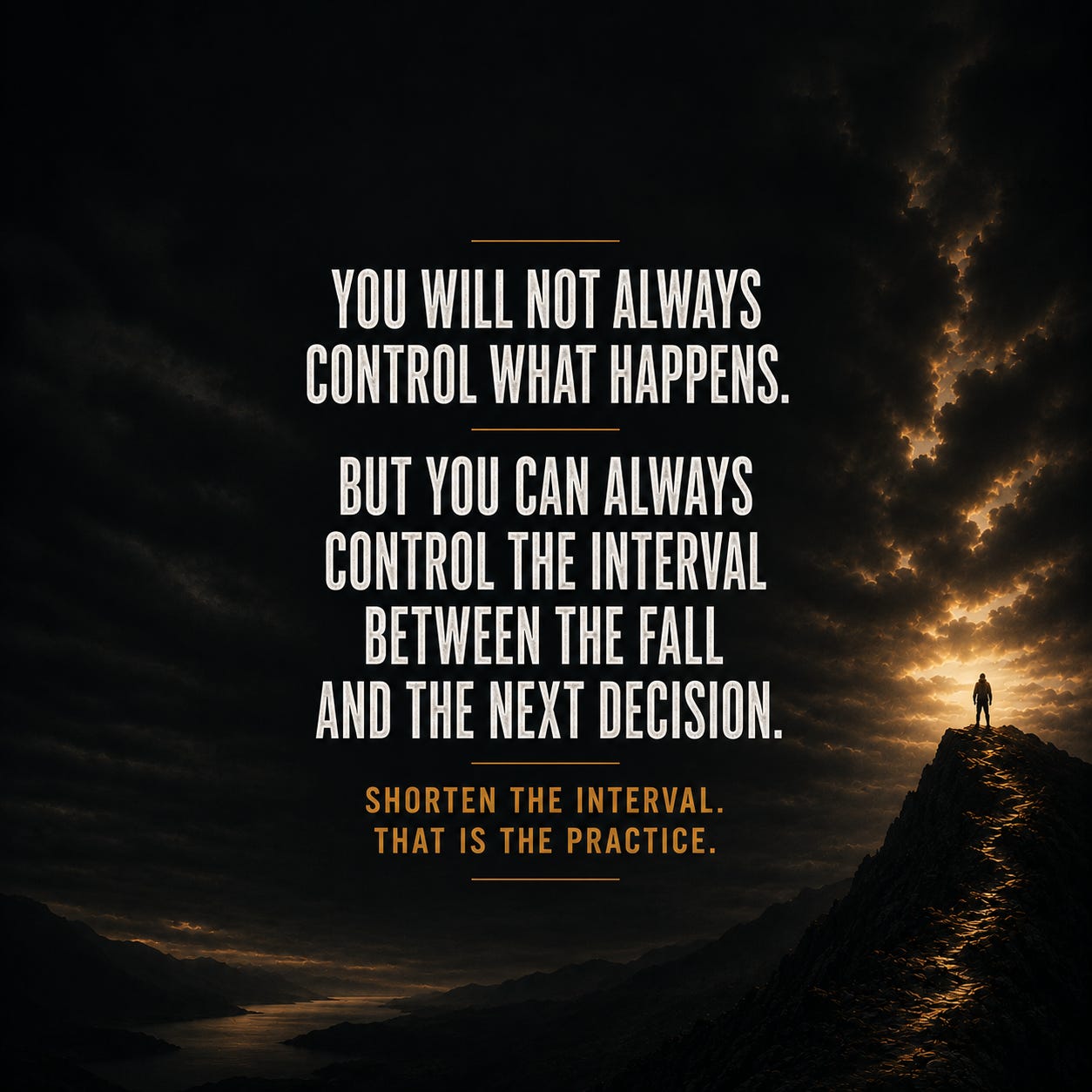
The actual skill is the interval—the precise amount of time that elapses between the fall and the moment you decide you are done falling.
1. The Myth of Passive Recovery
In physical training, there is a concept known as parasympathetic recovery. Your nervous system does not drift passively back into a calm state after an intense stressor; it has to actively shift gears. If you do not intentionally trigger that shift, your body remains on high alert, leaking energy and accumulating wear and tear.
The primary mistake most people make is treating a mental reset as a passive event rather than a deliberate choice. When you wait for a bad mood to “pass,” you are yielding control of your day to gravity. The reset requires an active, conscious pattern interrupt.
This distinction changes what you are responsible for. You are not responsible for the initial shock or the unexpected setback, but you are entirely responsible for how long you let it run the controls.
2. State Independence and Cognitive Carryover
When a morning goes sideways, most people let it carry forward. The hostile email before 9:00 AM becomes the lens through which they process the 11:00 AM meeting. The missed afternoon workout becomes a quiet permission structure that softens their discipline at dinner.
Psychologists refer to this as attention residue or cognitive carryover—the lingering mental load of a previous event that actively degrades your focus and decision-making capacity in the next environment. As organizational psychologist Sophie Leroy notes in her research on task transitions, when we leave a setback or an interrupted task unresolved in our minds, a portion of our neural bandwidth remains tethered to it, leaving fewer cognitive resources for the job right in front of us.
What you are training when you practice fast resets is state independence: the ability to keep the previous event from defining the current one.
Consider how this plays out across different domains:
The Athlete: In elite sports, carrying a mistake into the next play is a terminal diagnosis. As the viral sports mantra popularized by Ted Lasso puts it, you have to “be like a goldfish” because a goldfish only has a ten-second memory. When a quarterback throws an interception, the best coaches don’t ask them to analyze it on the sideline in agony—they establish what happened, extract the lesson, and reset for the next drive.
The Surgeon: A surgeon cannot let a complication in room A dictate their steady hand in room B.
The Executive: A leader cannot let a bad quarterly review bleed into a critical client pitch.
This is not a motivational platitude. It is a functional, mechanical necessity. State contamination is real, and its cost is measured in lost momentum and compound errors.
3. The Ego’s Trap: Penance as a Strategy
The hardest part of a fast reset is that the ego actively resists it. We have been conditioned to believe that staying in a bad state is a sign of taking things seriously. We think that if we snap out of a mistake too quickly, we are not giving the failure its due weight. We worry that moving on makes us look careless or unaffected.
This is entirely backward. Lingering isn’t accountability; it’s just friction wearing the costume of reflection.
Real accountability is fast. It is objective, clinical, and kinetic. You look at what happened, you extract whatever data is useful, and you pivot. Your processing does not need to be long to be honest. Lingering in the frustration is actually a form of self-indulgence—a way to feel like you are paying your dues without having to do the hard work of trying again.
The ancient Stoics recognized that fighting reality once it has occurred is the ultimate waste of energy. Epictetus framed this mindset cleanly: “Do not seek for things to happen the way you want them to; rather, wish that what happens happens the way it happens: then you will be happy.” The faster you accept the raw data of what just occurred, the faster you regain command of your actions.
4. The Micro-Reset Protocol
To build state independence, you need a reliable protocol to run when things go off the rails. It does not need to take thirty minutes; it should take thirty seconds.
Step 1: The 10-Second Post-Mortem (Data, Not Drama). Acknowledge the mistake without the emotional narrative. Swap “I ruined my diet and I have no self-control” for “I ate a donut. Noted.” Strip the adjectives from the event.
Step 2: The Physiological Circuit Breaker. Change your physical state. Neuroscientist Dr. Andrew Huberman highlights the physiological sigh—a double inhale through the nose followed by a long, slow exhale through the mouth—as one of the fastest, real-time mechanisms to shift the autonomic nervous system out of stress and trigger parasympathetic calm. Stand up, change rooms, or wash your face to break the immediate sensory loop.
Step 3: Establish the Next Smallest Action. Do not try to fix the entire day at once. Ask yourself: What is the single best decision I can make in the next five minutes? Execute that one thing.
5. Resetting vs. Pretending
It is critical to distinguish a fast recovery from avoidance or toxic positivity. They look similar from the outside, but their internal mechanics are entirely different.
The Reset acknowledges the setback, extracts the lesson, and pivots. It is a deliberate, forward-facing return to function that leaves you clear, grounded, and ready to engage.
Avoidance denies the setback occurred or minimizes its impact. It is a sideways flight into distraction, leaving you internally anxious, fragile, and hyper-vigilant against the truth.
One is a product of strength; the other is a product of fear. The difference lies in whether you briefly looked the failure in the eye before moving on, or whether you ran away from it.
As Confucius famously observed, “The green reed which bends before the wind is stronger than the mighty oak which breaks in a storm.” True psychological resilience isn’t rigidity; it’s the speed at which you spring back after absorbing a hit.
The Daily Practice
You will not avoid the falls. The idea of a flawless, uninterrupted path of progress is a fantasy sold to people who have never actually been tested.
You will get interrupted. You will make bad decisions. You will have days that start with a punch to the jaw.
The only variable you actually control is the length of the hangover. Your success in work and life is directly proportional to how quickly you can close the gap between what went wrong and what you are going to do next.
Shorten the interval. That is the practice.
Sources & Further Reading
On Attention Residue & Cognitive Carryover: Leroy, Sophie. “Why is it so hard to do my work? The challenge of attention residue when switching between work tasks.” Organizational Behavior and Human Decision Processes, 2009.
On Real-Time Nervous System Resets: Huberman, Andrew. “Breathwork Protocols for Health, Focus & Stress.” Huberman Lab Podcast, Stanford School of Medicine.
On Stoic Philosophy & Acceptance: Epictetus. The Enchiridion (The Handbook), Section 8.
On Adaptability and Resilience: Eastern Philosophical Thought; attributed to Confucius in classical translations of Chinese philosophy.