

There is a specific kind of regret that doesn’t announce itself until it’s too late to do anything about it. It doesn’t arrive after failure. It arrives after success, usually, when you look up and realize the thing you were optimizing around quietly expired while you were hitting your numbers.
The version of your child that needed you most is already gone. A new one is here. That’s not grief, exactly. But it is a permanent ledger entry.
Bill Perkins built the central argument of Die With Zero around a concept most high-performers intellectually accept and behaviorally ignore: experiences have a time value, and that value decays. You cannot purchase the experience of being present for your eight-year-old’s obsessions at forty-two when you’re finally less busy. That market is closed. The product was discontinued without announcement.
You can recover money. You can recover fitness. You can rebuild status after it collapses. You cannot retroactively parent a version of your child that expired while you were distracted.
That’s not a soft truth dressed up in harsh language. That is the economic reality of attention as a non-renewable resource.
The eight-year-old who still thinks you’re the smartest person alive has a shelf life. So does the five-year-old whose wonder is unconditional, who hasn’t yet learned to edit what they bring to you based on your availability patterns. That version doesn’t pause. It doesn’t wait for your quarter to close. It ages out on its own schedule and is replaced by a more self-sufficient, more guarded version who has already absorbed the lesson about how much of you is actually available.
Kids are extraordinarily good at this calibration. They learn fast. They stop asking.
Most high-performers don’t neglect their children intentionally. They neglect them algorithmically.
Work behaves like an emergency. It produces notifications, deadlines, revenue impact, social reinforcement and visible consequences for inaction. Childhood behaves like infrastructure. It is load-bearing and mostly silent. It doesn’t ping you. It doesn’t create a ticket. It just holds the structure of the relationship, invisibly, until one day it doesn’t.
The emergency always wins. Until the infrastructure collapses.
This is not a moral failing. It’s a broken prioritization framework operating exactly as designed. Your performance systems are calibrated to respond to urgency and reward output. Your kids produce neither on demand. So they get pushed to whatever capacity remains after the system has been fully served, which is usually not much, and usually late in the evening when your cognitive and emotional reserves are already depleted.
What screams loudest gets served first. Kids don’t scream loud enough. They adapt. And that adaptation is the actual problem, because it looks like everything is fine right up until it isn’t.
Marcus Aurelius returned to the same idea dozens of times across Meditations: you could leave life at any moment, and that fact should reshape how you move through the ordinary hours. Not as morbidity. As precision. The Stoic exercise of negative visualization isn’t designed to make you anxious about death. It’s designed to dissolve the comfortable lie that the moment you’re in will always be available for retrieval when it’s more convenient.
Here’s the operational version: if this was the last Tuesday your child ever asked you to sit with them, would your behavior tonight change?
If the answer is yes, the problem is not awareness. It’s alignment.
The boring conversations are the admission price for the important ones later.
When your kid wants to show you something about Minecraft, or explain a YouTube video you have no context for, or walk you through a game with rules that make no apparent sense, they are not wasting your time. They are testing your availability. They are running a low-stakes check on whether you are the kind of person who shows up for the mundane, because that’s the only way they’ll know whether to bring you the things that aren’t.
If you aren’t accessible at eight, don’t expect vulnerability at sixteen. The architecture of that relationship is being built right now, in the boring Tuesday evenings, out of materials you’re either providing or withholding.
This is what Viktor Frankl meant when he argued that meaning is not found, it’s enacted. You create it through what you actually direct your attention toward, specifically and repeatedly, over time. Not through what you intend to prioritize when conditions improve. Through what you do on a Tuesday night in May when there’s still a full inbox and a kid who wants five minutes.
Peter Attia frames the entire purpose of longevity medicine around what he calls the Marginal Decade — the final years of life where retained physical and cognitive capacity determines whether those years are lived or merely endured. You don’t train at fifty for the sake of living longer. You train so you still have the physical reserves to do the things that matter when you get there.
Parenting has its own version: the Formative Decade. The first ten years where emotional accessibility determines the architecture of everything that follows. If you don’t have the relational capacity to sit on the floor now, you will not have the relational standing to be their advisor later. You can’t sprint the last mile of a race you didn’t train for.
But the math cuts both directions. And this is where most people stop thinking.
In 2021, Sahil Bloom sat down for a drink with a friend whose father had just gotten sick. The conversation turned to parents, distance, infrequent visits. His friend ran the numbers out loud: given Bloom’s parents’ ages and how rarely he made it home from California to the East Coast, he was looking at roughly fifteen more visits before they were gone.
Fifteen.
Not fifteen years. Fifteen visits. The kind of number that reframes every casual deferral — I’ll get out there soon, maybe spring, maybe when things slow down — as what it actually is: a withdrawal from a finite account that does not replenish.
Time spent with parents peaks in childhood and declines sharply after age 20. By the time you leave home, the overwhelming majority of the hours you will ever spend with your parents is already behind you. The graph doesn’t gently taper. It drops. And most people are already past the steepest part of the cliff before they think to look down.
The same broken prioritization framework that deprioritizes your kids because they don’t generate urgency signals also deprioritizes your aging parents. They don’t demand. They don’t create consequences for your absence. They tell you it’s fine, they understand you’re busy, they’ll see you when they see you. And you believe them because it’s easier than running the math.
Run the math.
If your parents are in their mid-sixties and you see them twice a year, you are not in an ongoing relationship with unlimited runway. You are in the final chapter of something that has a specific and calculable end. The version of your father who still remembers everything, who still wants to take you fishing or watch the game or sit at the kitchen table and talk about nothing important, has a shelf life too. It’s just less visible than your kid’s because it doesn’t come with ages and grades and obvious developmental markers.
What Bloom understood after that conversation wasn’t sentimental. It was structural. The visits he was skipping weren’t just missed moments. They were a meaningful percentage of all the moments that remained. Every deferred trip home wasn’t I’ll go next time. It was I’m choosing to spend another unit of a resource I cannot replace.
Seneca wrote about a man who spent his entire life accumulating and never once stopped to live inside what he’d built. The accumulation was the avoidance. The work was how he didn’t have to be present to things that required him to show up as a person rather than a function.
That was two thousand years ago. The disease hasn’t changed.
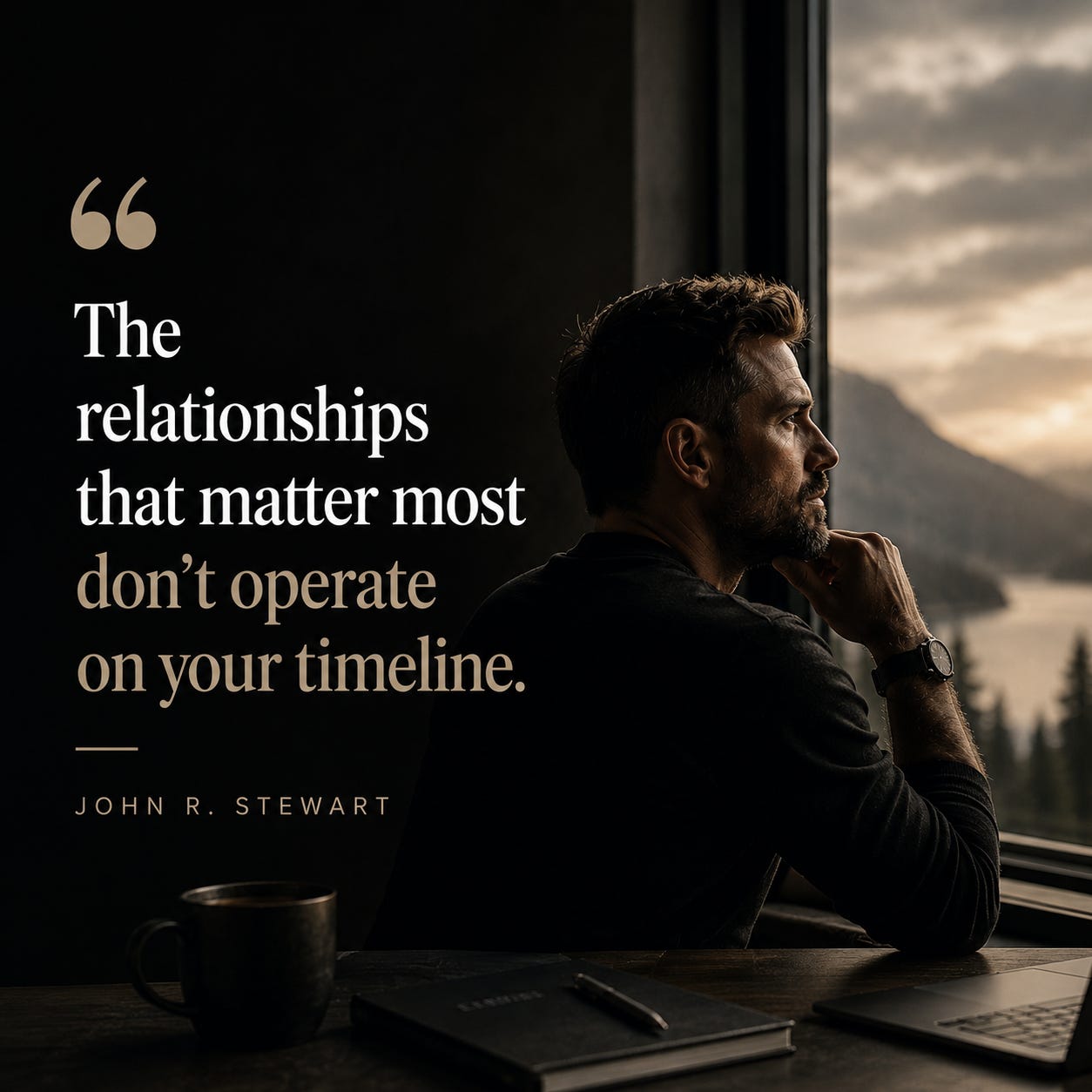
The article of faith in high-performance culture is that presence is a reward you earn after the work is done. Finish the season. Close the year. Hit the number. Then be present. But the relationships that matter most don’t operate on that timeline. Your kid’s childhood runs on its own clock. Your parents’ remaining capacity runs on another. Neither waits for your season to end.
Tomorrow is not guaranteed. Not as sentiment. As structural fact. The question is not whether you believe that. The question is whether your Tuesday nights look like you do.
Performance Protocol explores the systems, tradeoffs, and invisible patterns that shape health, work, relationships, and meaning in high-performance lives.