


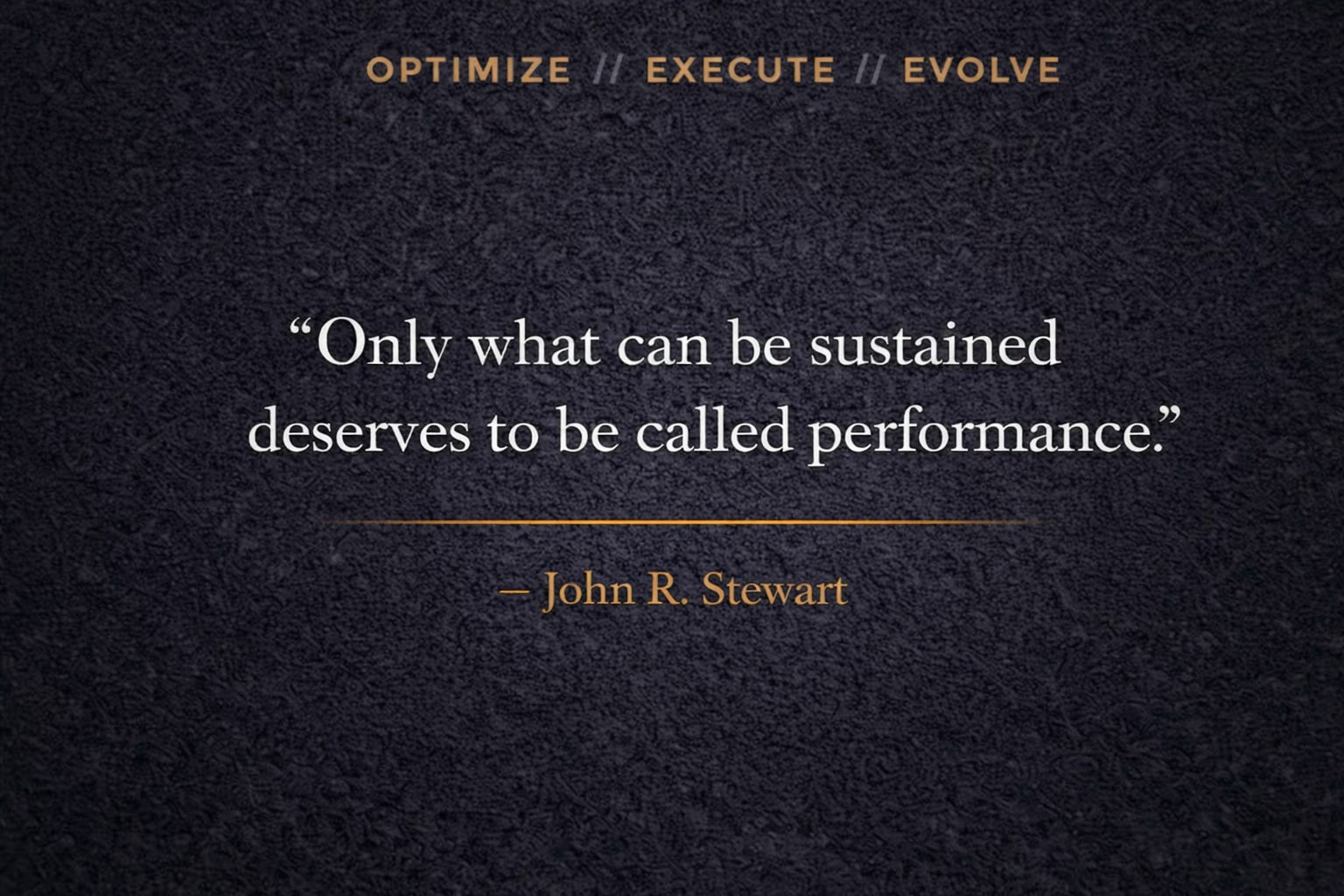
Peak performance is exciting.
There are seasons when everything moves fast. You think clearly. You make decisions with confidence. Your output increases. Other people notice. You feel capable and sharp.
It is easy to believe that this is who you are now — that you have leveled up into a new, permanent state.
But peak is not meant to be permanent.
It is a surge.
And surges cost energy.
Most high performers do not fail because they lack discipline or ambition. They fail because they try to live in a heightened state for too long. They confuse intensity with sustainability. They assume that if something works in the short term, it should be pushed as far as possible.
The body does not agree.
Your Body Was Designed for Cycles
Human performance follows a pattern: stress, recovery, adaptation.
When you take on a challenge — a heavy project, a stretch goal, a demanding season — your body activates a stress response. Hormones rise. Focus narrows. Energy mobilizes. You feel driven.
That stress response is useful. It helps you perform under pressure.
But it is not designed to stay switched on.
If you do not allow recovery, the stress response does not turn into growth. It turns into wear.
Sleep becomes lighter. You wake up earlier than you want to. Your mind feels busy even when you try to rest. Small frustrations feel larger. Decision-making becomes slower, even if you do not admit it to yourself.
Because you can still function, you assume everything is fine.
That assumption is often wrong.
The nervous system needs rhythm. Without rhythm, it shifts into chronic tension. And chronic tension is not strength. It is slow erosion.
Burnout Rarely Feels Dramatic
Many people imagine burnout as a breaking point — a collapse, a dramatic exit, a public failure.
More often, it is subtle.
You begin to rely on caffeine just to feel normal.
You find it harder to concentrate on deep work.
Your patience shortens in conversations.
You feel tired but restless at the same time.
Nothing feels catastrophic. You are still producing. You are still meeting expectations.
But you are no longer operating at your best.
The problem with high performers is that they can operate at reduced capacity for a long time. They can push through. They can compensate.
The gap between what they could be and what they are becomes invisible.
That gap compounds.
Sustainability Changes the Question
Instead of asking, “How much can I handle right now?” ask a better question:
“What level of output can I repeat for the next ten years?”
This question forces restraint.
It shifts your thinking from short-term wins to long-term durability. It reminds you that success is not a sprint or even a single marathon. It is a series of efforts over decades.
Elite athletes understand this deeply. They do not train at maximum intensity every day. They build cycles into their programs. Hard sessions are followed by lighter ones. Heavy training blocks are followed by deload weeks. Rest is planned, not accidental.
They do not see recovery as weakness.
They see it as part of performance.
Professionals, founders, and executives often ignore this lesson. They wear constant stress like a badge of honor. They measure commitment by exhaustion. They assume that being busy means being effective.
In reality, constant intensity reduces clarity. It narrows thinking. It shortens time horizons.
Sustainable performance expands them.
The Structure of Sustainable Output
Sustainability is not passive. It is structured.
First, protect your prime hours. Most people have a limited window each day when their thinking is sharpest. That window should be used for meaningful work — not meetings, not notifications, not low-value tasks. If you spend your best energy on noise, you will need artificial stimulation later just to catch up.
Second, plan recovery before you need it. Take lighter days seriously. Step away in the evenings. Build real breaks into your calendar. Recovery should not depend on exhaustion. It should be intentional.
Third, regulate your emotional state. Constant urgency feels productive, but it drains energy. Calm operators last longer. They think clearly under pressure because they are not living in pressure all the time.
Fourth, separate identity from output. If your sense of worth depends entirely on productivity, you will never slow down voluntarily. Rest will feel like failure. That mindset leads to overreach. You must be able to exist without producing in order to produce sustainably.
Finally, leave capacity unused. This is uncomfortable. Most driven people want to squeeze every drop from the day. But sustainable performers stop before they are empty. They end with something left in the tank.
That margin is what allows them to show up again tomorrow with clarity.
The Long Horizon
The world rewards visible intensity. It praises hustle. It celebrates the grind.
It rarely celebrates restraint.
But restraint is what keeps you in the game.
Peak performance is impressive in the moment. It creates spikes of output and recognition. Sustainable performance builds careers, reputations, and health that last.
The goal is not to avoid intensity. It is to control it.
Push hard when it is time to push.
Recover fully when it is time to recover.
Repeat the cycle deliberately.
Because real performance is not about how high you can spike.
It is about how long you can continue without breaking.
Performance Protocol
Performance Protocol is a system-first approach to human performance — built on physiology, recovery, and real-world constraints.
Each article is a layer in the same framework.
No hacks. No hype. Just structure.