


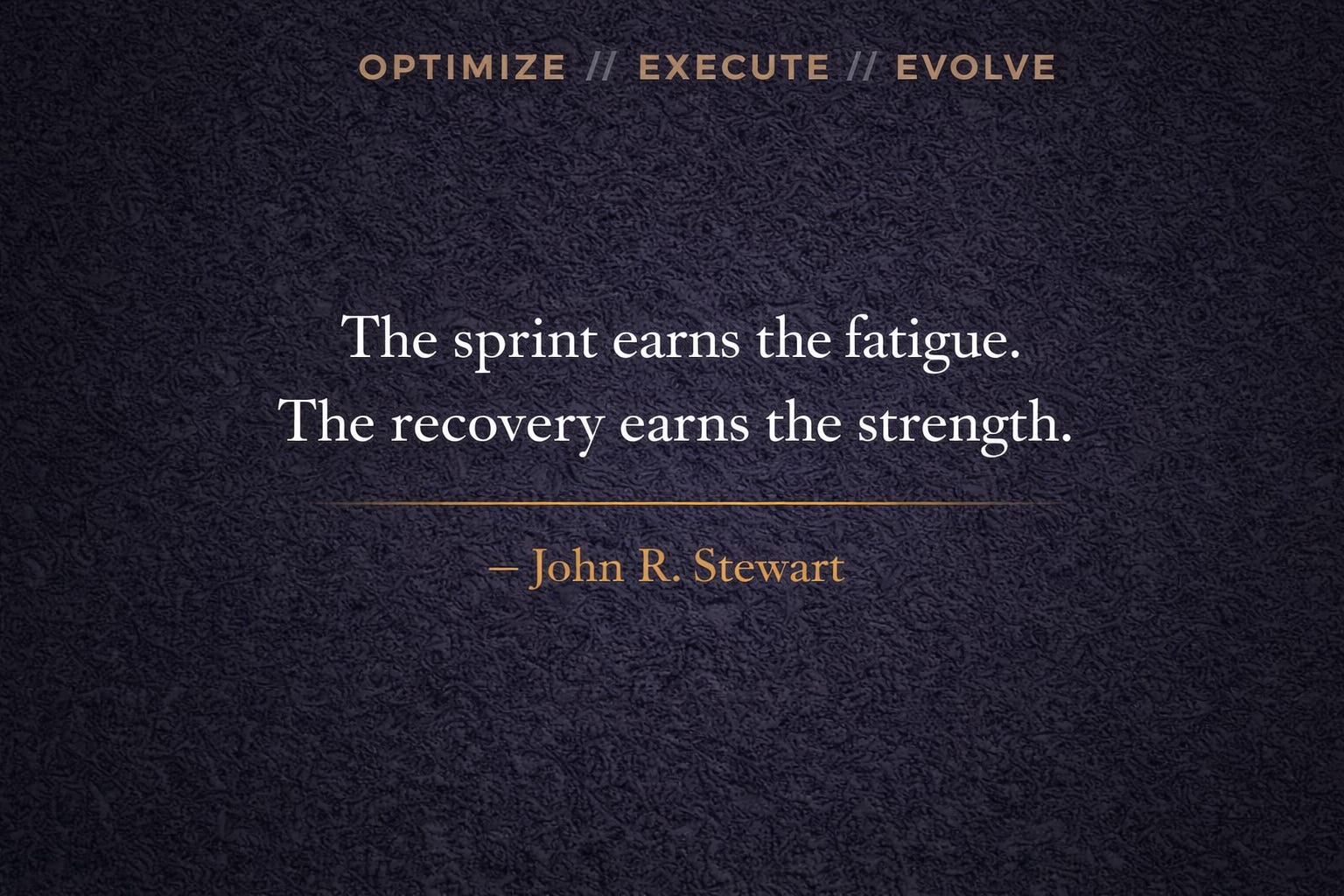
Most ambitious people treat recovery as weakness. That mindset is common, but it is wrong.
The body does not reward effort alone; it rewards adaptation. And adaptation does not occur during stress. It occurs after stress, when the system is allowed to repair, recalibrate, and rebuild at a higher level.
If you try to live permanently in the red zone, you do not become elite. You become depleted.
Peak performance is built on cycles.
What Rises Must Recover
Every high-performing biological system operates through cycles. Your heart rate rises and falls. Your nervous system shifts between sympathetic activation and parasympathetic recovery. Hormones spike and then normalize. Even seasons rotate between growth and dormancy.
Yet modern ambition tries to eliminate the down-cycle. We attempt to hold peak output indefinitely, as if constancy equals strength.
It does not.
Chronic elevation of effort without structured recovery leads to diminishing returns. The nervous system fatigues. Sleep quality declines. Decision-making becomes reactive rather than strategic. Over time, output may remain high, but clarity drops and resilience erodes.
You do not break down because you worked hard. You break down because you never came down.
Sleep Architecture Is Non-Negotiable
Sleep is not passive rest; it is an active biological upgrade. During deep sleep, growth hormone pulses, tissue repairs, and neural pathways consolidate. During REM cycles, emotional regulation improves and memory integrates. The glymphatic system clears metabolic waste from the brain.
Disrupt sleep architecture and you blunt adaptation at its source.
Alcohol fragments REM cycles. Late-night screens delay melatonin release. Irregular sleep timing destabilizes circadian rhythm. Chronic stress elevates nighttime cortisol, preventing deep recovery.
You can train intelligently and eat well, but if sleep is compromised, progress stalls.
As Matthew Walker notes in Why We Sleep, “Sleep is the single most effective thing we can do to reset our brain and body health each day.” That is not hyperbole. It is physiology.
High performers protect sleep like capital. Because it is.
Cortisol Regulation, Not Elimination
Cortisol is often treated as the enemy. It is not. Cortisol mobilizes energy, sharpens focus, and allows you to perform under pressure. It is essential for execution.
The problem is not cortisol spikes. The problem is the absence of recovery.
When cortisol remains chronically elevated—due to constant urgency, excessive caffeine, unresolved stress, or digital overstimulation—the body never returns to baseline. Over time, this impairs sleep depth, reduces insulin sensitivity, suppresses testosterone, increases visceral fat storage, and destabilizes mood.
Stress is productive only when it is paired with recovery.
“The same fire that forges steel can also melt it.”
Recovery is what determines which outcome you get.
Strategic Deload Weeks (Work and Training)
In strength training, programmed deloads are standard. Volume decreases, intensity drops, and the nervous system recalibrates. Ironically, many athletes experience growth after these periods because prior stress is finally absorbed.
Cognitive and professional performance should follow the same model.
A strategic deload week in business may include reduced meeting density, a temporary halt on new initiatives, shorter work blocks, longer sleep windows, and lower-intensity training. It may also include long walks, extended thinking time, or structured reflection.
This is not laziness. It is consolidation.
Without consolidation, effort becomes noisy. With consolidation, clarity returns and capacity expands.
Psychological Decompression
Physical recovery without mental recovery is incomplete. Cognitive strain accumulates quietly through decision fatigue, unresolved tasks, constant notifications, and the subtle pressure to respond immediately.
Psychological decompression requires reducing inputs. Fewer notifications. Less consumption. Time without performance. Time without metrics.
True stillness allows the nervous system to shift toward parasympathetic dominance. In that state, repair accelerates and creativity resurfaces.
Many people fear doing nothing because it removes distraction. But distraction is not recovery.
Stillness is.
Why “Doing Nothing” Is Often the Highest Leverage Move
Doing nothing does not mean scrolling or passive stimulation. It means the absence of demand. No output. No evaluation. No performance.
In that space, subconscious integration occurs. Patterns connect. Solutions surface without force. The breakthrough often arrives during the exhale, not the sprint.
As Naval Ravikant has said, “You will get rich by giving society what it wants but does not yet know how to get.” Insight of that caliber rarely emerges from constant noise. It emerges from space.
Recovery creates space.
And space creates leverage.
Recovery Is Discipline
Anyone can push harder. Few can step back strategically.
Recovery requires self-awareness, ego regulation, and long-term orientation. It demands that you measure success not by how hard you can go today, but by how well you can sustain performance across years.
If it cannot be sustained, it is not performance. It is acceleration.
And acceleration without recovery always collects.
You do not measure performance by intensity alone. You measure it by durability.
That is the Discipline of Deloading.
That is the Recovery Protocol.
Performance Protocol
Performance Protocol is a system-first approach to human performance — built on physiology, recovery, and real-world constraints.
Each article is a layer in the same framework.
No hacks. No hype. Just structure.