


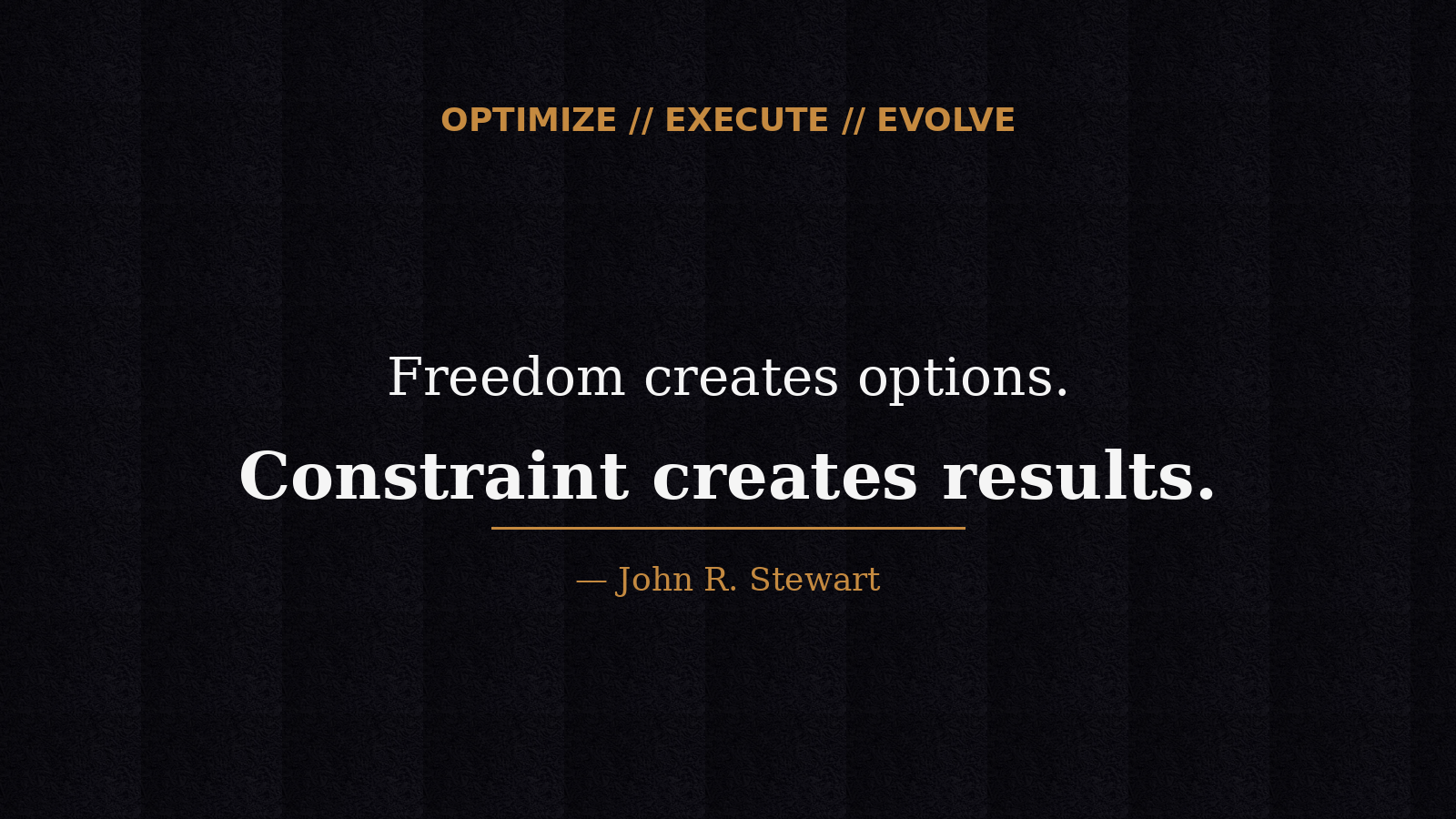
Modern ambition is built on a foundational lie: If I just had more, I would perform better.
More time. More flexibility. More optionality. More tools.
We treat expansion as progress. But no high-performing system—biological, cognitive, or organizational—improves by expanding indefinitely. Performance is not created by expansion.
Performance is created by compression.
The Myth of Unlimited Freedom
Unlimited freedom feels like empowerment. In reality, it is a debt trap.
When options expand, focus fragments. You start more than you finish. You ship less than you plan. You think more than you execute. Effort diffuses until your standards soften and your identity blurs.
Freedom without structure is just drift disguised as autonomy.
As Leonardo da Vinci noted, “Small rooms discipline the mind; large ones weaken it.” Sophistication is not the addition of complexity; it is the disciplined reduction of it.
The Physiology of the Limit
The human body does not adapt to vague stress. It adapts to defined tension.
Muscle grows under controlled, specific load.
Endurance improves within strict heart-rate zones.
Neural pathways sharpen when a task is repeated inside rigid parameters.
Remove the specificity, and adaptation stops. The nervous system requires a “wall” to push against to signal growth.
The same is true for your work. Deep work is not an act of willpower; it is an act of exclusion. As Cal Newport suggests, clarity about what matters is only possible once you have absolute clarity about what does not. Constraint forces prioritization, and prioritization creates leverage.
The Complexity Trap
Most systems collapse because they confuse “more” with “better.”
We layer new goals, new variables, and new tools onto the stack until the plan is no longer a strategy—it’s an archive of indecision. We use expansion to hide the fact that we are afraid to choose.
In any high-performing system, constraint is oxygen.
A narrow objective is a constraint.
A rigid schedule is a constraint.
A “No” list is a constraint.
A limited resource pool is a constraint.
Without these, you don’t have a system. You have noise.
Complexity is the easy way out; it’s a hedge against being wrong. But performance requires the courage to be specific. Constraint answers the hardest question before you begin: Should we even be doing this?
Identity is Defined by What You Refuse
At the individual level, constraint is the architect of character. Standards do not exist in a vacuum; they only exist when something is excluded. If you allow everything, you stand for nothing.
“Every action you take is a vote for the type of person you wish to become.” — James Clear
The Constraint Protocol determines which votes are even allowed on the ballot. By protecting your best hours, refusing compromise on quality, and operating within fixed boundaries, you reduce the need for daily negotiation.
Constraint sharpens identity. It builds internal consistency.
The Drift Problem
Failure rarely looks like a catastrophe. It looks like an exception.
One task outside of scope.
One meeting extended “just this once.”
One standard lowered to hit a vanity deadline.
This is Drift. It is incremental erosion. Standards rarely collapse all at once; they bleed out. Constraint acts as the shoreline—it creates the edges that make accountability possible.
The Reframe
You do not need more freedom. You need fewer options. You do not need more ideas. You need sharper filters. You do not need more energy. You need clearer boundaries.
The highest-performing systems in the world are not open-ended. They are pressurized.
A system without constraint is not a system. It is noise.
Constraint is not limitation. It is alignment. And alignment is where leverage lives.
The Drift Problem
Failure rarely looks like a catastrophe. It looks like an exception.
One feature outside of scope.
One meeting extended “just this once.”
One standard lowered to hit a vanity deadline.
This is Drift. It is incremental erosion. Constraint acts as the shoreline—it creates the edges that make accountability possible.
The Reframe
Stop looking for more freedom. Start building sharper filters.
You don’t need more ideas; you need a higher rejection rate.
You don’t need more energy; you need clearer boundaries.
You don’t need more tools; you need a more rigorous workflow.
The highest-performing systems in the world are not open-ended. They are pressurized.
Constraint is not limitation. It is alignment. And alignment is where leverage lives.
Performance Protocol
Performance Protocol is a system-first approach to human performance — built on physiology, recovery, and real-world constraints.
Each article is a layer in the same framework.
No hacks. No hype. Just structure.