


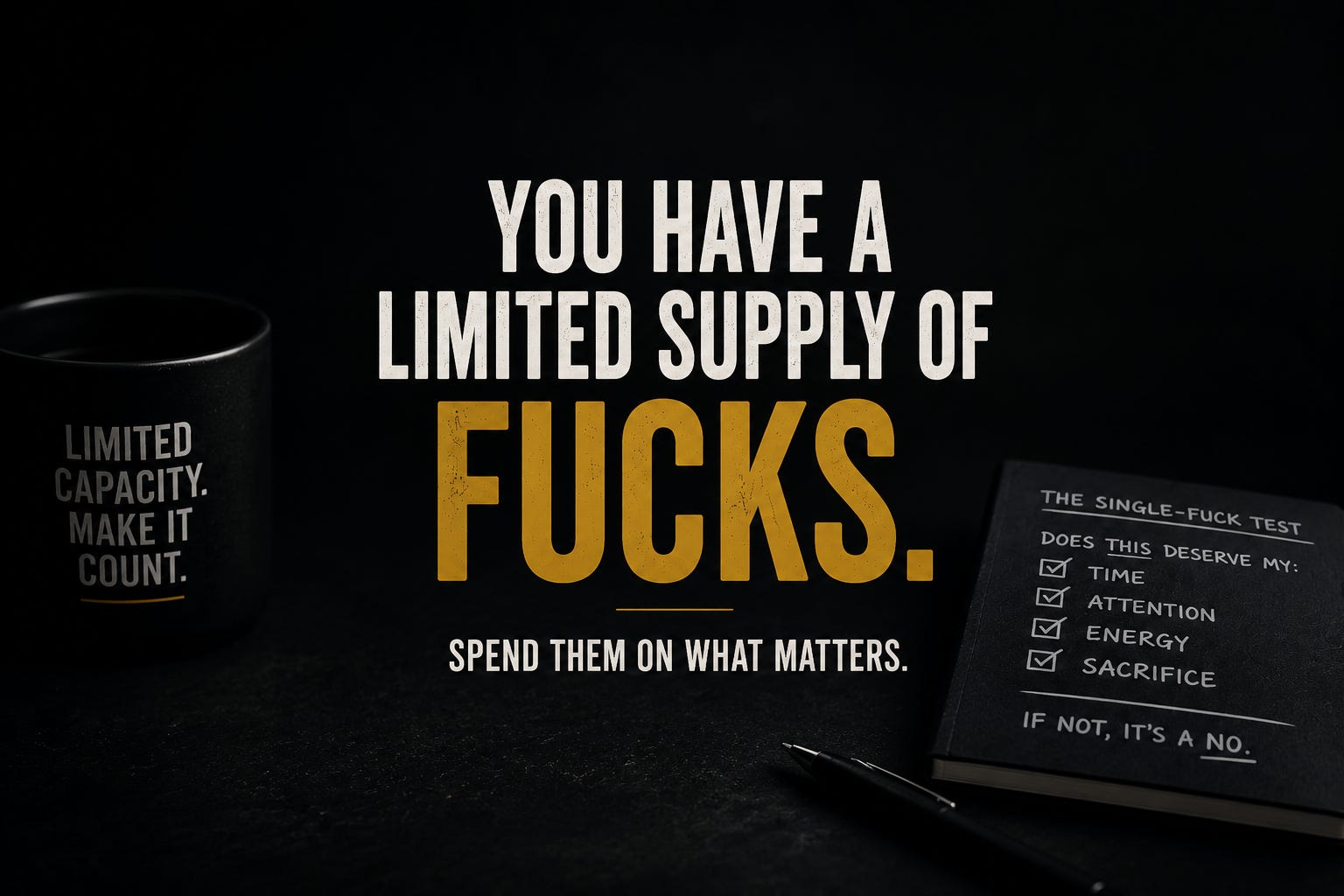
There is a finite number of things you can genuinely care about at one time. Not theoretically, not aspirationally, but actually, in the way that produces real effort, real attention and real sacrifice.
That number is smaller than you think.
Most people never reckon with this. They operate as though caring is free, as though adding one more priority costs nothing. It does. Every time you decide something matters, you are spending from a reserve that does not replenish on demand. When the reserve runs out, you do not stop caring selectively. You stop caring effectively, across the board.
You give a fuck. You just cannot give them indefinitely.
The Math Nobody Does
Think about the last week. How many things were you supposed to care about? Your health, your work, your relationships, the financial anxiety running in the background, the project that is behind schedule, the difficult conversation you are delaying, the habit you said you would build.
Each one is pulling at the exact same resource.
The cognitive load literature calls this depletion. The Stoics called it something closer to discernment. Marcus Aurelius was essentially calculating his daily allocation of fucks when he wrote:
“You always own the option of having no opinion. There is never any need to get anxious or to trouble your soul about things you can’t control. These things are not asking to be judged by you. Leave them alone.”
Attention is not just scarce. It is rivalrous. Every drop of anxiety you spend on something that doesn’t matter is a drop stolen from the things that do.
The failure mode is not laziness. It is diffusion. You end up giving a fuck about everything at forty percent.
Caring is a Physical Act
Genuine care is not an internal emotional state. It is expressed in behavior, and behavior costs energy.
Care about your health? That translates to time, preparation, physical discomfort and recovery. Care about your business? Concentrated mental effort, decisions under uncertainty and the willingness to be wrong in public. Care about your family? Real presence, not just physical proximity.
Every one of these draws from the same underlying resource. You cannot fake the ones you do not have capacity for. You can perform caring, but performed caring only produces performed results.
The Inventory Question
The useful exercise is not asking what you care about. It is asking: what are you acting like you care about?
Those two lists are rarely the same.
The stated list is what you say matters. Health. Deep work. Family. A collection of aspirational targets that sit on the list perpetually, waiting for a capacity that never arrives.
The behavioral list is what actually gets your first two hours. What you check before anything else. What you rearrange your entire day to accommodate.
Peter Drucker noted that nothing is less productive than making efficient what should not be done at all. Translated here: most people are highly efficient at giving their fucks to things that do not matter. The behavioral list is what you actually care about, whether you admit it or not. It is usually full of things that accumulated through inertia, obligation and other people’s emergencies.
Once you face that reality, the question becomes: is this how I want to spend mine?
Triage is Not Abandonment
There is a resistance to this kind of thinking because it sounds like permission to stop caring about things you should care about. It is not. It is a call to be honest about the structural reality you are already operating inside.
You are already triaging. You are just doing it unconsciously, which means whatever is loudest and most urgent wins rather than what is most important.
The kid who needs more than a distracted half-hour. The body that needs more than a last-minute workout crammed into a calendar gap. The work that needs deep thinking, not the version of you that is already spent by noon.
Conscious triage does not mean giving up. It means choosing the shape of your care rather than having it chosen for you by whoever is applying the most pressure.
The Single-Fuck Test
Before you add something new to the list of things that should matter, ask what it costs. Not just in time, but in genuine attention, the kind of presence that actually moves the needle.
If you cannot give it that level of attention, you have two options: clear something else off the list to make room, or acknowledge you are going to underinvest and accept the consequences.
What you cannot do is add it to the pile and pretend you will find capacity somewhere. Capacity does not appear. It gets allocated.
What This Actually Looks Like
The people who operate at the highest level in any domain are not more motivated than everyone else. They are more ruthless about what gets their actual care.
Steve Jobs put it plainly:
“People think focus means saying yes to the thing you’ve got to focus on. But that’s not what it means at all. It means saying no to the hundred other good ideas that there are. Innovation is saying no to 1,000 things.”
He wasn’t talking about product design in isolation. He was talking about human capacity. The top tier is populated by people who have made peace with what they are leaving behind: the athlete who genuinely does not care about social events during a training block, the writer who has made peace with a messy house, the entrepreneur who has told people clearly what this season requires and what it cannot accommodate.
This is not balance. Balance is the wrong frame entirely. It is deliberate imbalance, consciously chosen, in service of something that deserves the concentrated version of you.
Most things do not. Most things deserve competent, proportionate effort from a person who is not emotionally invested in the outcome. That is fine. Reserve the deep investment for the things that actually change the trajectory.
The Protocol
Name the top three things that genuinely get your fucks right now. Not aspirationally. Actually, in this specific season.
Manage everything else. The rest of the world gets managed, not cared about the way those three do.
Enforce a hard ceiling. When something tries to take a slot in the top three, something else has to come off. The list is never allowed to grow.
That is the discipline. Not caring harder, which is what everyone tries. Caring less, elsewhere, on purpose.
You only have so many. Spend them like it.
Performance Protocol is a system-first approach to human performance — built on physiology, recovery, and real-world constraints.
Each article is a layer in the same framework.
No hacks. No hype. Just structure.