


Scarcity vs. Abundance: The War of Operating Systems
Most people experience scarcity without ever naming it. They feel it as a hesitation before a decision, as the reflex to protect the perimeter rather than expand it. They call it “caution.” They call it “pragmatism.”
In reality, it is a parasitic filter distorting every choice you make.
The distinction between a scarcity mindset and an abundance mindset is not fluff or motivational vocabulary. It is a description of two genuinely different operating systems. Which one you run determines your outcomes far more than your tactics ever will. And it runs everywhere: in how you eat, how you train, how you show up in relationships, how you work.
What scarcity actually costs you
Scarcity is not just pessimism. It is a behavioral prison with specific symptoms.
In your health, it looks like all-or-nothing thinking. You miss one workout and the week is written off. You eat one bad meal and the diet is over. The standard was so rigid that any deviation became an exit ramp. Peter Attia makes the case in Outlive that longevity is built through consistency over decades, not perfect execution over weeks. Scarcity cannot hold that frame. It keeps resetting to zero.
In your personal life, it looks like conflict avoidance dressed up as keeping the peace. You let tension accumulate because addressing it feels riskier than tolerating it. You withhold effort in relationships because you are not sure it will be reciprocated. The math feels protective. What it actually produces is slow erosion, a gradual narrowing of what the relationship is capable of becoming.
In your work, it looks like optimization as a substitute for action. The person refining a plan for the fourth time is not making it better; they are avoiding the exposure of execution. Pressfield called this Resistance: “The degree of fear equates to the strength of Resistance.” The more important the work, the more elaborate the delay.
Scarcity tells you that someone else’s win is your loss, treats every domain of life as zero-sum and produces contraction, comparison and a narrowing of what you are willing to attempt.
The anatomy of abundance
Abundance is not the conviction that everything will work out. That is blind optimism, and optimism without structure is just a different form of avoidance.
Abundance is the conviction that outcomes are generative. In health, it means believing that one bad week does not cancel the trajectory; the body responds to sustained input, not perfect input. In relationships, it means investing without a guaranteed return because the act of investing changes the quality of what you are building. In work, it means treating failure as high-quality data rather than a verdict.
Epictetus argued that suffering comes from confusing what is in our control with what is not. Scarcity fixates on the external supply: the market, the competition, the economy, other people’s behavior, what your body can or cannot do. Abundance redirects attention to internal capability. That is not a semantic distinction. It changes where you apply force. That shift is the core premise at Performance Protocol: your standard, your identity and your output are things you construct through repeated deliberate action, not things you inherit or wait to feel ready for.
The compounding argument
This is where it gets concrete. More decisions, made faster, with a genuine willingness to burn the wrong ones, produces superior results over time across every domain.
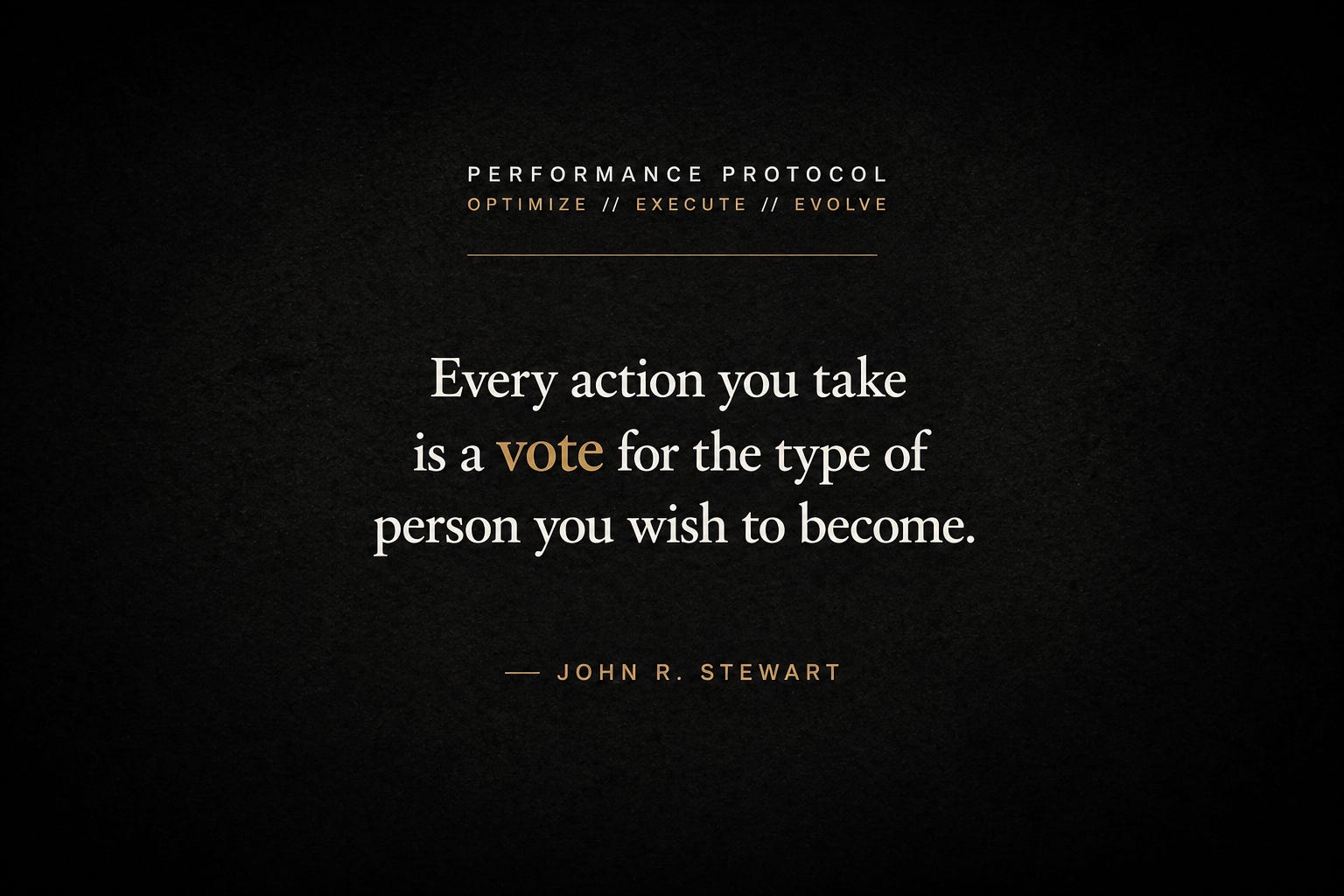
In Atomic Habits, James Clear writes: “Every action you take is a vote for the type of person you wish to become.”
That logic does not stop at your work. Every training session you show up for when you do not feel like it is a vote. Every hard conversation you choose not to avoid is a vote. Every decision you make without waiting for certainty is a vote. Scarcity suppresses the volume of those votes. It makes every swing feel like the last one, so you take fewer of them and hedge the ones you do take.
The gap between potential and output is almost never a talent problem. It is an operating system problem.
The shift
You do not flip this by thinking differently about thinking. You flip it by changing your behavior this week.
Train when the conditions are imperfect. Have the conversation you have been postponing. Make the decision you have been sitting on. Ship the work before you feel ready. Treat every outcome as data regardless of the result. Do that often enough and you are not adopting a mindset; you are building a behavioral record that makes abundance credible.
Scarcity is for people managing what they have. Abundance is for people building what they want.
Performance Protocol publishes systems-based frameworks for physical durability, execution and emotional control. Read more at performanceprotocol.ai.