


Søren Kierkegaard did not write self-help. He wrote philosophy. This means he was entirely uninterested in what makes you feel better, and obsessively focused on what is actually true. What he concluded roughly 200 years ago is a bitter but liberating pill to swallow: the choice itself is not your problem.
Your problem is the quiet, haunting ache that a different life would have been better.
That belief is not based on reality. It is born of the imagination, and imagination is a cruel, biased auditor. It plays a dazzling highlight reel of the road not taken while you are stuck living inside the messy, unedited director’s cut of the one you actually chose.
Your friend who stayed single while you got married looks entirely free. Your colleague who has kids while you do not looks deeply fulfilled. Neither of you is seeing clearly. You are both staring into the dark and filling in the gaps with exactly what your soul feels it is missing.
“Marry, and you will regret it; don’t marry, you will also regret it; marry or don’t marry, you will regret it either way.” — Søren Kierkegaard
This is the tragedy of romanticizing a life you have not lived. The untraveled path has no potholes. It has no grueling Mondays, no heartbreak, and no version of you that still shows up with the exact same fears, patterns, and limitations. The other life looks pristine only because you never had to do the heavy work of actually living it.
The Weight vs. The Rot
Every serious choice we make is an act of violence against another possibility. That is not a flaw in the system. It is the very definition of commitment. When you decide for one thing, you inherently decide against another. The ghost of what you rejected will occasionally look beautiful, especially when the life you chose gets heavy, as all lives inevitably do.
The question Kierkegaard poses to us is not which choice will you regret. It is far more urgent:
“Which regret can you carry with integrity?”
There is a profound difference between the regret that comes from choosing and the regret that comes from avoiding.
The Weight: The heavy, honest burden of a life actually lived. It is the scar tissue of real commitment.
The Rot: The slow, suffocating decay of a life deferred. It is the accumulating awareness that you kept your options open for so long that you never actually exercised any of them.
Most of us mistake optionality for freedom. We hedge our bets. We wait for more information, desperately believing we are protecting ourselves from pain. We are not. We are just choosing a quieter, colder kind of regret. It is the kind where you never find out what you were actually capable of, what you could have built, or who you might have become under the pressure of real stakes.
Regret is not optional. The only variable is its shape.
What Have You Decided?
The real work of being human is not finding the flawless, right choice. It is deciding how you will stand in relation to the choice you have already made. Will you carry it proudly as evidence that you lived deliberately? Or will you drag it around like a ball and chain, treating it as proof that you should have been someone else?
Writer Salih Guney cuts through the noise with a sharp, direct question:
“What have you decided?”
That is not rhetorical. It is a diagnostic tool for your soul. The truth is that most of us have not decided at all. We are still paralyzed at the fork in the road, optimizing, reconsidering, and waiting for the uncertainty to vanish.
It will not. The fog never clears before you step into it.
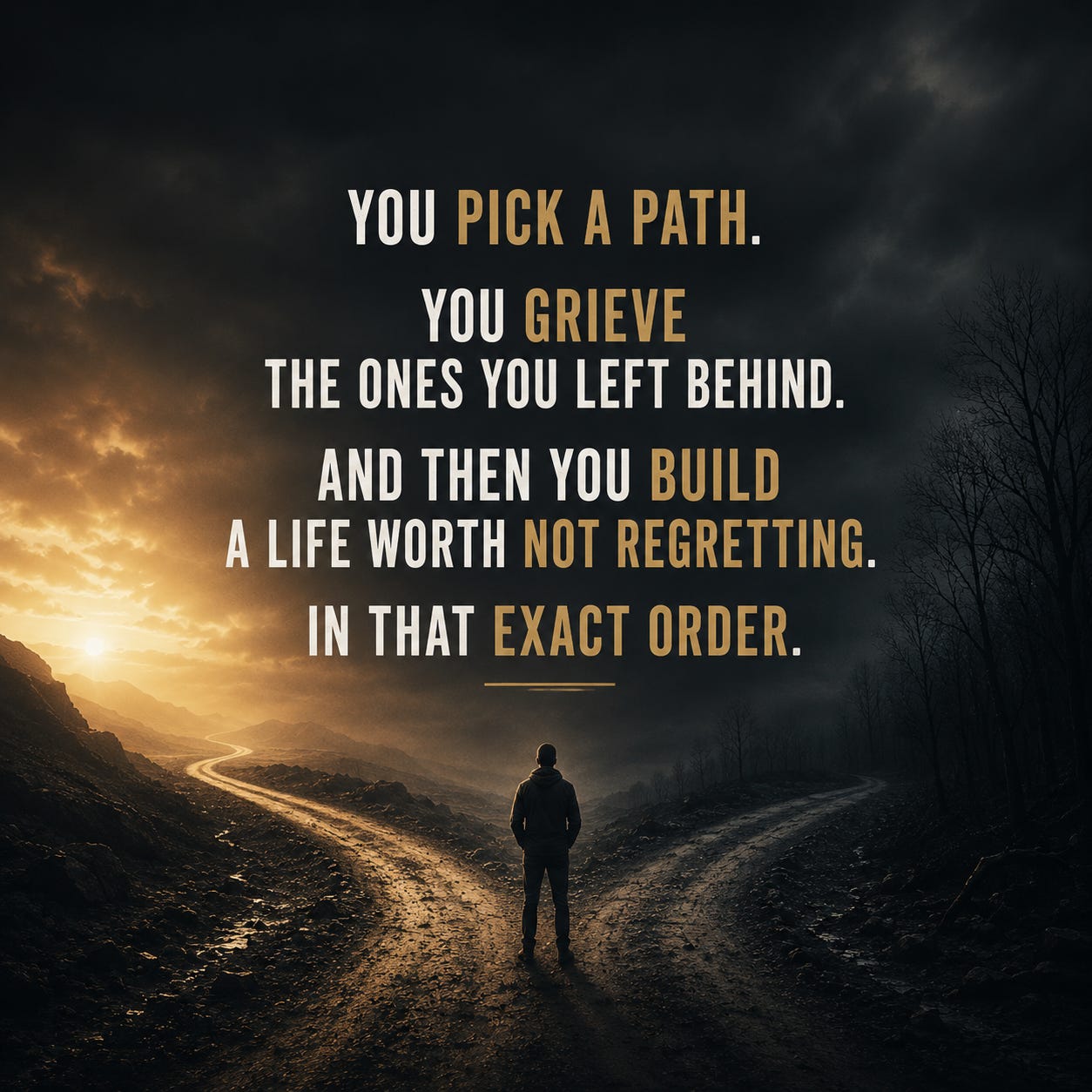
You pick a path. You grieve the ones you left behind. And then you build a life worth not regretting. In that exact order.
Performance Protocol is a system-first approach to human performance — built on physiology, recovery, and real-world constraints.
Each article is a layer in the same framework.
No hacks. No hype. Just structure.