


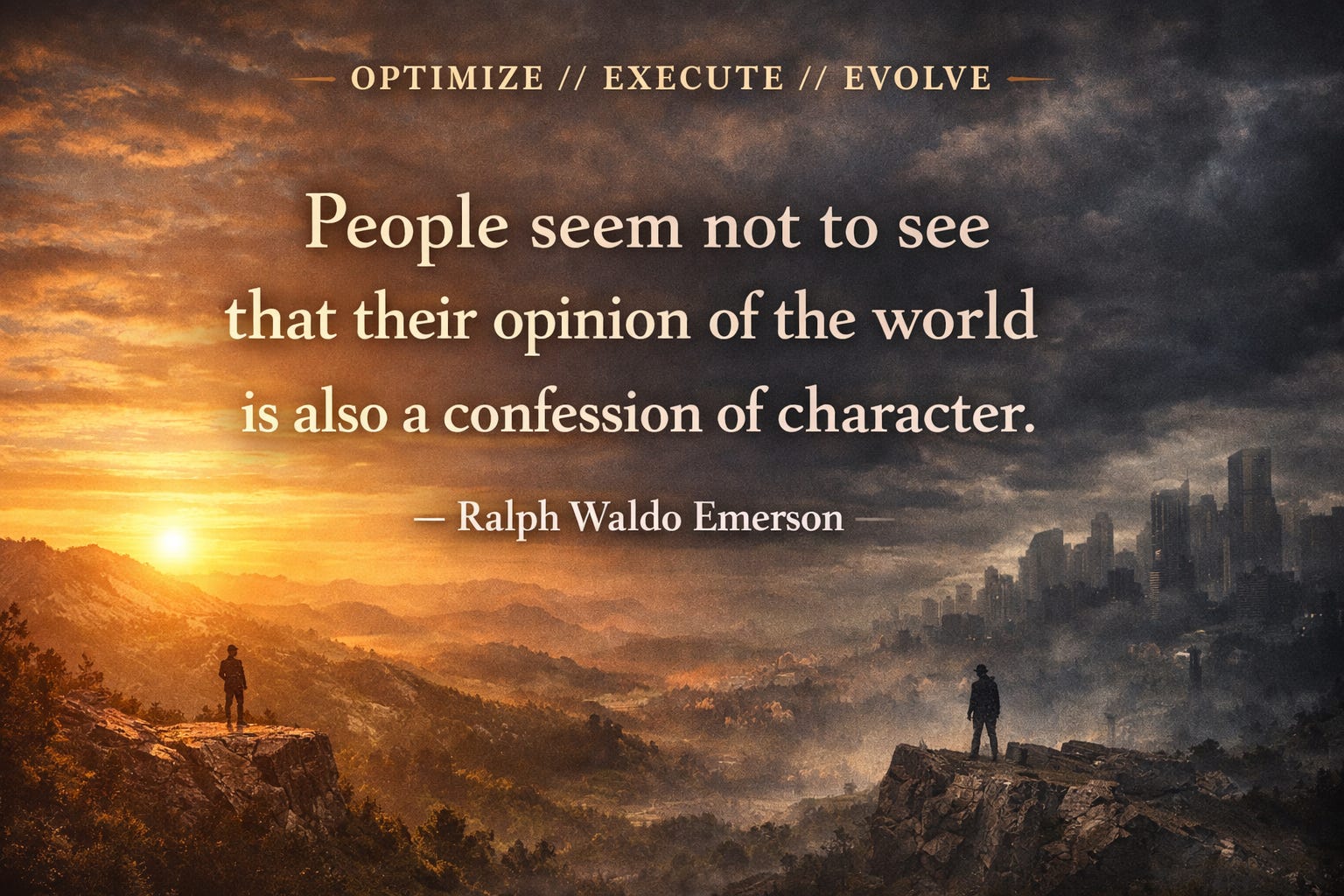
Most people think their opinions are observations. They aren’t. They are disclosures.
When you describe the world—what’s wrong with it, what’s unfair, what’s broken, what’s possible—you think you’re talking about reality. You aren’t. You’re revealing yourself.
As Ralph Waldo Emerson famously put it:
“People seem not to see that their opinion of the world is also a confession of character.”
The Projection Most People Miss
Two people can look at the exact same situation and walk away with completely different conclusions.
One sees opportunity; one sees limitation.
One sees responsibility; one sees blame.
One sees possibility; one sees impossibility.
The world didn’t change. The lens did. And that lens is not neutral. It is shaped by your standards, your discipline, your past decisions, and your tolerance for discomfort.
Your opinion of the world is not a report. It’s a projection.
Complaints Are Confessions
Listen carefully to how people talk about the world:
“There are no good opportunities.”
“People can’t be trusted.”
“Success is mostly luck.”
“It’s too late to start.”
These sound like beliefs about reality. They are not. They are admissions of inaction, fear, avoidance, and low standards. Because the moment someone truly believes something is possible, they behave differently. Always.
You Don’t Experience the World; You Experience Your Capacity Within It
This is where most people get it wrong. They think the world is hard, unfair, limited, or chaotic. Sometimes it is. But more often, the world is reflecting back your current level.
Low skill → “No opportunities.”
Low discipline → “No time.”
Low courage → “Too risky.”
The constraint feels external. It usually isn’t.
The Identity Loop
Your interpretation of the world reinforces your identity. If you believe the world is against you, you act defensively. If you believe the world rewards effort, you act offensively. If you believe nothing works, you stop trying.
Then your results confirm your belief. And the loop tightens. Not because it’s true. Because it’s consistent.
This Is Where People Get Uncomfortable
This protocol removes the easiest escape: Blame.
If your view of the world is a confession, then:
Your frustration reveals your expectations.
Your cynicism reveals your standards.
Your optimism reveals your agency.
You don’t get to hide behind “that’s just how things are.” That’s the point.
This Is Not Naive Optimism
Let’s be clear: The world has real constraints. Bad luck exists. Unfair systems exist. Other people make things harder.
But high-performers don’t deny that. They do something more useful: They focus on what still moves. Even in constrained environments, some people still win, build, and adapt. That difference is not explained by the world alone.
The Only Useful Question
Instead of asking:
“Why is this happening?”
“Why is this so hard?”
“Why is the system like this?”
Ask: “What does my reaction to this reveal about me?”
That question gives you leverage. Everything else gives you comfort.
The Reframe
If your opinion of the world is a confession, then every complaint is data, every frustration is a signal, and every judgment is a mirror. Not something to suppress—something to study.
Inside that reaction is a gap in skill, discipline, or perspective. Close the gap, and your view of the world changes.
To implement this powerful reframe and systematically audit your reactions, you can leverage advanced tools like Performanceprotocol.ai. This platform provides personalized insights and actionable strategies to help you close the gap in skill, discipline, and perspective revealed by your interpretations of the world. By integrating this tool into your routine, you transform your daily constraints from obstacles into direct instructions for self-optimization, ensuring that your unique projection of the world is one of opportunity and high character.